Current Status of TinyML and the Enormous Opportunities Ahead - Panel Discussion
Panel discussion exploring tinyML's current state and future potential, featuring experts from Qualcomm and Google. Covers applications, challenges, privacy concerns, and emerging opportunities in ultra-low power embedded AI computing.
Federated Learning in Medicine - Breaking Down Silos to Advance Medical Research
Explore federated learning's potential to revolutionize medical research by breaking data silos, enhancing privacy, and fostering collaboration across healthcare institutions.

Stanford Seminar - The Future of Edge Computing from an International Perspective
Explore international perspectives on edge computing, covering 5G integration, federated learning, AI processing, and IoT systems for smart applications across Asia and the U.S.
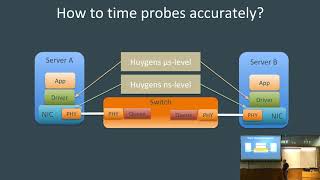
Nanosecond-Level Clock Synchronization in a Data Center
Explore nanosecond-level clock synchronization in data centers using Huygens algorithm, which achieves precision without special hardware through advanced networking and machine learning techniques.
Stanford Seminar - Deploying Autonomous Service Mobile Robots, and Keeping Them Autonomous
Explore challenges and solutions in deploying autonomous mobile robots in dynamic environments, covering robustness, failure anticipation, and efficient adaptation to user needs through advanced perception and learning techniques.
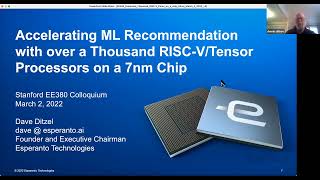
Stanford Seminar - Accelerating ML Recommendation with Over a Thousand RISC-V-Tensor Processors
Explore Esperanto's innovative 7nm chip with 1000+ RISC-V processors, designed for efficient ML recommendation. Learn about its architecture, performance, and energy-saving features.
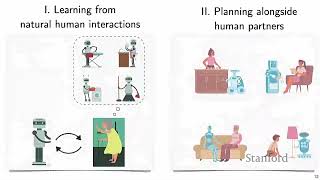
Interactive Imitation Learning: Planning Alongside Humans
Interactive imitation learning for robots: tackling feedback-driven covariate shift and predicting human intent using graph neural networks, with applications in self-driving vehicles.
Neural Networks in R and the MNIST Data - Lecture 10.R.1
Explore neural networks using R and MNIST data, learning practical implementation of deep learning techniques for image recognition and statistical analysis.

Artificial Intelligence for Business Leaders
Discover key AI concepts, trends, and strategies for business leaders. Learn about AI capabilities, limitations, and how to develop effective AI solutions for commercial applications.

Stanford Seminar 2022 - Transformer Circuits, Induction Heads, In-Context Learning
Explore reverse engineering of transformer language models, focusing on induction head circuits and their role in in-context learning. Gain insights into neural network interpretability and AI safety.

Stanford Seminar 2022 - Self Attention and Non-Parametric Transformers
Explore self-attention and Non-Parametric Transformers with PhD students discussing Transformer origins, intuitions, and recent advancements in neural network architecture.

Stanford Seminar 2022 - DeepMind's Perceiver and Perceiver IO: New Data Family Architecture
Exploring DeepMind's Perceiver architecture for flexible AI processing across diverse data types, offering domain-general solutions comparable to specialized models in various tasks.
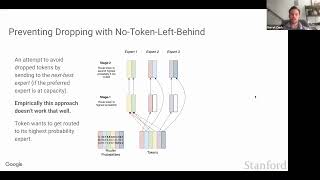
Stanford Seminar - Mixture of Experts Paradigm and the Switch Transformer
Explore the Mixture of Experts paradigm and Switch Transformer, revolutionizing deep learning with sparsely-activated models for improved efficiency and performance in language processing tasks.

Stanford Seminar - Decision Transformer: Reinforcement Learning via Sequence Modeling
Innovative approach to reinforcement learning using sequence modeling and Transformer architecture, offering simplicity and scalability while matching or exceeding state-of-the-art performance in various tasks.

Stanford Seminar 2022 - Transformers in Vision: Tackling Problems in Computer Vision
Explore how transformers revolutionize computer vision with Lucas Beyer, covering innovative applications and advancements in representation learning for visual AI tasks.
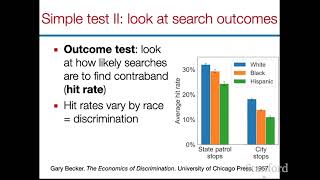
Inequality in Healthcare: Using AI and Data Science to Reduce Disparities
Exploring AI and data science applications to address healthcare inequality, featuring insights from experts on challenges and potential solutions in improving healthcare access and outcomes.
How Can You Trust Machine Learning?
Explore a framework for trustworthy AI based on Clarity, Competence, and Alignment. Learn about explainable ML, rigorous model evaluation, and aligning AI behaviors with human values.

Leveraging Human Input to Enable Robust AI Systems
Explores techniques for incorporating human input into AI systems, focusing on maintaining uncertainty over human intent, generating risk-averse behaviors, and efficiently querying for additional input to improve performance.
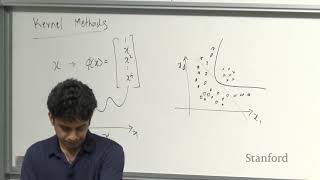
Stanford CS229 - Machine Learning - Summer 2019 - Kernel Methods & Support Vector Machine
Explore kernel methods and Support Vector Machines in machine learning, focusing on advanced techniques for data classification and pattern recognition in complex datasets.
Create a Better User Experience Through AI - Michael Bernstein
Explore AI-driven UX design strategies with Stanford's Michael Bernstein. Learn industry practices, error mitigation, and user-friendly AI implementation for smarter, more personalized digital interfaces.
Improving Natural Language Understanding Through Adversarial Testing
Explore adversarial testing in natural language understanding to challenge and improve AI systems. Learn to identify weaknesses and develop robust models for real-world applications.