Reinforcement Learning Course
Comprehensive exploration of reinforcement learning concepts, from basics to advanced topics, including deep RL, policy gradients, and practical applications in classic games.

Taylor Series
Explore the power of Taylor polynomials for approximations and analysis, covering cos(x), e^x, geometric interpretations, and convergence issues in this animated math lesson.
The Challenges of Model-Based Reinforcement Learning and How to Overcome Them - Csaba Szepesvári
Explore challenges in model-based reinforcement learning, including modeling errors and efficient planning, and discover strategies to overcome them in complex environments.
Online Reinforcement Learning and Regret
Explore online learning in reinforcement learning, focusing on regret analysis under Markovian dynamics, function approximation, and structural challenges in unknown model scenarios.

Calculus 2 - Approximation of Functions by Taylor Polynomials
Explore the approximation of functions using Taylor polynomials, a powerful mathematical tool for estimating complex functions with simpler polynomial expressions.
Calculus 2 - Representation of Functions by Taylor Series and Maclaurin Series
Explore Taylor and Maclaurin series for representing functions, enhancing your understanding of advanced calculus concepts and their practical applications.

Introduction to Orthogonal Polynomials - Lecture 41
Explore orthogonal polynomials: definition, properties, examples, and mapping to standard intervals. Gain insights into this fundamental mathematical concept.
Mathematics for Deep Neural Networks: Advantages of Additional Layers - Lecture 3
Explore the mathematical advantages of deep neural networks over shallow networks, focusing on localization, approximation capabilities, and the Kolmogorov-Arnold theorem.
Machine-Precision Neural Networks for Multiscale Dynamics
Discover how multi-stage neural networks can achieve machine-precision accuracy in scientific predictions, addressing spectral bias and improving deep learning applications in multiscale physics problems.

Deep Learning for Scientific Computing - Two Stories on the Gap Between Theory & Practice - Ben Adcock
Explores deep learning in scientific computing, highlighting limitations and recent theoretical advancements in high-dimensional function approximation and inverse problems for imaging, aiming to bridge the gap between theory and practice.

What Are the Statistical Limits of Offline Reinforcement Learning With Function Approximation?
Explore statistical limitations in offline reinforcement learning with function approximation, covering realizability, coverage, policy evaluation, and practical considerations.
Online Learning in Markov Decision Processes - Part 2
Explore advanced concepts in Markov Decision Processes, including adversarial scenarios, regret analysis, and algorithms for online learning in dynamic environments.
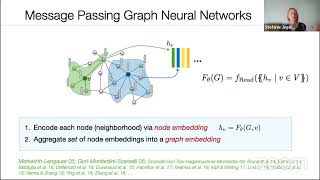
Theory of Graph Neural Networks: Representation and Learning
Explore the theory behind Graph Neural Networks, covering approximation, learning properties, and connections to graph isomorphism, equivariant functions, and dynamic programming.
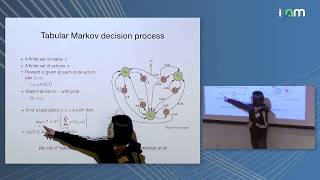
On the Statistical Complexity of Reinforcement Learning
Explores statistical complexities in reinforcement learning, covering sample complexity, regret analysis, and off-policy evaluation. Discusses minimax-optimal approaches and function approximation in MDPs.
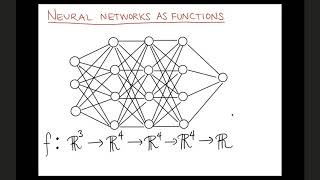
On the Topological Expressiveness of Neural Networks
Explore the topological constraints of neural network architectures and their impact on function representation, with insights from recent research and ongoing work in the field.
Deep Neural Network Autoencoders in TensorFlow and Keras - Part 1
Learn to create and implement autoencoders in Keras and TensorFlow, including denoising autoencoders, for deep neural network applications in image processing and function approximation.
ADSI Summer Workshop- Algorithmic Foundations of Learning and Control
Explore model-based control for physical systems, covering inverse dynamics, optimization techniques, and automated discovery methods for advanced robotics and control applications.
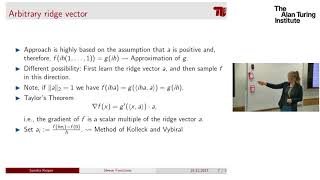
Approximation of Generalized Ridge Functions in High Dimensions – Sandra Keiper
Explores mathematical approaches to reconstruct complex processes in high dimensions, focusing on approximation theory and techniques to overcome the curse of dimensionality.
Implementation and Synthesis of Math Library Functions
Explore MegaLibm, a domain-specific language for implementing, testing, and tuning math library functions. Learn how it enhances safety, modularity, and tunability in mathematical software development.
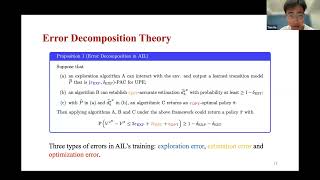
Provably Efficient Adversarial Imitation Learning with Unknown Transitions - Oral Session 4
Explore provably efficient adversarial imitation learning with unknown transitions. Discover a framework connecting reward-free exploration and AIL, and learn about the MB-TAIL algorithm's optimal performance and generalization ability.

Interpretable Hierarchical Calibration of Agent-Based Models
Explore scientific machine learning's fusion of traditional modeling and ML, focusing on neural network surrogates for agent-based models in epidemiology and automated hierarchical calibration.