Deep Generative Models - Energy Based Models - Lecture 12
Explore energy-based models in deep learning, their applications, and theoretical foundations. Gain insights into this powerful approach for modeling complex data distributions.
Deep Generative Models - Energy Based Models - Lecture 14
Explore energy-based models in deep learning, their applications, and theoretical foundations. Gain insights from Stanford's expert on advanced generative modeling techniques.
Deep Generative Models - Energy Based Models - Lecture 11
Explore energy-based models in deep learning, their applications, and theoretical foundations. Gain insights from Stanford's expert on advanced generative modeling techniques.
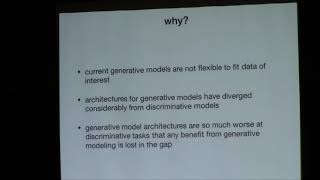
Your Brain on Energy-Based Models - Applying and Scaling EBMs to Problems
Explore energy-based models in machine learning, covering applications, scaling techniques, and their impact on classification, calibration, and robustness in AI systems.
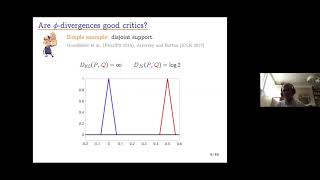
On the Critic Function of Implicit Generative Models - Arthur Gretton
Explore implicit generative models' critic function, divergence measures, and energy-based models with Arthur Gretton. Gain insights into topological properties, neural net divergences, and multimodality in machine learning.
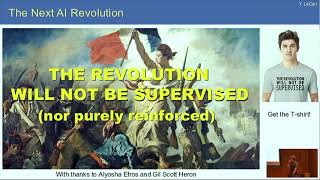
Energy-Based Approaches to Representation Learning - Yann LeCun
Explore energy-based approaches to representation learning with Yann LeCun, covering self-supervised learning, video prediction, and sparse modeling in high-dimensional spaces.
Sampling through Exploration Exploitation in Markov Chain Monte Carlo
Explore an innovative Markov chain Monte Carlo algorithm combining global proposals and mobile moves for efficient, parallelizable sampling in various applications.
Towards Understanding Generalization Properties of Score-Based Losses
Explore score-based losses as alternatives to maximum likelihood in generative models, examining their statistical efficiency and connections to diffusion algorithms for improved model design.

A Path Towards Autonomous Machine Intelligence - Paper Explained
Explanation of Yann LeCun's paper on autonomous machine intelligence, combining self-supervised learning, energy-based models, and hierarchical predictive embedding for creating world models and planning.
Author Interview - VOS- Learning What You Don't Know by Virtual Outlier Synthesis
Interview exploring Virtual Outlier Synthesis for out-of-distribution detection in neural networks. Discusses motivations, methodology, and key findings of novel approach to improve model robustness using synthesized outlier data.
Self-Supervised Learning - The Dark Matter of Intelligence
Explore self-supervised learning as a promising approach for AI to develop background knowledge and common sense, with insights from Yann LeCun and Ishan Misra of Facebook AI Research.
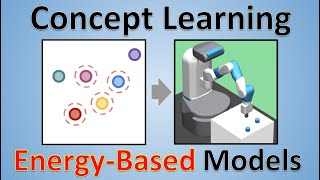
Concept Learning with Energy-Based Models
Explore energy-based models for concept learning, focusing on their ability to generalize, reason abstractly, and solve problems creatively with limited data through inference-time optimization.
Structured Prediction with Energy Based Models
Explore energy-based models for structured prediction, covering factor graphs, efficient inference, Graph Transformer Networks, loss functions, and variational inference in deep learning applications.
PyTorch Activation and Loss Functions
Explore activation and loss functions in PyTorch, including kink vs. smooth activations, margin-based losses, and designing effective loss functions for Energy-Based Models (EBMs).

Group Sparsity, World Model, and Generative Adversarial Networks
Explore advanced deep learning concepts: sparse auto-encoders, world models for autonomous control, and generative adversarial networks (GANs). Gain insights into cutting-edge AI techniques and their applications.

Contrastive Methods and Regularised Latent Variable Models
Explore contrastive methods and regularized latent variable models in energy-based models, covering self-supervised learning, autoencoders, sparse coding, and variational techniques for advanced machine learning applications.
Energy Based Models and Self-Supervised Learning
Explore energy-based models, latent variables, and self-supervised learning. Dive into EBM training, inference, and comparison with probabilistic models. Discover contrastive methods and applications like K-means and BERT.
Backpropagation and Deep Learning in the Brain
Explore deep learning in the brain, backpropagation, and credit assignment algorithms. Discover neuroscience evidence and new models of neurons in this computational brain theory talk.
Generalizing Outside the Training Distribution through Compositional Generation
Explore compositional generative modeling for AI generalization beyond training data, enabling complex planning and decision-making in unseen tasks and environments.
Protein Discovery with Discrete Walk-Jump Sampling
Explore discrete generative modeling for protein discovery using Walk-Jump Sampling. Learn to train energy functions, sample with Langevin MCMC, and optimize for distributional conformity in antibody design.
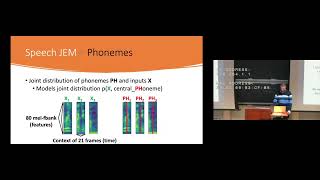
Joint Energy-based Models for Speech
Explore generative models, focusing on Energy-based Models and Joint Energy-based Models for speech, with potential applications in multiple tasks.