
Steps to AGI
Explore DeepMind Alberta's plan for achieving AGI through reinforcement learning, continual learning, and meta-learning in complex environments, with a focus on key steps and core concepts.
Towards Safe and Efficient Learning in the Physical World - Stanford Seminar
Exploring safe Bayesian optimization and model-based deep reinforcement learning for efficient, safe online learning in real-world applications like robotics and laser tuning.
EI Seminar - Recent Papers in Embodied Intelligence
Explore cutting-edge research in embodied intelligence, covering topics like experiment design, neuro-symbolic models, robot design, speech recognition, and social perception.
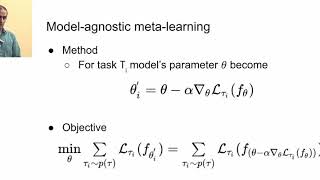
Unsupervised Meta-Learning for Few-Shot Image Classification
Explore unsupervised meta-learning techniques for few-shot image classification, including task construction, augmentation methods, and performance on benchmark datasets.
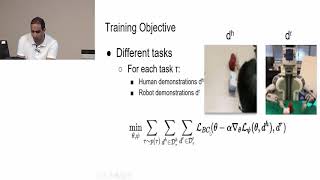
One-Shot Imitation from Observing Humans via Domain-Adaptive Meta-Learning
Learn domain-adaptive meta-learning for one-shot imitation, enabling robots to quickly learn new tasks by observing human demonstrations and adapting across domains.
MetaHKG: Meta Hyperbolic Learning for Few-shot Temporal Reasoning - M1.2
Explore meta hyperbolic learning for few-shot temporal reasoning in knowledge graphs, enhancing reasoning capabilities with limited data.
Machine Learning in Drug Discovery - Lightning Talks
Explore cutting-edge ML applications in drug discovery through lightning talks on antibody optimization, PROTAC design, small molecule binders, and protein-fragment interactions.
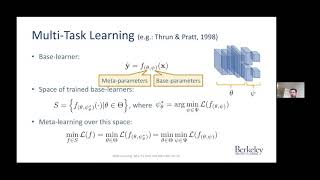
Meta-Learning - Why It’s Hard and What We Can Do - Ke Li
Explore meta-learning challenges and solutions with Ke Li, covering optimization, model selection, and program induction in this theoretical machine learning seminar.
Dynamic Meta-Learning for Anomaly Detection - Cole Sodja, Microsoft Defender ATP
Explore dynamic meta-learning for anomaly detection, focusing on probabilistic calibration and adaptive mixtures of models to enhance cyber threat detection in Microsoft Defender ATP.
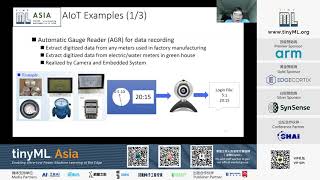
Toward Data-Driven Applications with AIoT Devices
Explore data-driven AIoT applications, model reduction techniques, and meta-learning approaches for enhanced inference accuracy in diverse environments, with real-life examples and future research directions.
Gödel's Theorem and Self-Learning AI Machines - From Incompleteness to Recursive Agents
Explore the groundbreaking Gödel Agent framework for AI, examining how self-referential systems and recursive self-improvement enable machines to autonomously evolve and optimize their own code and decision-making processes.

Automated Design of AI Agents Using ADAS Framework
Explore the cutting-edge framework for self-designing AI agents, featuring automated architecture generation, peer evaluation systems, and iterative refinement processes for enhanced problem-solving capabilities.
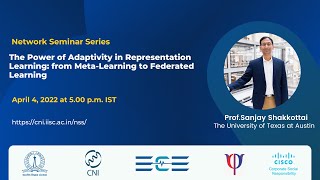
The Power of Adaptivity in Representation Learning - From Meta-Learning to Federated Learning
Delve into advanced machine learning concepts exploring adaptivity in representation learning, focusing on meta-learning and federated learning approaches for model deployment in new environments.
Meta-Learning Dynamics Forecasting Using Task Inference
Explore meta-learning dynamics forecasting using task inference to improve generalization across heterogeneous domains in deep learning models for predicting complex systems.
Challenges in Deep Learning - Open Problems and Recent Observations
Explore key open problems in deep learning, focusing on continual learning and implicit biases. Gain insights from a leading researcher on crucial areas for advancing the field.
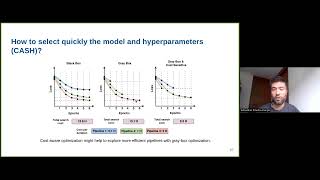
Quick-Tune: Quickly Learning Which Pretrained Model to Finetune and How
Discover a methodology for efficiently selecting and fine-tuning pretrained models through meta-learning, optimizing model selection and hyperparameter configurations for new datasets.
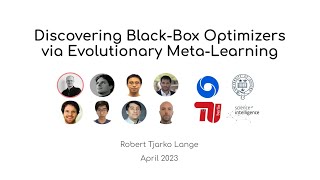
Discovering Black-Box Optimizers via Evolutionary Meta-Learning
Delve into evolutionary meta-learning techniques for discovering black-box optimizers, exploring advanced concepts in evolution strategies and genetic algorithms through self-attention architectures.
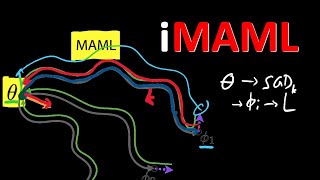
IMAML- Meta-Learning with Implicit Gradients
Explore an innovative approach to meta-learning that improves computational efficiency through implicit gradients, enabling faster adaptation to new tasks using prior knowledge.
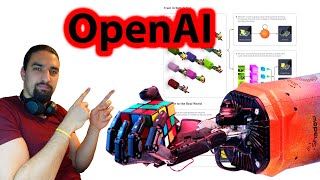
OpenAI - Solving Rubik's Cube with a Robot Hand - RL Paper Explained
Detailed explanation of OpenAI's robotic hand solving Rubik's Cube using simulation-based training, covering system design, domain randomization, and reinforcement learning techniques.
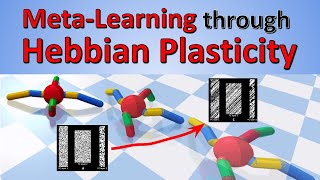
Meta-Learning Through Hebbian Plasticity in Random Networks - Paper Explained
Explores biologically-inspired Hebbian learning for adaptive AI agents. Demonstrates how random neural networks can self-organize during runtime to solve RL tasks and adapt to new situations without fixed policies.

Parameter Prediction for Unseen Deep Architectures - With First Author Boris Knyazev
Explore parameter prediction for neural networks using graph hypernetworks. Learn about DeepNets-1M dataset, training techniques, and experimental results for efficient network training paradigms.