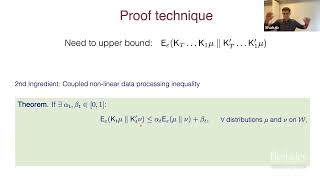
Contraction of Markov Kernels and Differential Privacy - Part I
Explore Markov kernel contraction and its connection to differential privacy in machine learning, focusing on information-theoretic approaches for trustworthy algorithms.
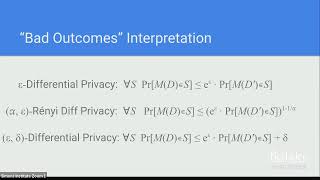
Differential Privacy & Variants
Explore differential privacy and its variants, focusing on information-theoretic methods for enhancing trustworthiness in machine learning algorithms and applications.

Learning Classification Metrics from Preference Feedback
Explore techniques for learning classification metrics using preference feedback, focusing on information-theoretic approaches for trustworthy machine learning.

Privacy and Fairness in Collaborative AI
Explore information-theoretic approaches to enhance privacy and fairness in collaborative AI systems, focusing on trustworthy machine learning techniques.
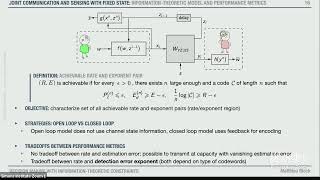
Decision Making with Information-Theoretic Constraints
Explore information-theoretic constraints in decision-making processes, focusing on applications in trustworthy machine learning and their impact on algorithmic outcomes.

Variational Formulations and Distributed Convex Optimization Methods for...
Explore variational formulations and distributed convex optimization methods in information-theoretic approaches to trustworthy machine learning.

Learning Under Data Poisoning
Explore data poisoning's impact on machine learning, its detection methods, and strategies for building robust models against adversarial attacks in this informative talk.
Information-Theoretic Methods for Fair Risk Minimization
Explore information-theoretic approaches to fair risk minimization in machine learning, focusing on trustworthy AI and ethical considerations in algorithm design.

Differentially Quantized Gradient Methods
Explore advanced gradient quantization techniques for machine learning, focusing on differential methods and their impact on algorithm efficiency and performance.

Information Constrained Optimal Transport
Explore information-constrained optimal transport theory and its applications in trustworthy machine learning with Stanford researcher Ayfer Ozgur.

Data Valuation: A Perturbation-Aware Approach
Explore perturbation-aware data valuation techniques for machine learning, focusing on information-theoretic methods to enhance trustworthiness and reliability in AI systems.

Information-Theoretic Foundations of Generative Adversarial Models
Explore information-theoretic methods for trustworthy machine learning, focusing on generative adversarial models and their foundations for enhanced reliability and performance.
Generalization Bounds for Neural Network Based Decoders
Explore generalization bounds for neural network decoders, examining their implications for information-theoretic approaches in trustworthy machine learning.

Optimal Neural Network Compressors and the Manifold Hypothesis
Explore the intersection of neural network compression and the manifold hypothesis, examining optimal compressors and their implications for machine learning efficiency and performance.
Improving Accuracy-Privacy Tradeoff via Model Reprogramming
Explore innovative techniques for enhancing the balance between model accuracy and data privacy through advanced model reprogramming strategies.
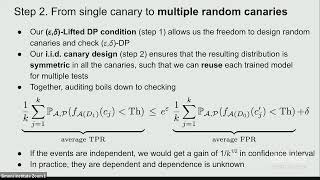
Fundamental Trade-Offs in FL-FA - Sparsity - DP - Communication Constraints
Explore trade-offs in federated learning, focusing on sparsity, differential privacy, and communication constraints. Gain insights into balancing these factors for effective machine learning.