
Harnessing Chaos and Predicting the Unpredictable with Artificial Intelligence
Explore how Reservoir Computing and AI can predict chaotic systems like weather and brain dynamics, pushing beyond traditional forecasting limits and combining knowledge-free and knowledge-based approaches.
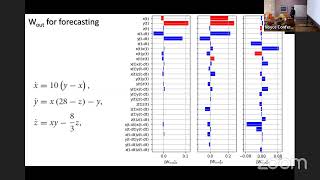
Next-Generation Reservoir Computing
Explore cutting-edge advancements in reservoir computing, a powerful machine learning technique for processing sequential data and solving complex temporal problems.
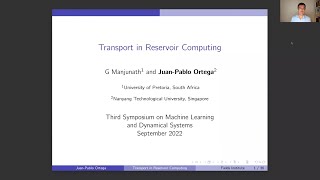
Transport in Reservoir Computing
Explore the intersection of machine learning and dynamical systems, focusing on transport phenomena in reservoir computing and its applications in data analysis and prediction.
Physics-Constrained Reservoir-Computing for Turbulence and Chaotic Learning
Explore physics-constrained reservoir-computing for turbulence and chaotic learning, combining physical principles with empirical modeling to predict and optimize complex fluid flows in aerospace propulsion and turbulence.
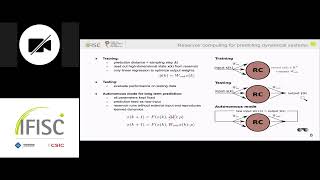
Learn One Size to Infer All: Exploiting Symmetries in Dynamical Systems Using Scalable Neural Networks
Explore symmetries in dynamical systems using scalable neural networks to infer patterns across various sizes and complexities.
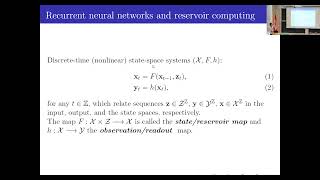
Kernelization of Reservoir Systems
Explore advanced techniques in machine learning and dynamical systems, focusing on the kernelization of reservoir systems and their applications in data analysis.
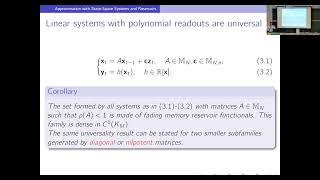
Understanding Forecasting with Reservoir Computing via Synchronization
Explore reservoir computing's forecasting capabilities through synchronization, presented by Juan Pablo Ortega at the Fourth Symposium on Machine Learning and Dynamical Systems.
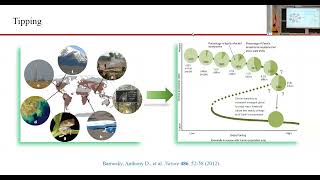
Predicting Tipping Points with Reservoir Computing
Explore reservoir computing techniques for predicting critical transitions in complex systems, with applications in climate science and ecology.
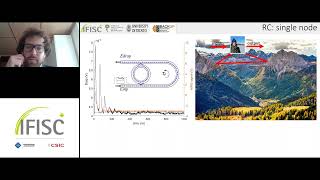
Experimental Investigation of a Microring-Based Time-Delay Reservoir Computing
Explore microring-based time-delay reservoir computing through experimental investigation, delving into advanced concepts and practical applications in photonic computing.
Reservoir Computing in Quantum Systems
Explore quantum reservoir computing, its applications, and potential for enhancing machine learning in quantum systems.
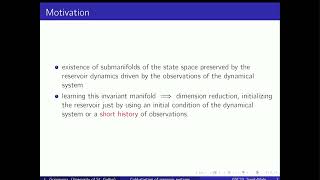
Cold Starting of Reservoir Systems in the Forecasting of Dynamical Systems
Explore cold starting techniques for reservoir systems to enhance dynamical system forecasting. Gain insights into advanced prediction methods.
Efficient Optical Computing with Exciton-Polaritons
Explore efficient optical computing using exciton-polaritons, combining photonic processing benefits with strong optical nonlinearity for high-performance, energy-efficient all-optical neural networks.
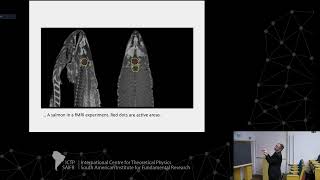
Structure-to-Function Relationship in Neuronal Cultures: Applications to Biological Machine Learning and Reservoir Computing - Class 2
Explore structure-function relationships in neuronal cultures, focusing on biological machine learning and reservoir computing applications.
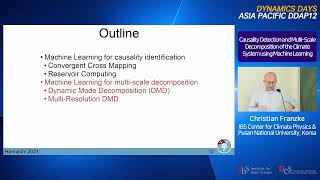
Causality Detection and Multi-Scale Decomposition of the Climate System Using Machine Learning
Explore machine learning approaches for detecting causal relationships and meaningful patterns in climate systems, focusing on Reservoir Computing and Multi-Resolution Dynamic Mode Decomposition techniques.
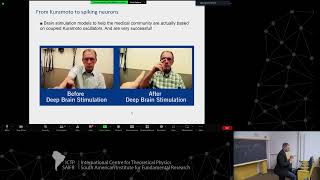
Structure-to-Function Relationship in Neuronal Cultures: Applications to Biological Machine Learning and Reservoir Computing - Class 1 of 3
Explore structure-function relationships in neuronal cultures, focusing on biological machine learning and reservoir computing applications.

Dynamical Systems and Reservoir Computing - Lecture 1
Explore dynamical systems and reservoir computing applications in climate network analysis, focusing on methods for understanding and predicting climate patterns and phenomena.

Dynamical Systems and Reservoir Computing - Lecture 2
Delve into dynamical systems and reservoir computing applications in climate networks, focusing on analysis methods, bifurcation behavior, and network characterizers for climate data organization.