
Entropy and Curvature of Markov Chains on Metric Spaces
Explore the Peres-Tetali conjecture and its implications for Markov chains in this 57-minute lecture by Justin Salez from the Hausdorff Center for Mathematics. Delve into the relationship between contraction in Wasserstein distance and relative entropy f…
Some Bounds for the Wasserstein Distance Between the Empirical Measure
Explorez les limites de la distance de Wasserstein entre la mesure empirique, en approfondissant les concepts mathématiques avancés et leurs applications statistiques.
Analysis of Mean-Field Games - Lecture 1
Explore static mean-field games, Nash equilibria, and convergence theorems in large symmetric systems. Learn key concepts and proofs in this advanced applied probability lecture.
Private Convex Optimization via Exponential Mechanism - Differential Privacy for Machine Learning
Explore private convex optimization using the exponential mechanism. Learn differential privacy, noisy SGD, and isoperimetric inequality for ML applications.
Uniform Propagation of Chaos for a Dollar Exchange Model
Explore a mathematical model for money exchange, focusing on agent-based dynamics and the convergence to a Poisson distribution as time and agent numbers increase.
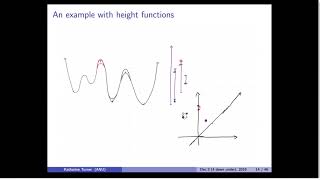
Why Should Q=P in the Wasserstein Distance Between Persistence Diagrams?
Explore Wasserstein distance in persistence diagrams, focusing on q=p choice. Covers geometric implications, stability results, algebraic versions, and computational advantages for central tendencies.
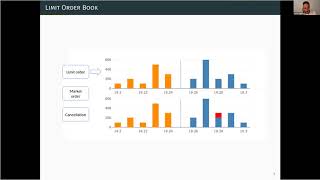
Detecting Spoofing Strategies in High Frequency Trading
Exploring detection methods for spoofing strategies in high-frequency trading, focusing on volume imbalance impact and optimization models to identify manipulative behaviors in limit order books.
Topological Data Analysis on Dynamic Brain Networks
Explore topological data analysis for dynamic brain networks, learning to cluster networks into states and analyze temporal changes using Wasserstein distance. Gain insights into state space estimation and heritability of network changes.
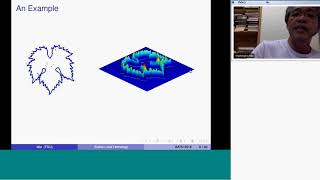
Washington Mio - Stable Homology of Metric Measure Spaces
Explore stable homology in metric measure spaces, covering Wasserstein distance, local homology stability, and applications in data analysis and taxonomic classification.
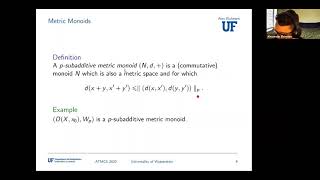
Universality of Persistence Diagrams and Bottleneck & Wasserstein Distances
Explore the mathematical foundations of persistence diagrams and their associated metrics, focusing on universality properties and distance calculations in topological data analysis.
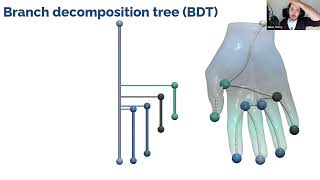
Wasserstein Distances, Geodesics and Barycenters of Merge Trees
Explore computational frameworks for merge trees, including Wasserstein distances, geodesics, and barycenters. Learn efficient algorithms and applications in visualization, feature tracking, and ensemble clustering.
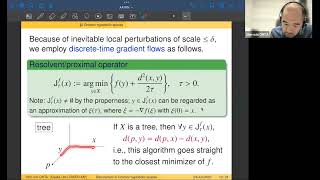
Barycenters and a Law of Large Numbers in Gromov Hyperbolic Spaces
Explore barycenters in Gromov hyperbolic spaces, examining contraction properties and a law of large numbers for convex optimization applications in metric spaces.
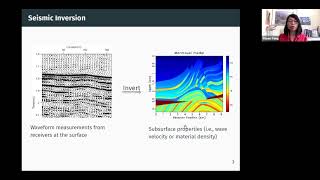
Optimal Transport for Inverse Problems and Implicit Regularization
Exploring optimal transport theory for inverse problems, addressing nonconvexity and noise sensitivity in least-squares methods, with applications in industry and broader data-fitting challenges.
Dual of the Dual Formula for Distance in Noncommutative Geometry
Explore Connes's spectral distance and its dual formula in noncommutative geometry, extending Kantorovich's and Beckmann's concepts from optimal transport theory.
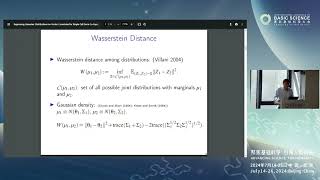
Regressing Multivariate Gaussian Distribution on Vector Covariates for Co-expression Network Analysis
Explore Fréchet regression for analyzing gene co-expression networks using population-level single-cell data. Learn to test associations between covariance matrices and covariates.
Functional Priors for Bayesian Deep Learning
Explore functional priors for Bayesian deep learning, focusing on imposing Gaussian process priors on neural networks through Wasserstein distance minimization.

Quantitative Uniform Propagation of Chaos for Maxwell Molecules
Explores propagation of chaos in Kac's N-particle system for Maxwell molecules, using probabilistic coupling techniques and recent stabilization results to establish uniform-in-time estimates.
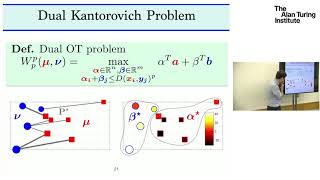
Regularization for Optimal Transport and Dynamic Time Warping Distances - Marco Cuturi
Explore regularization techniques for optimal transport and dynamic time warping distances, focusing on smoothing strategies to enhance machine learning applications and Fréchet mean computation.
Wasserstein Distributionally Robust Optimization - Theory and Applications in Machine Learning
Explore Wasserstein distributionally robust optimization theory and its applications in machine learning, focusing on data-driven decision-making under uncertainty and statistical learning.
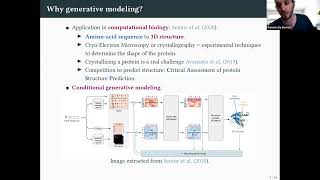
Convergence of Denoising Diffusion Models Under the Manifold Hypothesis
Explores theoretical analysis of denoising diffusion models, providing convergence results for data distributions on lower-dimensional manifolds or empirical distributions, with quantitative bounds on Wasserstein distance.
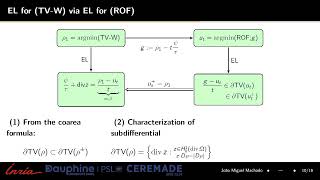
The Total Variation Wasserstein Problem - A New Derivation of the Euler-Lagrange Equations
Explore a novel derivation of Euler-Lagrange equations for the Total Variation Wasserstein problem, advancing understanding in mathematical optimization and transport theory.