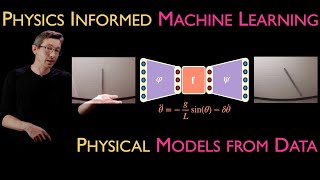
Physics Informed Machine Learning: High-Level Overview of AI and ML in Science and Engineering
Explore how to integrate physics into machine learning, enhancing model accuracy and efficiency in engineering applications. Learn to leverage prior physical knowledge across all stages of the ML process.
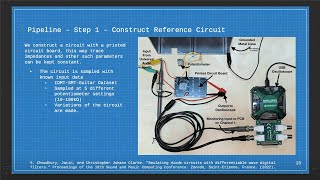
Pipeline for VA Modelling with Physics-Informed Machine Learning
Explore a VA modelling pipeline using Differentiable Wave Digital Filters and neural networks for accurate, real-time circuit modelling, demonstrated with a diode clipper circuit.
Uncertainty Quantification with Physics-Informed Machine Learning
Exploring uncertainty quantification in physics-informed machine learning, focusing on architecture and learning approaches for scientific applications and complex real-world phenomena.
UQ for ML and ML for UQ - Uncertainty Quantification and Machine Learning in Physics-Based Modeling
Explore the interplay between Uncertainty Quantification and Machine Learning in physics-based modeling, examining their roles in solving complex computational challenges across various applications.
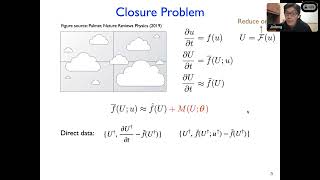
Data-Driven Closure Modeling Using Derivative-free Kalman Methods
Explore data-driven closure modeling for complex dynamical systems using derivative-free Kalman methods. Learn to improve predictions in turbulence and cloud dynamics with advanced machine learning techniques.

Deep Learning to Discover Coordinates for Dynamics - Autoencoders & Physics Informed Machine Learning
Explore deep learning techniques for discovering effective coordinate systems in dynamical systems, enabling simpler models and physical law discovery. Focus on autoencoders and physics-informed machine learning.
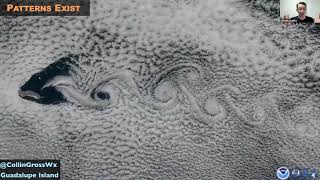
Machine Learning in Fluid Dynamics and Climate Physics
Explore machine learning applications in fluid dynamics and climate modeling, including physics-informed approaches, data integration, and simulation validation techniques.
Unique Challenges in Physics-Informed Machine Learning
Explores unique challenges in physics-informed machine learning, focusing on non-convexity in loss functions and insufficient model expressibility compared to conventional machine learning approaches.

Neural ODEs - From ResNet to Continuous-Time Machine Learning
Explore Neural ODEs: a powerful machine learning approach for learning ODEs from data. Discover its advantages over ResNet and extensions like HNNs and LNNs.
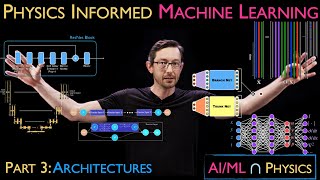
Designing an Architecture for Physics-Informed Machine Learning - Part 3
Explore various neural network architectures for physics-informed machine learning, including ResNets, UNets, and PINNs. Learn how to incorporate physical principles and symmetries into model design for improved performance.
Feature Encoded and Multi-Resolution Physics-Informed Machine Learning for Musculoskeletal Digital Twins
Innovative machine learning approaches for musculoskeletal digital twin applications, focusing on parameter identification and motion prediction using surface electromyography signals.
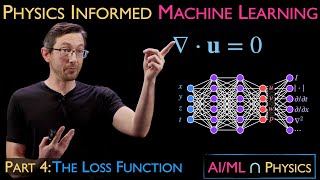
Crafting a Physics-Informed Loss Function for AI/ML in Physics - Part 4
Explores designing physics-informed loss functions in AI/ML, including case studies on fluid dynamics, sparse modeling, and equivariant loss, to enhance model performance and incorporate physical constraints.

Neural Implicit Flow - Physics Informed Machine Learning
Explore physics-informed machine learning with Neural Implicit Flow, covering turbulent data compression, sparse sensor placement, and mesh-agnostic approaches for advanced fluid dynamics applications.
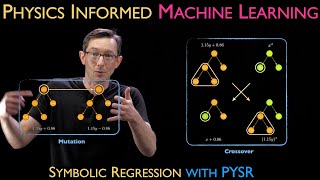
Python Symbolic Regression - Physics Informed Machine Learning
Explore Python Symbolic Regression for physics-informed machine learning. Learn algorithm basics, historical context, and PySR tool benefits for discovering interpretable mathematical models from data.
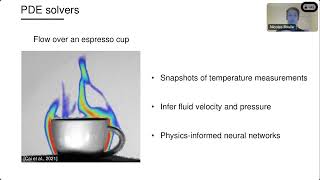
Elliptic PDE Learning: Provably Data-Efficient Techniques
Explore data-efficient PDE learning techniques, combining deep learning with physics and mathematics to discover properties of unknown physical systems from limited experimental data.
Physics-Informed Machine Learning for Complex Systems - A Focus on Power System Applications
Explorez l'application de l'apprentissage automatique aux systèmes électriques, en mettant l'accent sur les modèles réduits et la calibration à partir de données enregistrées pour améliorer la résilience du réseau.

Probabilistic Simulation Methods for Machine Learning in Science and Technology
Explore probabilistic numerics in machine learning, bridging computation and inference. Gain insights into physics-informed ML and adaptive solver integration for enhanced efficiency in scientific computing.
A Connection between Probability, Physics and Neural Networks
Explore the intersection of probability, physics, and neural networks, focusing on constructing physics-consistent models using Gaussian processes and the central limit theorem.
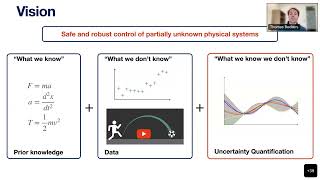
Physics-Enhanced Gaussian Processes for Learning of Electromechanical Systems
Explore physics-enhanced Gaussian processes for modeling electromechanical systems. Learn about GP-PHS and physics-enhanced variational autoencoders to improve data efficiency and ensure physical correctness.
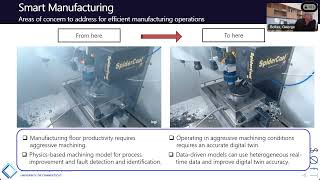
Physics Informed Machine Learning through Symbolic Regression
Explore symbolic regression for identifying PDE models from scarce, noisy data. Compare with Physics-Informed Neural Networks and discuss applications in fault detection and system health prognostics.
Aurora: A Foundation Model of the Atmosphere - Tutorial 1
Explore Aurora, a groundbreaking foundation model for atmospheric science, and learn its applications in climate modeling and weather prediction.