Explaining Model Decisions and Fixing Them Through Human Feedback
Explore algorithms for explaining deep network decisions, building user trust, incorporating domain knowledge, learning grounded representations, and correcting unwanted biases in AI models.
Optimizing for Interpretability in Deep Neural Networks - Mike Wu
Explore techniques for making deep neural networks more interpretable through regularization, focusing on medical applications in critical care and HIV treatment. Insights on balancing model performance with human-understandable decision processes.

Leveraging Social Theories to Enhance Human-AI Interaction
Explores challenges in human-AI partnerships, focusing on interpretability tools' limitations and cognitive heuristics. Proposes incorporating social theories to improve decision-support systems and human-AI interaction.
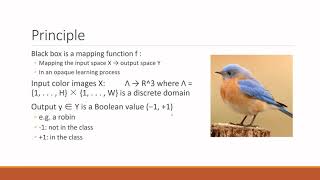
Interpretable Explanations of Black Boxes by Meaningful Perturbation - CAP6412 Spring 2021
Explore principles and methods for explaining black box functions in machine learning, focusing on image saliency, perturbation techniques, and meta-predictors for interpretable AI.

Interpretability Agents: Automating and Scaling Model Interpretation
Explore automated interpretability agents for scaling model interpretation, enabling efficient analysis of AI systems through hypothesis-driven experimentation and modular design.

Interpretability for Deep Learning: Theory, Applications and Scientific Insights
Dive into deep learning interpretability, exploring methods to enhance transparency, safety, and trustworthiness in AI deployment while uncovering scientific insights in various domains.
Live Responsible AI Dashboard: One-Stop Shop for Operationalizing RAI in Practice - Episode 43
Explore the Responsible AI Dashboard, a comprehensive toolkit for ethical machine learning development. Learn about model debugging, fairness assessment, and responsible decision-making in AI systems.
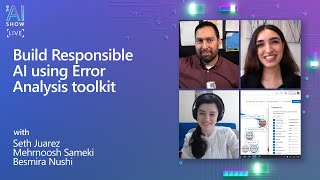
Build Responsible AI Using Error Analysis Toolkit
Explore Microsoft's Error Analysis toolkit for responsible AI, identifying model errors, diagnosing root causes, and building reliable solutions through interpretability, fairness, and debugging techniques.

Transparency in Algorithmic Decision-Making - Karen Yeung, Birmingham Law School
Exploring transparency in algorithmic decision-making, focusing on legal, ethical, and social implications of AI and automated systems in light of GDPR implementation and its impact on data protection.

The GDPR and Beyond - Ideas from Academia and Policy Panel
Exploring GDPR's impact on data protection, automated decision-making, and AI regulation. Experts discuss key concepts, implementation challenges, and future implications for governments and corporations.

The GDPR and Beyond - Elizabeth Denham, UK Information Commissioner
Elizabeth Denham discusses GDPR implementation, its impact on data protection, and future implications for AI regulation. Insights from the UK's top data protection official on privacy, innovation, and accountability.

Machine Learning and Data Science for Medicine - A Vision, Some Progress and Opportunities
Explore machine learning and data science applications in medicine, focusing on AutoPrognosis - an automated system for creating tailored, interpretable, and accurate prognostic models for various diseases.

Introduction to Data Ethics - Brent Mittelstadt
Explore data ethics with Dr. Mittelstadt, covering algorithmic fairness, accountability, transparency, and privacy. Learn about ethical challenges in AI and data analytics, with real-world examples and regulatory insights.

Be Prepared to Show Your Working! - Professor Sir David Spiegelhalter
Explore algorithmic decision-making transparency, validation, and explainability with Professor Spiegelhalter. Learn about the importance of demonstrating trustworthiness and intelligent transparency in automated advice systems.
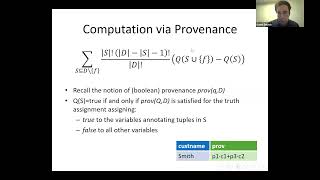
Towards Interpretable Data Science
Explore holistic approaches to interpretable data science, focusing on counterfactual and attribution-based explanations for complex data processing and decision support systems.
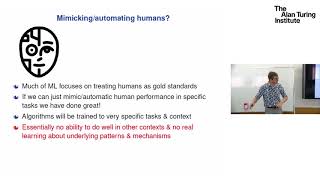
Beyond Tech - Machine Learning in Science & Policy - Professor David Dunson, Duke
Exploring machine learning applications beyond tech, highlighting challenges in science and policy. Discusses fair algorithms, interpretable models, and the need for targeted methods in complex domains.

Interpretable Chirality-Aware Graph Neural Networks for QSAR Modeling in Drug Discovery
Explore an innovative Graph Neural Network approach for drug discovery, incorporating molecular chirality and offering interpretable results to enhance quantitative structure-activity relationship modeling.

Pragmatic Interpretability - A Human-AI Cooperation Approach
Explore pragmatic interpretability in machine learning, focusing on human-AI cooperation, selective explanations, and incorporating human intuition to enhance decision-making and model understanding.

Using Logic Programming and Kernel-Grouping for Improving Interpretability of Convolutional Neural Networks
Explore a neurosymbolic framework for improving CNN interpretability in image classification using logic programming and kernel-grouping techniques.
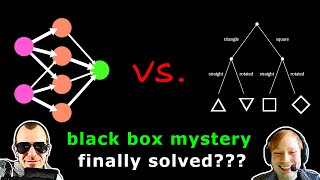
Neural Networks Are Decision Trees - With Alexander Mattick
Exploring the equivalence between neural networks and decision trees, discussing interpretability, computational advantages, and potential collaborations between the two approaches.

Understanding Deep Neural Networks - CVPR 2020 iMLCV Tutorial
Explore deep neural network interpretability through meaningful perturbations, extremal perturbations, and activation analysis. Learn techniques for understanding and improving model behavior in computer vision tasks.