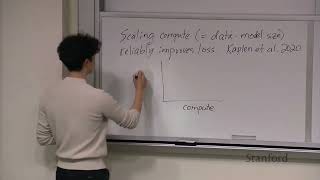
Intuitions on Language Models and Shaping AI's Future - Stanford CS25 Lecture
Explore intuitions on language models and the evolution of Transformer architectures with OpenAI researchers. Gain insights into next-word prediction, scaling laws, and the future of AI development.
Modeling Computer Networks from Chips to the Internet
Explore network modeling strategies for the Internet, from chip-level communication to global-scale simulations, examining scaling laws, biological concepts, and socio-economic factors shaping its future.
How Does Size Shape Our Understanding of and Search for Life? Alien Crash Site with Chris Kempes
Explore how size influences our understanding of life, from microscopic to cosmic scales, and its implications for the search for extraterrestrial life with mathematical biologist Chris Kempes.
The Laws of Life, Time and Chance
Explore the intersection of physics and biology, uncovering mathematical frameworks for understanding life, time, and probability. Discover how chance governs cellular behavior and impacts complex biological phenomena.
Using Buckingham's Π Theorem for Dimensionless Similarity Parameters in Macroecology
Explore dimensionless similarity parameters in macroecology using Buckingham's Π theorem, presented by Sandra Chapman from the University of Warwick.
Geoffrey West on Scaling, Open-Ended Growth, and Accelerating Crisis/Innovation Cycles
Geoffrey West explores scaling laws in cities, discussing how urban environments amplify human creativity and challenges, and examines the accelerating cycle of crisis and innovation driving our global economy towards potential peril.
Scaling Laws and Social Networks in the Time of COVID-19 - Part 1
Exploring scaling laws in biology, cities, and economies, and their implications for societal challenges like pandemics and sustainability. Insights from complex systems science for understanding human civilization.
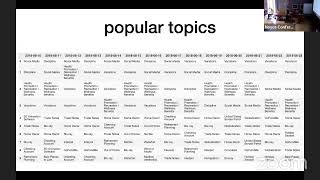
Scaling of Information Costs in Firms
Explore the scaling dynamics of information costs within organizations, examining how firms manage and process data as they grow and evolve in size and complexity.

Capturing Intelligence at the Level of Thought - Deep Learning and Language Models
Explore deep learning, language models, and AI alignment challenges in this talk on capturing intelligence at the thought level, offering insights into the future of AI research.
Why is Life So Diverse? - Episode 3
Exploring biodiversity's origins, constraints, and threats. Discusses scaling laws in evolution, exceptions to rules, and the potential for forecasting biosphere changes, featuring insights from ecology and evolutionary biology experts.
The Mathematics of Scaling Laws and Model Collapse in AI
Explore the mathematics behind AI scaling laws and model collapse, focusing on the shift from linear to flattened performance relationships in large language models.
Re-thinking Transformers: Searching for Efficient Linear Layers over a Continuous Space
Explore efficient alternatives to dense linear layers in neural networks, examining structured matrices and their compute-optimal scaling laws for improved performance in large language models.
Scaling Laws for Dense Retrieval
Explore scaling laws for dense retrieval, examining their impact on information retrieval systems and performance optimization strategies.
Infinite Limits and Scaling Laws of Neural Networks
Explore infinite parameter limits of deep neural networks, scaling laws, and their impact on performance. Gain insights into representation learning and computational resource optimization for neural network training.
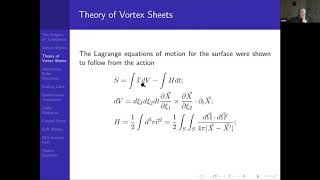
Turbulence as Gibbs Statistics of Vortex Sheets - Alexander Migdal
Explore vortex sheet dynamics, anomalous Euler equations, and Gibbs statistics in turbulence. Gain insights into scaling laws, spontaneous turbulence, and the ground state of turbulent systems.
City Analytics - Professor Peter Grindrod CBE
Explore urban analytics, scaling laws, and data science applications in cities. Discover insights on citizen behavior, political trends, and smart city concepts through mathematical modeling and real-world examples.
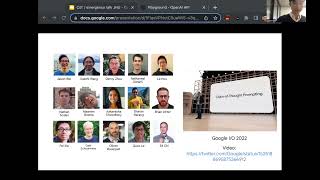
Emergence and Reasoning in Large Language Models
Explore emergence and reasoning in large language models with Google researcher Jason Wei, delving into self-supervised statistical models and their implications.
The Unreasonable Effectiveness of Mathematics in Large Scale Deep Learning - Lecture 3
Explore the mathematical foundations of large-scale deep learning and their surprising effectiveness in this lecture by Greg Yang, delving into advanced concepts and cutting-edge research.
The Unreasonable Effectiveness of Mathematics in Large Scale Deep Learning - Lecture 2
Explore the mathematical foundations of large-scale deep learning and their surprising effectiveness in this lecture by Greg Yang, delving into advanced concepts and recent developments.
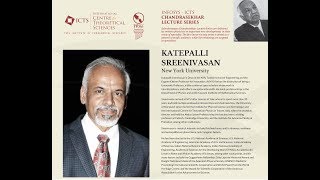
S. Chandrasekhar's Fluid Dynamics by Katepalli Raju Sreenivasan
Explore S. Chandrasekhar's contributions to fluid dynamics, scaling in physics, and turbulent mixing through lectures by Katepalli Raju Sreenivasan, covering theoretical concepts and their applications.
Turbulence Energy Spectrum by Jayanta K. Bhattacharjee
Explore turbulence energy spectrum, from homogeneous isotropic turbulence to stably stratified fluids. Covers universal range, stochastic models, eddy viscosity, perturbation theory, and Bolgiano-Obukhov scaling.