Linear Discriminant Analysis - Discriminant Analysis Tutorial - Machine Learning Tutorial
Explore Linear Discriminant Analysis for dimension reduction and pattern classification in machine learning. Learn its applications, core mathematics, and practical implementation through exercises and examples.
Intro and Foundations of Data Science I
Explore key concepts in data science, including random variables, distributions, dimension reduction, and singular value decomposition, with experts from Microsoft Research India.
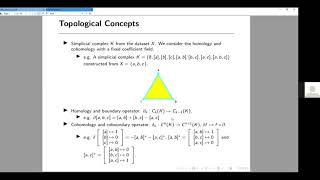
Hengrui Luo - Generalized Penalty for Circular Coordinate Representation
Explore dimension reduction using circular coordinates and generalized penalties in topological data analysis. Enhance visualization of high-dimensional datasets while preserving topological structures.
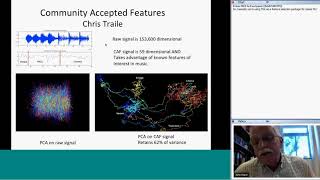
John Harer - Topological Data Analysis and Machine Learning
Explore topological data analysis and machine learning, covering methodology, examples, dimension reduction, and advanced techniques for feature extraction and classification.
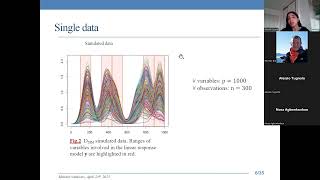
Dual-SPLS - A Versatile Approach Improving PLS with Lasso Shrinkage
Explore dual-sPLS, an innovative algorithm combining PLS and Lasso for improved variable selection and dimension reduction in high-dimensional analytical chemistry problems, offering enhanced accuracy and interpretability.
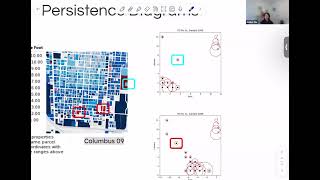
Topological Data Analysis in Economic Context - Property Tax Maps
Exploring property tax patterns using topological data analysis to classify housing structures and regional demographics, offering new insights into community organization and economic indicators.
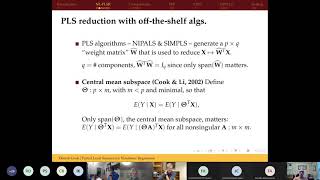
Partial Least Squares for Nonlinear Regression
Explore dimension reduction in PLS regression for nonlinear relationships, challenging traditional views and proposing new insights into PLS-like methods for predictive modeling.
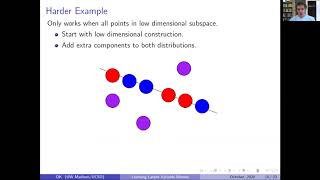
Small Covers for Near-zero Sets of Polynomials and Learning Latent Variable Models
Explore techniques for parameter estimation in Gaussian mixture models and mixtures of linear regressions, focusing on dimension reduction and higher moments to overcome obstacles in learning latent variable models.
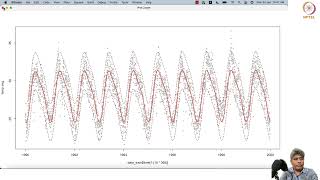
Hands-on with R: Regression Modeling and Feature Selection - Part 5
Fit regression models to temperature data, apply stepwise variable selection, and choose the best model using out-sample RMSE. Enhance skills in feature engineering and dimension reduction.
Rectifiable-Reifenberg and the Regularity of Stationary and Minimizing Harmonic Maps
Explore sharp rectifiability results for singular sets of minimizing harmonic maps, with uniform Minkowski bounds and integrability. Analyze quantitative stratification and dimension-reduction techniques.
K-Means and K-Medians Under Dimension Reduction
Explore k-means and k-medians clustering algorithms under dimension reduction, examining distortion graphs, cost analysis, and combinatorial lemmas for robust high-dimensional statistics.
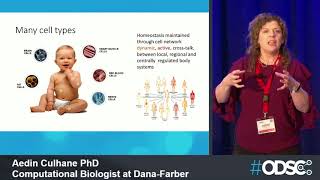
Unsupervised Feature Learning with Matrix Decomposition - Aedin Culhane, PhD | ODSC East 2018
Explore unsupervised learning techniques for high-dimensional data analysis, focusing on matrix factorization methods and their applications in oncology and precision medicine.
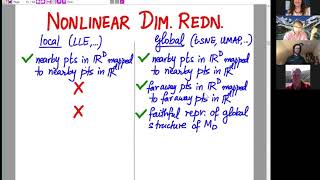
Dimension Reduction - An Overview
Comprehensive overview of dimension reduction techniques, from linear methods like PCA to nonlinear approaches such as LLE, Isomap, t-SNE, and UMAP, with practical application to chemical reaction data.
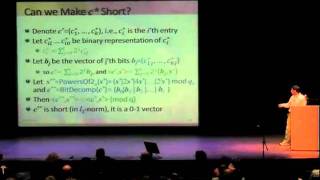
Tutorial on Homomorphic Encryption
Explore advanced homomorphic encryption concepts, including LWE, BV'11b construction, dimension reduction, and leveled FHE, building on fundamental knowledge from part 1.

Non-interpenetration in Thin-film Models of Elastic Solids
Explore non-interpenetration in thin-film models for elastic solids, focusing on dimension reduction, membrane regimes, and suitable conditions for preventing material penetration.

Leveraging Latent Representations for Predictive Physics-Based Modeling
Explore advanced techniques for leveraging latent representations in predictive physics-based modeling, focusing on surrogate models, inverse problems, and transfer learning for complex PDEs.