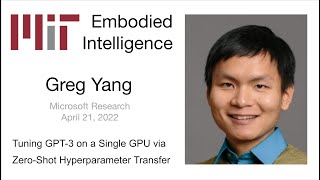
Tuning GPT-3 on a Single GPU via Zero-Shot Hyperparameter Transfer
Discover how to tune GPT-3 hyperparameters efficiently on a single GPU using µTransfer, a technique based on the maximal update parametrization that enables optimization of large language models with minimal resources.

Federated Hyperparameter Tuning - Challenges, Baselines, and Connections
Explores challenges and solutions for hyperparameter tuning in federated learning, introducing FedEx method to accelerate the process. Connects to weight-sharing in neural architecture search and demonstrates improved accuracy on benchmarks.

Нейросети на Python
Учебный курс начального уровня для программистов, которые хотят научится применять нейронные сети для решения практических задач.

Boosting LLM Development and Training Efficiency: Automated Parallelization with MindSpore
Explore automated parallelization for efficient LLM development and training using MindSpore. Learn to optimize distributed training on large-scale clusters without intrusive model modifications, accelerating AI research and implementation.
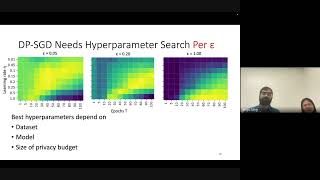
Improving the Privacy-Utility Tradeoff in Differentially Private Machine Learning with Public Data
Explore techniques to enhance privacy-utility balance in differentially private machine learning using public data, focusing on DP-RAFT and DOPE-SGD algorithms for improved model accuracy.
Utility Analysis for Differentially-Private Pipelines
Explore a methodology for estimating differential privacy's impact on data quality, aiding informed decision-making in implementing privacy-preserving pipelines.
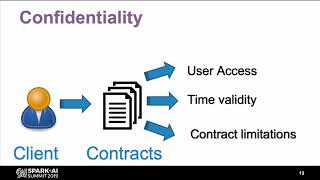
Revolutionizing Legal Industry with Spark, NLP and Azure Databricks - Clifford Chance Case Study
Explore how a top law firm revolutionizes operations using advanced analytics, Spark, NLP, and Azure Databricks to handle millions of legal documents and enhance client relationships.
Robust Equation Discovery and Sparse Sensing with Guarantees
Explore statistical mechanics for robust sparse equation discovery and optimal sensor placement, with applications in nuclear digital twins and high-dimensional field reconstruction.

Training High Quality Embedding Models for Production Vector Search
Master practical techniques for training and optimizing embedding models for production-ready vector search, covering data quality, loss functions, and efficient updating strategies.
SETFIT Hyperparameter Optimization for SBERT Text Classification - Part 45
Master SETFIT hyperparameter optimization techniques for efficient text classification using Sentence Transformers, focusing on contrastive training and automated parameter tuning for optimal performance.
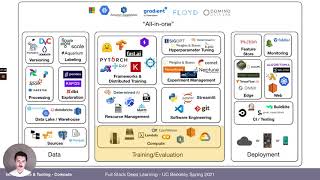
Infrastructure & Tooling - Full Stack Deep Learning - Spring 2021
Comprehensive overview of ML infrastructure and tools, covering software engineering, computing, resource management, frameworks, experiment management, and hyperparameter optimization for practitioners.
Efficient AutoML with Ludwig, Ray, and Nodeless Kubernetes
Explore efficient AutoML using Ludwig and Ray, leveraging heuristics for model production. Learn how Nodeless Kubernetes optimizes GPU resource management, reducing costs in cloud environments.
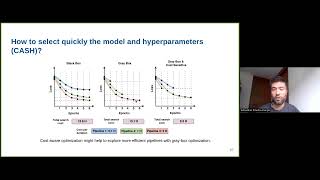
Quick-Tune: Quickly Learning Which Pretrained Model to Finetune and How
Discover a methodology for efficiently selecting and fine-tuning pretrained models through meta-learning, optimizing model selection and hyperparameter configurations for new datasets.
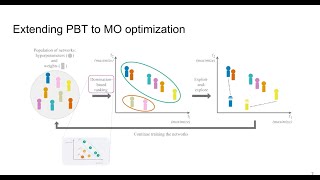
Multi-Objective Population Based Training for Hyperparameter Optimization
Discover advanced hyperparameter optimization techniques through Population Based Training (PBT) and its multi-objective evolution, focusing on real-world applications in precision, fairness, and robustness.
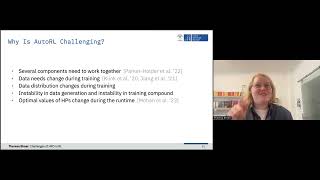
Challenges in Hyperparameter Optimization for Reinforcement Learning - Understanding AutoRL Through AutoML
Explore the complexities of hyperparameter optimization in Reinforcement Learning, examining AutoML tools and methods to better understand and tune RL algorithms for improved performance.
Multi-objective Bayesian Optimization with Heuristic Objectives for Biomedical and Molecular Data Analysis Workflows
Discover advanced Bayesian optimization techniques for biomedical data analysis, focusing on multi-objective approaches with heuristic objectives in unsupervised bioinformatics workflows.
Hyperparameter Optimization and Algorithm Configuration from a Black-Box Optimization Perspective
Explore dynamic algorithm configuration and hyperparameter optimization approaches, comparing AutoML and black-box optimization methods for efficient, adaptive parameter tuning.

Pytorch TensorBoard Tutorial
Comprehensive guide to TensorBoard in PyTorch: plotting functions, hyperparameter search, image and weight visualization, and embedding projector. Practical examples included.
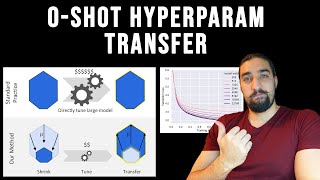
Tensor Programs - Tuning Large Neural Networks via Zero-Shot Hyperparameter Transfer
Explore μTransfer: a technique for tuning large neural networks via zero-shot hyperparameter transfer, making optimal hyperparameters stable with respect to width scaling.

Scaling AI Applications with Ray - Richard Liaw & Eric Liang | ODSC East 2019
Explore Ray, a distributed execution engine for AI workloads. Learn about Tune for hyperparameter optimization and RLib for reinforcement learning, with insights on scalability and practical applications.
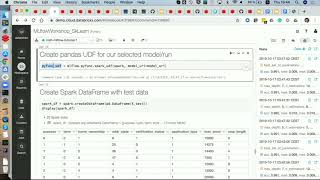
Managing the Complete Machine Learning Lifecycle with MLflow - Part 2
Explore MLflow's capabilities for managing machine learning lifecycles, from data preparation to model deployment, with practical insights on hyperparameter optimization and production workflows.