Docs, CI Tests, Error Messages, and Interfaces in Julia's SciML - JuliaCon 2024
Explore SciML's infrastructure practices in Julia, covering documentation, testing, error handling, and benchmarking. Gain insights into scalable and reproducible numerical ecosystems for Julia developers.
JuliaSim: Machine Learning Accelerated Modeling and Simulation
Explore JuliaSim: Accelerate modeling and simulation with machine learning. Learn about fast differential equation solvers, neural network integration, and surrogate models for enhanced computational efficiency.
Solving Fractional Differential Equations with FractionalDiffEq.jl
Discover how to solve complex fractional differential equations using FractionalDiffEq.jl, a powerful Julia package that integrates with SciML for advanced mathematical modeling and scientific computing.
UQ for ML and ML for UQ - Uncertainty Quantification and Machine Learning in Physics-Based Modeling
Explore the interplay between Uncertainty Quantification and Machine Learning in physics-based modeling, examining their roles in solving complex computational challenges across various applications.
Leveraging Physics-Induced Bias in Scientific Machine Learning for Computational Mechanics
Explore physics-induced bias in scientific machine learning for computational mechanics, focusing on physics-informed, structure-preserved learning for irregular geometries.
Generalizing Scientific Machine Learning and Differentiable Simulation Beyond Continuous Models
Explore advanced scientific machine learning, extending differentiable simulation to complex models like jump diffusions and agent-based systems, addressing challenges in implementation and numerical stability.
Hierarchical Component-Based Modeling with ModelingToolkit.jl
Explore hierarchical component-based modeling using ModelingToolkit.jl for efficient simulation of complex systems. Learn to build, simplify, and analyze large-scale models with Julia's SciML ecosystem.
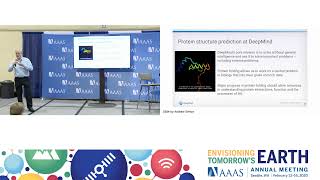
AI for Science - Expo Stage Talk - AAAS Annual Meeting
Explore the impact of deep learning on scientific research, from cryoelectron microscopy to AlphaFold, and discover how AI is revolutionizing various scientific disciplines.
Raising the Ki of a SciML Model - Enhancing GOKU-nets for Scientific Machine Learning
Explore advanced SciML techniques with GOKU-UI, enhancing Latent ODEs through attention mechanisms and multiple shooting. Learn to improve model performance and data efficiency for complex system modeling.
ODINN.jl - Multi-language Geoscientific Machine Learning for Glacier Evolution Modeling
Explore ODINN.jl, a global glacier evolution model using Julia's SciML capabilities for geoscientific machine learning, combining differential equations with Python tools for flexible, multi-language modeling.
PEtab.jl - Efficient Parameter Estimation for Dynamic Models
Explore efficient parameter estimation for dynamic models in biology using PEtab.jl. Learn to import problems, set up estimations, and choose optimal gradient computation methods.
Model Reparametrization with StructuralIdentifiability.jl - JuliaCon 2024
Explore StructuralIdentifiability.jl's new features for rapid identification of identifiable functions and model reparametrization, enhancing modeling and control practices.

FMIExchange.jl - Foreign Models Through a Familiar Interface
Explore FMIExchange.jl for seamless integration of FMI-compliant models with Julia's DifferentialEquations.jl, enabling multi-model simulations and advanced control strategies in complex systems.
ProcessSimulator.jl - A Differentiable Chemical Process Simulator
Differentiable chemical process simulator leveraging symbolic transformations and automatic differentiation for robust flowsheeting, thermodynamic property calculations, and system-level optimization in Julia.
Combined Stochastic Models for Cancer Patient Trajectories
Integrating diverse clinical data into a unified stochastic model for cancer patient trajectories, combining tumor growth, metastasis, and survival data using Julia for simulation and Bayesian inference.
Interpretable Hierarchical Calibration of Agent-Based Models
Explore scientific machine learning's fusion of traditional modeling and ML, focusing on neural network surrogates for agent-based models in epidemiology and automated hierarchical calibration.
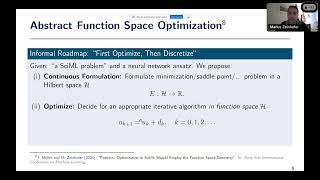
Infinite Dimensional Optimization for Scientific Machine Learning
Explore advanced optimization techniques in scientific machine learning, focusing on infinite-dimensional perspectives and the "first optimize, then discretize" paradigm for neural network applications.
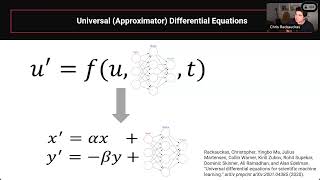
Generalizing Scientific Machine Learning and Differentiable Simulation Beyond Continuous Models
Explore generalizing scientific machine learning beyond continuous models, covering differentiable simulation for chaotic systems, stochastic processes, and inverse problems in advanced scientific computing.
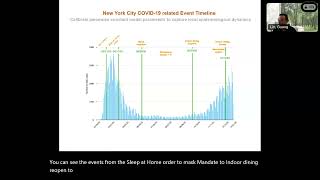
Towards Third Wave AI: Interpretable, Robust Trustworthy Machine Learning
Explore new theories and algorithms for complex dynamical systems, creating trustworthy AI for real-time prediction and national security applications. Learn about innovative neural networks and physics-integrated models.
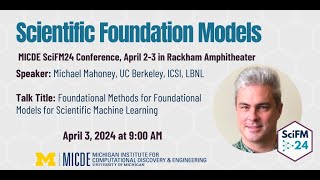
Foundational Methods for Foundation Models in Scientific Machine Learning - Lecture 6
Explore foundational methods for scientific machine learning models, addressing challenges in integrating data-driven ML with domain-driven scientific computing methodologies.
State of Julia's SciML Ecosystem - Current Status and Future Directions
Comprehensive overview of Julia's SciML ecosystem, highlighting maturity levels of various packages, current development focus, and future directions in scientific machine learning and differential equations.