
Parables from Complex Systems and Their Possible Meanings for Our Lives - Lecture 2
Explore complex systems through parables, examining prediction models, chaos theory, and market dynamics to gain insights applicable to everyday life and decision-making.
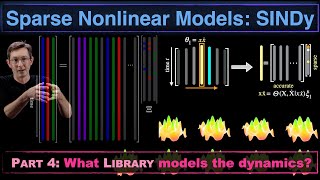
Sparse Nonlinear Dynamics Models with SINDy - The Library of Candidate Nonlinearities
Explores advanced techniques for SINDy algorithm, including control variables, bifurcation parameters, rational functions, dimensionality reduction, and symmetry constraints in nonlinear dynamics modeling.
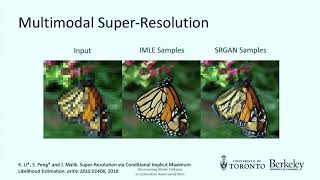
Overcoming the Curse of Dimensionality and Mode Collapse - Ke Li
Explore techniques to overcome dimensionality challenges and mode collapse in deep learning, focusing on GANs, maximum likelihood estimation, and efficient algorithms for high-dimensional spaces.
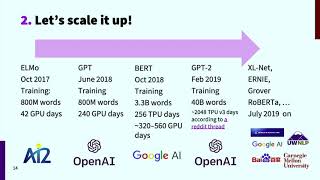
Emergent Linguistic Structure in Deep Contextual Neural Word Representations - Chris Manning
Explore emergent linguistic structures in deep neural word representations with Stanford's Chris Manning, examining language models, attention mechanisms, and vector space analysis.

N-Grams - Introduction to Text Analytics with R
Explore N-grams in text analytics, including TF-IDF validation, word ordering, dimensionality challenges, and hardware limitations. Enhance your R-based text analysis skills.

High-Dimensional PDEs, Tensor Networks, and Convex Optimization
Explore innovative computational methods for high-dimensional PDEs using tensor networks and convex relaxations, addressing the curse of dimensionality with low-order statistics approximations.

VSM, LSA, & SVD - Introduction to Text Analytics with R
Explore advanced text analytics techniques: VSM, LSA, and SVD. Learn to handle high-dimensional data, uncover latent semantic structures, and efficiently map new data in reduced dimensions.

Multilevel Weighted Least Squares Polynomial Approximation – Sören Wolfers, KAUST
Explore multilevel weighted least squares polynomial approximation for high-dimensional function reconstruction, addressing the curse of dimensionality and leveraging structural assumptions for improved accuracy.
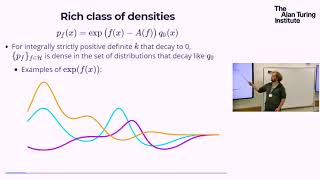
Score Estimation with Infinite-Dimensional Exponential Families – Dougal Sutherland, UCL
Explore score estimation in infinite-dimensional exponential families, covering reproducing kernel Hilbert spaces, maximum likelihood, and Nystrom approximation. Includes theoretical overview and experimental results.
Generalization Theory in Machine Learning
Explore generalization theory in machine learning, covering traditional methods, deep learning, and statistical learning theory. Gain insights into overcoming the curse of dimensionality and understanding learning bounds.
Optimal Sampling in Weighted Least-Squares Methods - Application to High-Dimensional Approximation
Explore optimal sampling in weighted least-squares for high-dimensional approximation, focusing on mathematical foundations and modern approaches to overcome the curse of dimensionality.

Random Tessellation Forests: Overcoming the Curse of Dimensionality
Explore random tessellation forests in machine learning, overcoming dimensionality challenges through innovative partitioning methods and directional distributions for improved statistical performance.
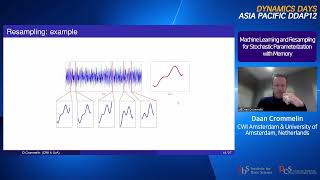
Machine Learning and Resampling for Stochastic Parameterization with Memory
Explore machine learning and resampling techniques for stochastic parameterization with memory in multiscale dynamical systems, focusing on overcoming challenges in long-memory scenarios.
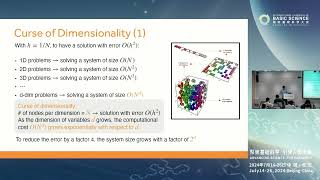
Solving High-Dimensional Partial Differential Equations Using Deep Learning
Explore deep learning algorithms for solving high-dimensional PDEs, overcoming dimensionality challenges in scientific computing applications.

On Algorithms in High Dimensions
Explore algorithms for high-dimensional data analysis, focusing on separated representations and multivariate mixtures to overcome the "curse of dimensionality" in complex computational problems.

The Quest for Adaptivity in Machine Learning - Comparing Popular Methods
Explore supervised learning algorithms' strengths and weaknesses, comparing k-nearest-neighbor, kernel methods, and neural networks for adaptivity and performance across various problems.

Computational Quantum Mechanics in Phase Space - An Attempt to Break the Curse of Dimensionality
Explore computational quantum mechanics in phase space, focusing on breaking the curse of dimensionality through grid-based and particle-based methods for high-dimensional Wigner quantum dynamics simulations.
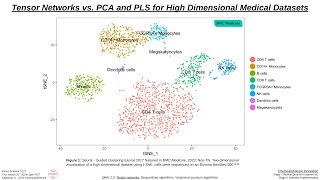
Tensor Networks vs. PCA and PLS for High Dimensional Medical Datasets
Explore dimensionality reduction techniques for high-dimensional medical data. Compare tensor networks with PCA and PLS, gaining insights on their applications and effectiveness in handling complex datasets.
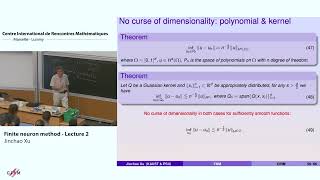
Finite Neuron Method - Lecture 2
Explore finite neuron method, covering electrical entropy, curse of dimensionality, neural networks, and approximation properties. Gain insights into deep learning concepts and techniques.