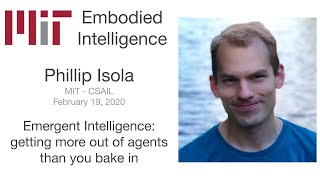
MIT EI Seminar - Phillip Isola - Emergent Intelligence- Getting More Out of Agents Than You Bake In
Explore emergent intelligence in AI through unsupervised learning, generative modeling, and self-assembling agents. Discover surprising outcomes beyond explicit programming in representation, video generation, and creature development.
Human and Machine Inductive Biases for Compositional Linguistic Generalization
Explore compositional linguistic generalization in humans and artificial neural networks. Compare model results with human patterns, highlighting challenges and opportunities in structural generalization research.
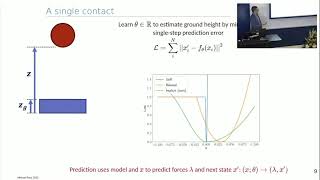
Do We Really Need All That Data? Learning and Control for Contact-rich Manipulation
Explore data efficiency in robotic manipulation, focusing on contact-driven aspects and implicit learning techniques for improved adaptability and real-time multi-contact MPC deployment.
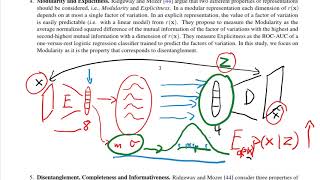
Challenging Common Assumptions in the Unsupervised Learning of Disentangled Representations
Explores challenges in unsupervised learning of disentangled representations, questioning assumptions and efficacy of current approaches through theoretical analysis and extensive experiments.
Improved Machine Learning Algorithm for Predicting Ground State Properties
Efficient ML algorithm predicts ground state properties of quantum systems using geometric locality, requiring minimal data and scaling favorably for large systems.
An Image is Worth 16x16 Words - Transformers for Image Recognition at Scale
Explore how Transformers outperform CNNs in image recognition, delving into Vision Transformer architecture, experimental results, and implications for AI research.
Noether Networks - Meta-Learning Useful Conserved Quantities
Explore Noether Networks: a novel approach to meta-learning conserved quantities in sequential prediction problems, inspired by Noether's theorem and aimed at discovering useful symmetries and inductive biases.
The Future of Natural Language Processing
Explore transfer learning in NLP, covering model efficiency, generalization, fine-tuning, and inductive biases. Gain insights into current trends and future directions from HuggingFace's science lead.
A Theory for Emergence of Complex Skills in Language Models
Explores statistical framework linking LLM cross-entropy loss to language skill competence, analyzing scaling laws' implications for efficient learning and emergence of complex abilities.
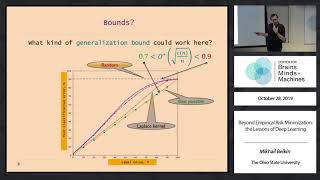
Beyond Empirical Risk Minimization - The Lessons of Deep Learning
Explore deep learning's challenge to traditional machine learning wisdom, examining the "double descent" risk curve and how over-parametrized models can generalize well despite perfect training fit.
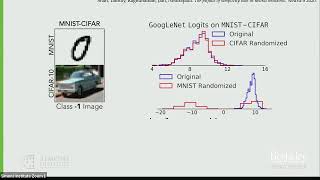
Understanding the Robustness of Deep Learning
Exploring deep learning robustness, transfer learning dynamics, and overparameterization to gain insights into network functioning and improve model reliability under distribution shifts.
Large ML Potentials for Chemistry - Generalization, Inductive Biases, and Error Cancellation
Explore machine learning potentials in chemistry, focusing on generalization, inductive biases, and error cancellation techniques for improved accuracy and efficiency.
Generalization in Diffusion Models from Geometry-Adaptive Harmonic Representation
Explore generalization in diffusion models through geometry-adaptive harmonic representation. Analyze denoising DNNs, score functions, and inductive biases to understand high-dimensional density learning and optimal basis adaptation.
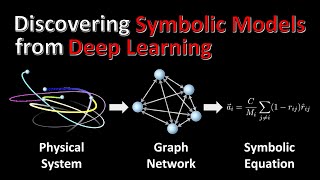
Discovering Symbolic Models from Deep Learning with Inductive Biases
Exploring how Graph Neural Networks and symbolic regression can derive accurate symbolic equations from observational data, combining deep learning with physics-inspired inductive biases.
PirateNets - Physics-Informed Deep Learning with Residual Adaptive Networks
Explore PirateNets: a novel deep learning architecture for solving PDE-governed problems, offering improved stability and efficiency over traditional physics-informed neural networks.
Understanding Generalization from Pre-training Loss to Downstream Tasks
Explore the mystery of pre-trained models' effectiveness, examining contrastive loss, embedding spaces, and the roles of inductive bias and optimizers in generalization to downstream tasks.