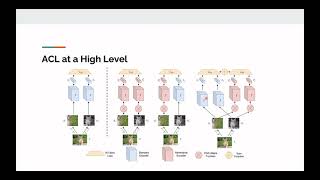
Robust Pre-Training by Adversarial Contrastive Learning - CAP6412 Spring 2021
Explore robust pre-training techniques using adversarial contrastive learning, focusing on unsupervised and semi-supervised methods for improved model resilience and accuracy.
Private Convex Optimization via Exponential Mechanism - Differential Privacy for Machine Learning
Explore private convex optimization using the exponential mechanism. Learn differential privacy, noisy SGD, and isoperimetric inequality for ML applications.
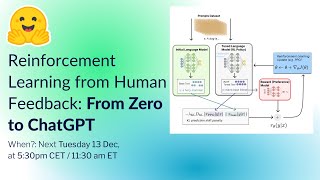
Reinforcement Learning from Human Feedback - From Zero to ChatGPT
Explore Reinforcement Learning from Human Feedback, its role in ChatGPT, and key concepts in NLP and RL. Gain insights into RLHF's technical aspects and open research areas.
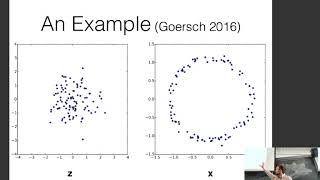
CMU Neural Nets for NLP - Models with Latent Random Variables
Explore neural network models with latent random variables for NLP, covering VAEs, generative models, and techniques for discrete latent variables and controllable text generation.
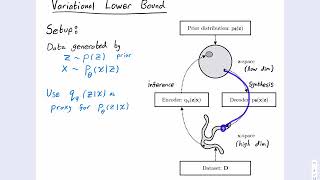
Variational Autoencoders
Explore generative models, autoencoders, and variational techniques in deep learning. Learn about architecture, optimization, and practical applications of variational autoencoders.
Quantum "Supremacy" - Lecture 25 of Quantum Computation at CMU
Explore quantum supremacy, its challenges, and implications in computational theory. Delve into error correction, threshold theorems, and the potential of quantum systems.
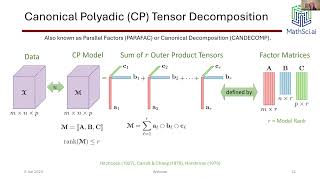
Generalized Tensor Decomposition - Utility for Data Analysis
Explore tensor decomposition methods beyond sum of squares error, including KL divergence and logistic odds, for improved data analysis in various fields like criminology and neuroscience.
Direct Preference Optimization - Fine-Tuning LLMs Without Reinforcement Learning
Explore Direct Preference Optimization (DPO), an efficient method for training Large Language Models without reinforcement learning. Learn about the Bradley-Terry model, KL divergence, and loss function.
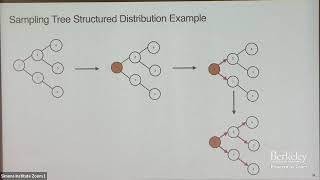
Distribution Learning Meets Graph Structure Sampling
Explore the connection between PAC-learning of graphical models and efficient graph structure sampling, leveraging online learning algorithms for new insights in high-dimensional distribution learning.

What Is Quantum Machine Learning?
Friendly introduction to quantum computing and machine learning, covering qubits, quantum gates, entanglement, and their applications in generative modeling and optimization.

Distillation of Transformer Models - Tutorial and Code Walk-through
Learn advanced techniques for distilling transformer models, including pruning, fine-tuning, and performance evaluation. Gain practical insights through code walkthroughs and real-world examples.