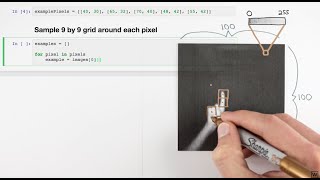
Learning To See
In this series, we'll explore the complex landscape of machine learning and artificial intelligence through one example from the field of computer vision: using a decision tree to count the number of fingers in an image. It's gonna be crazy.

Support Vector Machines
Explore Support Vector Machines, covering main concepts, polynomial and radial kernels, and practical implementation in Python.

Pattern Recognition and Application
This course covers feature extraction techniques and the representation of patterns in feature space. Measure of similarity between two patterns. Statistical, nonparametric and neural network techniques for pattern recognition have been discussed in this…
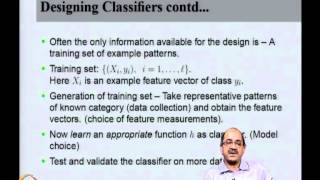
Pattern Recognition
Comprehensive exploration of statistical pattern recognition, covering Bayes classifiers, density estimation, linear discriminants, neural networks, SVMs, and advanced learning techniques.

Pattern Recognition
This course provides a fairly comprehensive view of the fundamentals of pattern classification and regression. Topics covered in the lectures include an overview of pattern classification and regression; Bayesian decision making and Bayes classifier

Sidney Redner on Statistics and Everyday Life
Explore everyday phenomena through statistical analysis, revealing hidden patterns in parking, elevators, and sports. Learn how complex systems research uncovers universal principles in daily life.

Demonology - Intelligence in Physics & Biology
Explore the historical role of intelligence in physics and biology, from Laplace's demon to modern information theory, and its implications for understanding natural phenomena.
Forecasting Natural Disasters in Complex Earth Systems - SFI Lecture
Explore forecasting natural disasters using satellite data, nonlinear dynamics, and numerical simulations. Learn about ensemble forecasting and pattern methods for predicting extreme events.

The Statue in the Stone: How Dynamical Systems Discover Environmental Patterns
Explores how complex systems adapt to environmental patterns, favoring stable configurations that match external forces. Illustrates with toy models and swarm-robotics experiment.
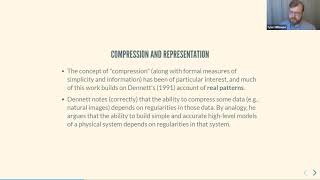
Patterns and Parsimony - High-Level Representations in Scientific Modeling
Explore the role of compression in developing effective high-level representations for scientific modeling, and discover why good representations require more than simplicity alone.
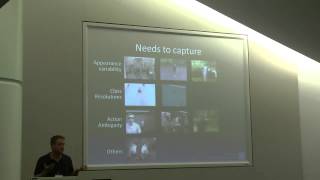
Action Recognition Benchmarks: Insights and Limitations - Tal Hassner
Explore action recognition benchmarks' insights, challenges, and limitations in assessing real-world capabilities, focusing on national benchmarks and recent developments in the field.
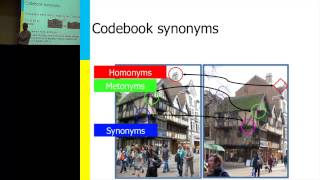
Object Recognition
Explore object recognition techniques, from Bag of Words to selective search, covering codebooks, visual synonyms, and object localization for effective image classification.
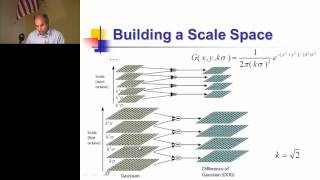
Scale-invariant Feature Transform (SIFT) - Lecture 5
Learn about Scale-invariant Feature Transform (SIFT), a robust algorithm for detecting and describing local features in images. Explore key point extraction, scale space, and descriptor generation.
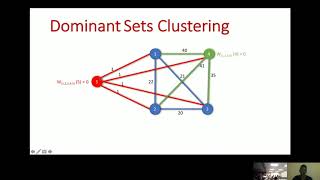
Deep Constrained Dominant Sets for Person Re-Identification
Explore advanced techniques for person re-identification using deep learning, including triplet loss, quadruplet loss, diffusion-based methods, and constrained dominant sets.
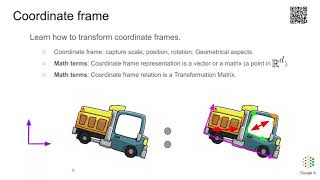
Introduction to Capsule Networks for Computer Vision
Explore Capsule Networks for computer vision, covering sparse pattern recognition, viewpoint equivariance, object detection, and dynamic routing techniques.
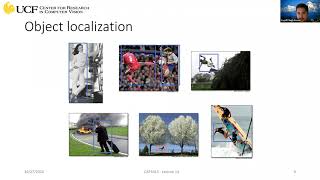
CAP5415 - Object Detection: Sliding Window and Image Pyramids - Lecture 13
Explore object detection techniques including sliding windows, scale-space pyramids, and non-maximum suppression. Learn about challenges and evaluation methods in this comprehensive lecture.
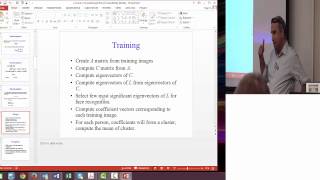
Facial Recognition: Eigenvectors and Covariance Matrices - Lecture 14
Explore facial recognition technology, from simple approaches to advanced techniques using eigenvectors and covariance matrices. Learn about challenges and solutions in this field.
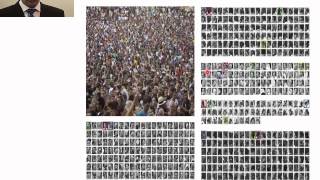
Visual Analysis of Extremely Dense Crowded Scenes
Analyzing dense crowd scenes using computer vision techniques for counting, detecting, and tracking individuals. Explores multiple data sources, context, and neighborhood motion to address challenges in extremely crowded environments.
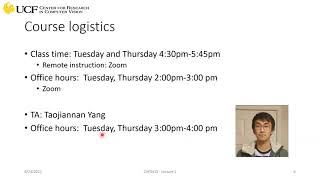
Computer Vision - Administrative and Course Overview - Lecture 1
Introduction to graduate-level computer vision, covering mathematical foundations, deep learning applications, and advanced topics like object detection and image segmentation.
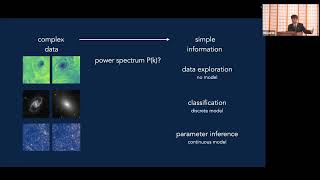
A Mathematical Vocabulary for Textures and its Astronomical Applications
Explore mathematical approaches to texture analysis and their applications in astronomy, focusing on innovative techniques for cosmic structure interpretation.
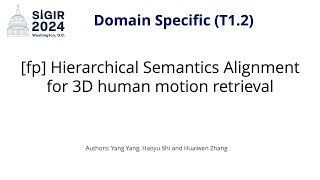
Hierarchical Semantics Alignment for 3D Human Motion Retrieval
Explore hierarchical semantics alignment techniques for efficient 3D human motion retrieval in this concise presentation on advanced computer vision applications.