Deep Learning
Explore deep learning fundamentals, computer vision, TensorFlow, Keras, transfer learning, and advanced topics like TPUs in this comprehensive introduction to neural networks.

Practical Machine Learning with Tensorflow
We will cover the basics of Tensorflow and Machine Learning in the initial sessions and advanced topics in the latter part. After this course, the students will be able to build ML models using Tensorflow.
Domain Adaptation with Invariant Representation Learning - What Transformations to Learn?
Explore domain adaptation in machine learning, focusing on invariant representation learning and its challenges. Learn about novel techniques for optimal feature mapping across domains.
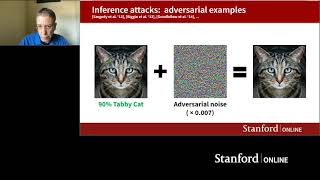
Hacking AI - Security & Privacy of Machine Learning Models
Explore adversarial machine learning with Prof. Dan Boneh, examining security challenges in AI models, defenses against attacks, and the balance between accuracy and privacy in ML systems.
Divide and Conquer - Concept-based Models for Efficient Transfer Learning
Exploring concept-based interpretable AI models for efficient transfer learning in healthcare, focusing on generalizability and minimal data requirements for domain adaptation in medical imaging.
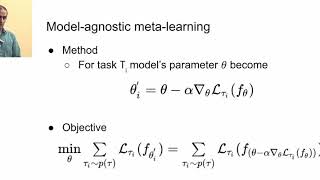
Unsupervised Meta-Learning for Few-Shot Image Classification
Explore unsupervised meta-learning techniques for few-shot image classification, including task construction, augmentation methods, and performance on benchmark datasets.
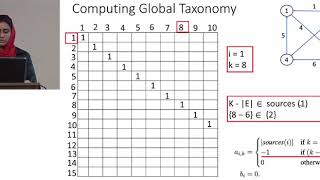
Taskonomy - Disentangling Task Transfer Learning
Explore task transfer learning, higher-order transfers, and task-specific networks. Discover global taxonomies, evaluate computed structures, and assess generalization to novel tasks.
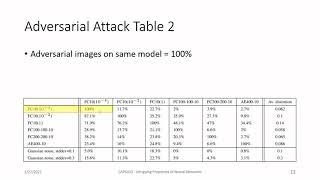
Intriguing Properties of Neural Networks - Spring 2021
Explore intriguing properties of neural networks, including adversarial attacks, transfer, training overlap, and semantic information in units. Analyze weaknesses and spectral instability.
Image Classification with ml5.js - MobileNet and Custom Models
Dive into image classification using ml5.js 1.0 in this comprehensive 32-minute video tutorial by Coding Train. Learn to implement both the default MobileNet model and train your own classifier using transfer learning and Teachable Machine. Explore the f…

Automatic Image Captioning with Vision Transformer and GPT-2
Learn how to generate descriptive captions for images using Python and PyTorch in this 16-minute tutorial. Explore the process of automatic image captioning with the pre-trained 'nlpconnect/vit-gpt2-image-captioning' model from Hugging Face. Set up the V…
Meaningful Signals Within Deep Learning Models for Biology - Primer and Meeting
Explore deep learning models in biology, from curating meaningful pre-training data to disentangling experimental noise, enhancing performance in biomedical imaging and high-throughput microscopy experiments.
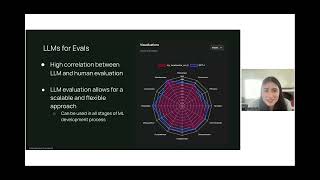
Beyond the Model Zoo - Optimizing Foundation Models for Your Application
Optimize foundation models for specific applications, exploring techniques beyond pre-trained models to enhance performance and efficiency in machine learning projects.
Understanding Foundation Models: A New Paradigm for Building and Productizing AI Systems
Explore foundation models as a new AI paradigm. Learn practical ways to leverage these models in building and productizing AI systems for your company.
Learning Representations for Image-Based Profiling of Perturbations - MPG Primer 2023
Dive into image-based profiling of perturbations, exploring cell painting assays, morphology profiling, and machine learning techniques for predicting compound interactions and cell phenotypes.
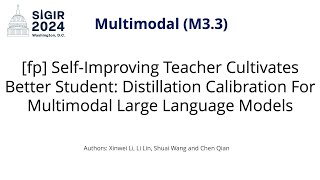
Self-Improving Teacher Cultivates Better Student: Distillation Calibration for Multimodal Large Language Models - Lecture 3.3
Explore innovative distillation calibration techniques for multimodal large language models, focusing on self-improving teacher methods to enhance student model performance.
Comparison and Transfer Between Tasks in Overparameterized Learning
Explore similarities and differences in classification and regression tasks for overparameterized linear models. Gain insights into task transfer and generalization in high-dimensional regimes.
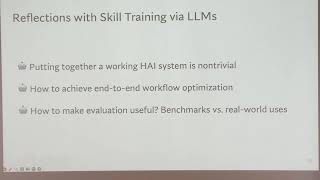
Adaptive Generalization: The Role of Dynamic Evaluation in Low-Resource Settings
Explore adaptive generalization techniques and dynamic evaluation strategies for enhancing AI performance in low-resource environments.
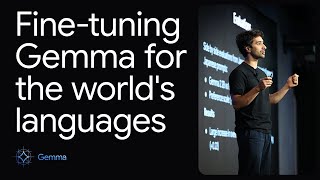
Fine-tuning Gemma for Non-English Languages
Dive into Gemma post-training techniques and explore adaptation strategies for non-English languages, enhancing multilingual AI capabilities.
TensorFlow 2.0 Beginner Tutorials
Learn TensorFlow 2.0 through hands-on tutorials covering installation, neural networks, CNNs, RNNs, transfer learning, data augmentation, custom training, and more. Build practical skills for deep learning projects.

PyTorch Tutorials - Complete Beginner Course
Comprehensive guide to PyTorch: from basics to advanced concepts, covering tensors, neural networks, and model deployment. Ideal for beginners seeking practical skills.
Crash Course on Transfer Learning
Explore transfer learning in deep learning models, including its concept, applications, benefits, and methods. Learn how models leverage prior knowledge for improved performance and efficiency.