
Stanford Seminar 2022 - DeepMind's Perceiver and Perceiver IO: New Data Family Architecture
Exploring DeepMind's Perceiver architecture for flexible AI processing across diverse data types, offering domain-general solutions comparable to specialized models in various tasks.
Intuitions on Language Models and Shaping AI's Future - Stanford CS25 Lecture
Explore intuitions on language models and the evolution of Transformer architectures with OpenAI researchers. Gain insights into next-word prediction, scaling laws, and the future of AI development.

When MOE Meets LLMs: Parameter Efficient Fine-tuning for Multi-task Medical Applications - Lecture 1
Explore parameter-efficient fine-tuning techniques for multi-task medical applications using Mixture of Experts and Large Language Models.
MDMTRec: An Adaptive Multi-Task Multi-Domain Recommendation Framework - SIGIR 2024
Explore an adaptive framework for multi-task, multi-domain recommendations, enhancing personalized content suggestions across various platforms and contexts.
MIT 6.S191 - Deep Learning Limitations and New Frontiers
Explore deep learning limitations, adversarial attacks, uncertainty quantification, and AutoML in this lecture. Gain insights into neural network challenges and emerging frontiers in AI research.

RoboCat - A Self-Improving Generalist for Robotic Manipulation
Explore RoboCat, a multi-embodiment, multi-task generalist agent for robotic manipulation. Learn about its ability to generalize across tasks and robots, and its potential for autonomous improvement.

LTV Forecasting and Churn Analysis for Mobile Gaming Revenue Optimization
Discover advanced LTV forecasting and churn analysis techniques for mobile gaming, focusing on whale player identification, MTL neural networks, and practical implementation strategies.
Industry NLP: Multitask and Continual Learning - Adapters and Hypernetworks Approach
Discover how adapters and hypernetworks revolutionize NLP tasks through multi-task and continual learning approaches, enabling faster training, efficient storage, and seamless ML system integration.
Active Dendrites Avoid Catastrophic Forgetting - Interview With the Authors
Interview exploring how active dendrites in neural networks can mitigate catastrophic forgetting, enabling better multi-task and continual learning for AI systems in dynamic environments.
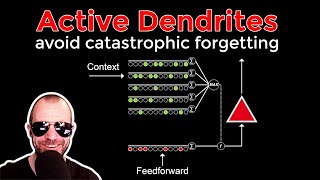
Avoiding Catastrophe - Active Dendrites Enable Multi-Task Learning in Dynamic Environments
Explore how active dendrites in neural networks mitigate catastrophic forgetting, enabling multi-task learning and adaptation in dynamic environments through context-sensitive gating and sparse representations.
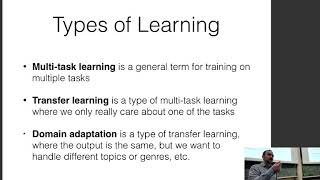
Neural Nets for NLP 2019: Sentence and Contextualized Word Representations
Explore sentence representations and contextual word embeddings for NLP tasks. Learn about multi-task learning, transfer learning, and pre-training techniques to improve model performance.
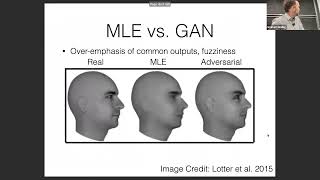
Advanced NLP: Adversarial Methods for Text
Explore advanced NLP techniques including adversarial networks, discrete outputs, and input manipulation for robust language models and applications.
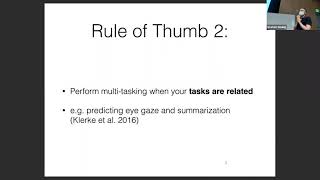
CMU Advanced NLP: Pre-training Methods
Explore advanced NLP concepts including multi-task learning, sentence embeddings, BERT variants, and language modeling objectives. Gain insights into cutting-edge techniques for natural language processing.

CMU Multilingual NLP 2020 - Advanced Text Classification-Labeling
Explore advanced text classification and sequence labeling methods, including subword models, unsupervised training, and structured prediction for multilingual NLP applications.
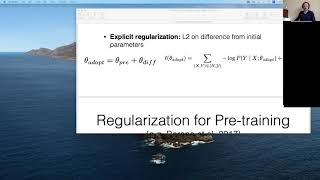
CMU Neural Nets for NLP 2020 - Multitask and Multilingual Learning
Explore multitask and multilingual learning in NLP, covering methods, objectives, and challenges. Gain insights into cross-lingual transfer, data balancing, and zero-shot approaches.
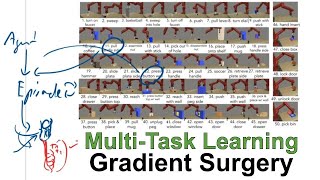
Gradient Surgery for Multi-Task Learning
Explore PCGrad, a technique addressing gradient conflicts in multi-task learning, enhancing efficiency and performance in supervised and reinforcement learning scenarios.
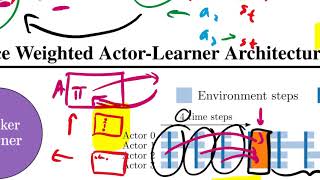
IMPALA - Scalable Distributed Deep-RL with Importance Weighted Actor-Learner Architectures
Explore IMPALA, a distributed reinforcement learning architecture for efficient multi-task learning. Learn about V-trace, off-policy correction, and scalable performance across thousands of machines.
Layer Increasing Network Scaling (LiNeS) - Preventing Catastrophic Forgetting in Language Models
Explore LiNeS, a novel post-training layer scaling technique that prevents catastrophic forgetting in large language models while enhancing multi-task performance and model merging capabilities.
Where Does Negative Transfer Come From? On the Implicit Bias of SGD in Multi-Task Learning
Explore negative transfer in multi-task learning, examining task conflict, optimization temperature, and SGD's implicit bias. Gain insights into generalization challenges in neural networks.
Next-Level Parameter Sharing - The Future of AI Collaboration
Explore cutting-edge multi-task learning techniques for tinyML, focusing on hard contextual parameter sharing to enhance AI collaboration and efficiency in resource-constrained environments.
Multi-Task Learning in Transformer-Based Architectures for Natural Language Processing
Explore multi-task learning in transformers, covering adapter techniques, hypernetworks, and efficient solutions for training multiple NLP tasks with shared architectures and reduced computational costs.