Deep Learning for Visual Computing
Comprehensive exploration of deep learning techniques for visual computing, covering neural networks, autoencoders, and CNNs with hands-on implementations using Python and popular datasets.

Deep Learning for Sequences in Quantitative Finance
Overview of deep learning sequence methods in quantitative finance, covering feature extraction, return forecasting, portfolio allocation, and trading execution. Explores applications and challenges in the investment process.

Pattern Recognition and Application
This course covers feature extraction techniques and the representation of patterns in feature space. Measure of similarity between two patterns. Statistical, nonparametric and neural network techniques for pattern recognition have been discussed in this…
Overview and Results of the THUMOS Action Localization Challenge
Learn about the THUMOS Localization Challenge, exploring datasets, annotation methods, and results in action recognition with numerous classes.
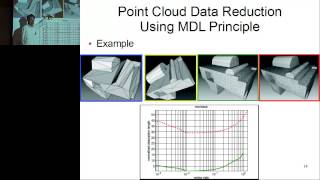
Integrating Close-Range 3D Computer Vision
Explore close-range 3D computer vision and synthetic aperture radar satellite remote sensing integration, covering image processing, point cloud analysis, and compressive sampling techniques.
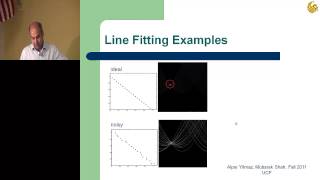
Hough Transform for Line and Shape Detection - Lecture 18
Learn about the Hough Transform technique for detecting lines and shapes in images, including its algorithm, applications, and variations like Generalized Hough Transform.
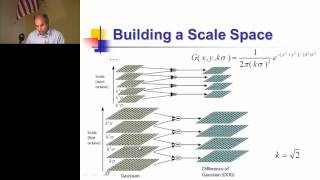
Scale-invariant Feature Transform (SIFT) - Lecture 5
Learn about Scale-invariant Feature Transform (SIFT), a robust algorithm for detecting and describing local features in images. Explore key point extraction, scale space, and descriptor generation.
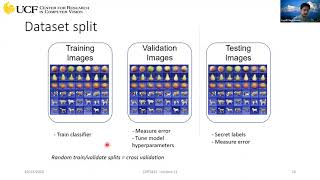
Computer Vision: Classification and Object Recognition - Lecture 11
Explore computer vision classification techniques, including object recognition, image classification, and machine learning frameworks. Learn about nearest neighbor and linear classifiers.
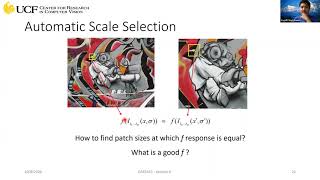
Computer Vision Features - Part 2 - Lecture 9
Explore advanced feature detection techniques including corner detection, HOG, and SIFT, focusing on their mathematical foundations and practical applications in computer vision.
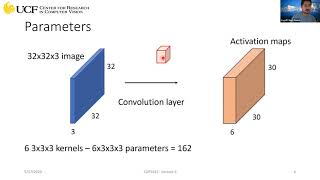
CAP5415 - Introduction to Convolutional Neural Networks Part 2 - Lecture 6
Explore convolutional neural networks' architecture, layers, and features. Learn about AlexNet, pooling, normalization, and the progression from low-level to complex features in deep learning.
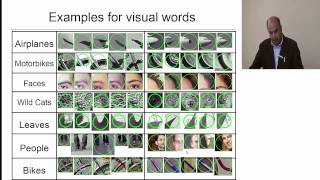
Bag of Words Model for Image Classification - Lecture 16
Explore bag-of-features for image classification, including feature extraction, quantization, and spatial pyramid matching. Learn about datasets and applications in scene and action recognition.
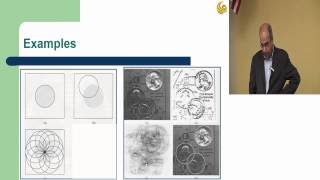
Hough Transform for Image Feature Extraction - Lecture 17
Explore image feature extraction, line fitting techniques, and the Hough Transform for shape detection in computer vision, including practical applications and challenges.
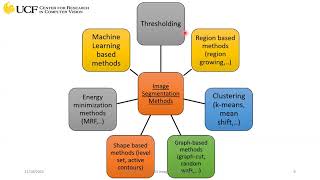
Image Segmentation Basics and Techniques - Lecture 23
Explore image segmentation basics, including binarization, thresholding, and region-based techniques. Learn algorithms, visualization methods, and practical applications in computer vision.
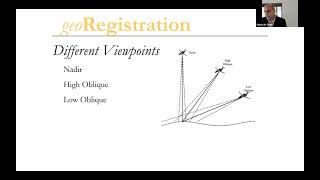
Cross-View Geo-Localization - Ground-to-Aerial Image Matching
Explore cross-view geo-localization techniques, focusing on ground-to-aerial image matching. Learn about approaches, limitations, and advancements in this field of computer vision.
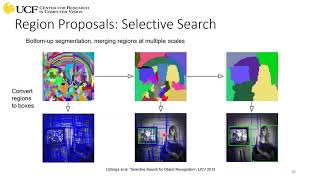
Object Detection in Computer Vision - Lecture 22
Explore advanced object detection techniques in computer vision, including R-CNN, Fast R-CNN, and Faster R-CNN. Learn about training processes, region proposals, and improvements in detection algorithms.
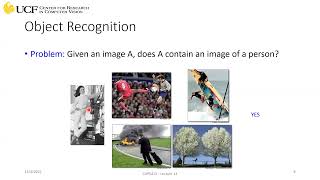
Object Detection Techniques - Part I - Lecture 20
Explore object detection techniques including sliding windows, pyramid construction, feature extraction, and post-processing. Learn about evaluation metrics like IoU, precision, and recall for assessing detection accuracy.
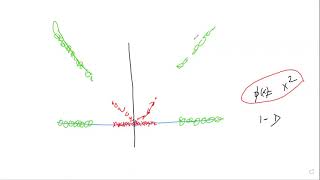
Classification in Computer Vision - Part II - Lecture 19
Explore advanced classification techniques in computer vision, including SVMs, neural networks, and fully convolutional networks. Learn about activation functions, loss functions, and optimization for effective model training.
Classification in Computer Vision - Lecture 18
Explore classification in computer vision, covering features, linear classification, nearest neighbor, decision boundaries, and maximum margin classifiers. Gain insights into fundamental algorithms and problem-solving approaches.
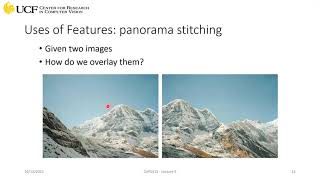
Features in Computer Vision - Lecture 14
Explore feature types, uses, and characteristics in computer vision, including matching, structure from motion, and panorama stitching. Learn about interest points and corner detection for keypoint applications.
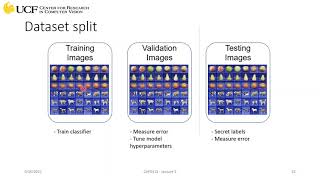
Introduction to Neural Networks for Computer Vision - Part I
Introduction to neural networks for computer vision, covering key concepts like pixel representation, feature extraction, and image classification. Explores biological inspiration and computational implementation of neural activation functions.

Unsupervised Cross-Domain Image Retrieval with Semantic-Attended Mixture-of-Experts
Explore unsupervised cross-domain image retrieval using semantic-attended mixture-of-experts, enhancing retrieval accuracy across diverse visual domains.