Statistical Rethinking
Comprehensive exploration of advanced statistical concepts and methods, emphasizing critical thinking and practical application in evolutionary anthropology research.
Steps Towards More Human-Like Learning in Machines - Josh Tenenbaum
Explore how machines can achieve more human-like learning through probabilistic programming, intuitive psychology, and simulation engines. Discover insights on core knowledge and one-shot learning in AI.

Computational Models of Cognition - Reverse-Engineering Common Sense in the Human Mind and Brain Pt 1
Explore cognitive modeling to reverse-engineer human common sense, examining AI progress, scientific context, and probabilistic programming techniques for capturing learning and constructing models.
Artificial Intelligence: Current State and Future Prospects - Keynote Conversation
Explore AI's current state, impact, and future with Noah Goodman and Jim Zemlin. Delve into open source's role, data's future, and the driving forces behind AI's rapid advancement.

Better Priors for Everyone - Keynote
Explore advanced techniques for improving prior distributions in probabilistic models, enhancing Bayesian inference across various applications.
PLSE Seminar Series - Willem Visser, "An Analytical Perspective on Mutations and Coverage"
Explores symbolic execution and model counting for analyzing mutations and coverage in software testing, discussing reachability, mutation operators, oracle precision, and probabilistic approaches.

Lower Bounds for Possibly Divergent Probabilistic Programs
Explore a new proof rule for verifying lower bounds on quantities of probabilistic programs, applicable to possibly divergent programs and non-trivial cases like three-dimensional random walks.

A Gradual Probabilistic Lambda Calculus
Explore a gradual probabilistic lambda calculus combining static and dynamic typing for probabilistic programming, enhancing flexibility in machine learning and differential privacy applications.

A Deductive Verification Infrastructure for Probabilistic Programs
Explore a novel deductive verification infrastructure for probabilistic programs, featuring an intermediate verification language and real-valued logic for quantitative property verification.
Probabilistic Programming with Programmable Variational Inference
Explore a modular approach to variational inference in probabilistic programming, enhancing expressiveness and enabling user-defined objectives with systematic gradient estimation transformations.
Inference of Probabilistic Programs with Moment-Matching Gaussian Mixtures
Explore a novel approach to probabilistic program inference using Gaussian mixtures, offering improved accuracy and efficiency for complex models and distributions.
Bayesian Inference Using Probabilistic Programming
Explore Bayesian inference techniques and probabilistic programming concepts with expert insights from Hong Ge at LAFI'24.
Asynchronous Probabilistic Couplings in Higher-Order Separation Logic
Explore asynchronous probabilistic couplings in higher-order separation logic, addressing synchronization issues in relational program logics for enhanced reasoning about probabilistic programs.

The Hamiltonian Monte Carlo Revolution Is Open Source - Probabilistic Programming with PyMC3
Explore Bayesian statistical computation and Hamiltonian Monte Carlo algorithms using PyMC3, an open-source probabilistic programming package. Learn to apply these advanced techniques to complex models in Python.
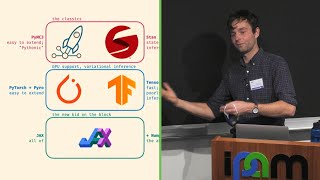
Methods for Scalable Probabilistic Inference - IPAM at UCLA
Explore scalable probabilistic inference methods for astrophysics, focusing on Gaussian Processes for time series analysis and open-source tools to accelerate Bayesian inference with large datasets.
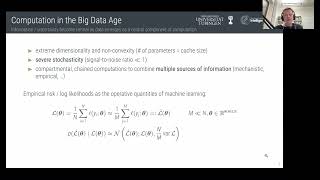
Probabilistic Numerics for Inference with Simulations
Explore probabilistic numerics for inference with simulations, covering high-dimensional models, numerical methods, and innovative approaches to machine learning challenges.

Probabilistic Programming
Explore probabilistic programming concepts, from intuitive physics to computational theory of mind, with hands-on practice in web-based probabilistic programming languages.
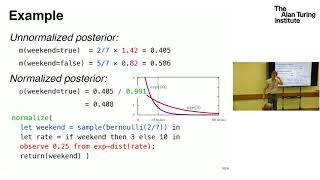
Semantic Models for Higher-Order Bayesian Inference - Sam Staton, University of Oxford
Explore probabilistic programming for Bayesian modeling, focusing on advanced languages with higher-order functions and continuous distributions. Learn about quasi-Borel spaces and modular inference algorithms.
Introduction to Machine Learning - Professor Zoubin Ghahramani, Cambridge University
Comprehensive overview of machine learning fundamentals by renowned expert, covering statistical approaches, Bayesian methods, deep learning, and automated data analysis techniques.
Lilac: A Modal Separation Logic for Conditional Probability
Explore Lilac, a novel separation logic for probabilistic programs, introducing a modality for conditional probability reasoning and validating its effectiveness through formal verification examples.
Bit Blasting Probabilistic Programs
Explore a novel approach to hybrid probabilistic programs using bit blasting for efficient discretization and inference. Learn about HyBit system and its benefits over existing methods.