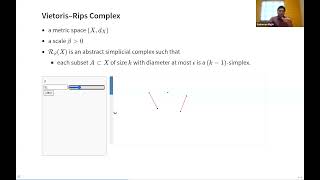
Demystifying Latschev's Theorem for Manifold Reconstruction
Explores quantitative approaches to Latschev's theorem for topological manifold reconstruction, advancing finite sample analysis in data science and manifold learning applications.
Deep Learning - Regularization Techniques - Lecture 4
Dive into advanced regularization techniques for deep learning, covering weight decay, early stopping, and noise injection methods to enhance model performance and prevent overfitting.
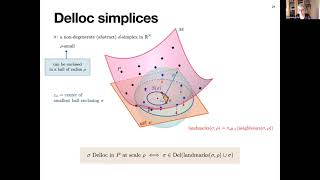
Reconstructing Manifolds by Weighted L_1-Norm Minimization
Innovative approach to shape reconstruction using weighted l_1-norm minimization, transforming triangulation into a convex optimization problem for smooth orientable manifolds in high-dimensional spaces.
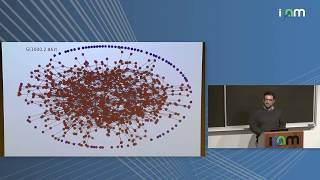
Quantifying the Topology of Coma
Explore a novel graph distance measure based on non-backtracking cycles, its relation to network features, and its application in distinguishing brain networks of healthy and comatose patients.
From Reinforcement Learning to Spin Glasses - The Many Surprises in Quantum State Preparation
Explore quantum state preparation, reinforcement learning, and spin glasses, uncovering surprising connections and insights in this cutting-edge physics research presentation.
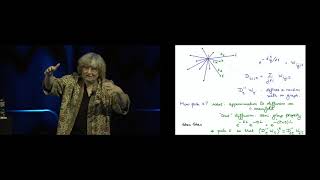
Mathematical Frameworks for Signal and Image Analysis - Diffusion Methods in Manifold and Fibre Bundle Learning
Explore advanced mathematical techniques for signal and image analysis, focusing on diffusion methods in manifold and fiber bundle learning with renowned mathematician Ingrid Daubechies.
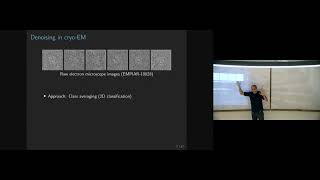
Manifold Denoising with Application to Electron Microscopy
Discover advanced manifold denoising techniques for electron microscopy image processing, focusing on Fourier-like basis construction and filtering methods to enhance two-dimensional image collections through mathematical analysis.
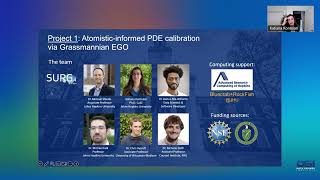
Leveraging Latent Representations for Predictive Physics-Based Modeling
Explore advanced techniques for leveraging latent representations in predictive physics-based modeling, focusing on surrogate models, inverse problems, and transfer learning for complex PDEs.

Geometry, Topology and Discrete Symmetries Revealed by Deep Neural Networks
Explore deep neural networks' ability to reveal geometry, topology, and discrete symmetries in manifolds. Learn about universal approximators and their applications in inverse problems and group actions.
Low Distortion Embeddings With Bottom-up Manifold Learning
Explore bottom-up manifold learning techniques for creating low distortion embeddings, enhancing data visualization and dimensionality reduction in signal processing applications.
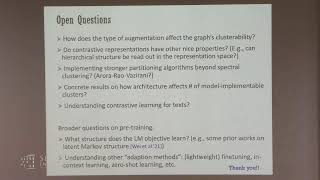
Understanding Generalization from Pre-training Loss to Downstream Tasks
Explore the mystery of pre-trained models' effectiveness, examining contrastive loss, embedding spaces, and the roles of inductive bias and optimizers in generalization to downstream tasks.
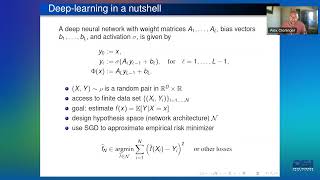
Networks that Adapt to Intrinsic Dimensionality Beyond the Domain
Explore neural networks' ability to adapt to intrinsic dimensionality, focusing on ReLU networks approximating functions with dimensionality-reducing feature maps. Gain insights into manifold learning and data analysis.
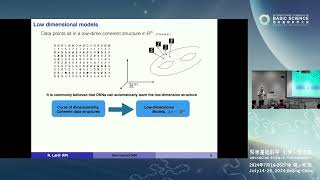
Learning Manifold-Structured Data Using Deep Neural Networks - Theory and Applications
Explore deep neural networks' ability to learn geometric data structures using multi-chart latent spaces and Chart Auto-Encoders, with theoretical foundations and practical applications.