Information Theory of Deep Learning - Naftali Tishby
Explores the connection between deep learning and information theory, offering new insights into neural network design, generalization, and optimization through an information bottleneck framework.
Iterated Models: Expressive Power, Learning, and Chain of Thought
Explore sequence-to-sequence models, focusing on transformers, their computational power, and learning complexities. Gain insights into iterated functions and chain of thought.
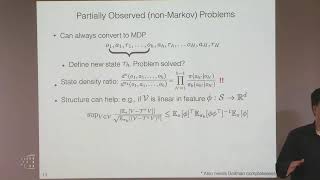
On the Curses of Future and History in Off-policy Evaluation in Non-Markov Environments
Delve into off-policy evaluation in non-Markov environments, exploring coverage concepts, future-dependent value functions, and novel estimators for partially observable MDPs with polynomial sample complexity guarantees.
Reinforcement Learning: An Introduction and Key Results
Découvrez les principes et applications du Reinforcement Learning, de la détection d'anomalies médicales à l'optimisation des processus décisionnels de Markov. Explorez les défis et solutions de cette approche d'apprentissage par interaction.
Multivariate Method of Moments: From Sample Complexity to Implicit Computations - 2023
Explore o método de momentos multivariados, sua complexidade amostral e cálculos implícitos na matemática aplicada e industrial, com insights da teoria pura.
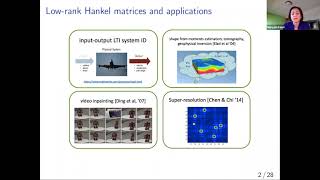
Learning Linear Dynamical Systems with Hankel Nuclear Norm Regularization
Explore finite-sample analysis and insights for learning low-order linear dynamical systems using Hankel nuclear norm regularization, with applications in control and reinforcement learning.
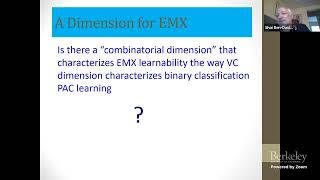
Learning Probability Distributions: What Can and Can't Be Done
Explore statistical learning, focusing on guaranteed generalizations from finite samples and characterizing learnable distribution families. Gain insights into modern paradigms in generalization.
Hypothesis Selection with Computational Constraints
Explore optimal tradeoffs between memory, sample complexity, and time in hypothesis selection algorithms for distribution matching, with focus on achieving near-optimal accuracy efficiently.
Proper vs Improper Quantum PAC Learning
Explore quantum PAC learning theory through a comparative analysis of proper and improper learning methods, focusing on the Quantum Coupon Collector problem and its padded variant.
Provable Advantage in Quantum PAC Learning
Discover groundbreaking research on quantum PAC learning, exploring provable advantages over classical methods with square root improvements in sample complexity and theoretical quantum information science.
Closed-form Analytic Expressions for Shadow Estimation with Brickwork Circuits
Explore closed-form analytical expressions for quantum shadow estimation using brickwork circuits, focusing on two-layer parallel two-local Haar-random unitaries and their practical implementations.
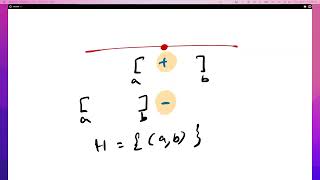
Machine Learning: Understanding VC Dimensions and Computational Learning Theory - Lecture 18
Delve into advanced computational learning theory concepts and VC dimensions, exploring fundamental principles that shape machine learning algorithm capabilities and limitations.

Machine Learning: Shattering and VC Dimension - Lecture 17B
Delve into computational learning theory, focusing on shattering concepts and VC dimension fundamentals in machine learning through theoretical frameworks and practical applications.

Machine Learning: Positive and Negative Learnability Results - Lecture 16
Explore key theoretical foundations of machine learning through positive and negative learnability results, enhancing your understanding of learning theory fundamentals.

Vapnik-Chervonenkis Theorem and Statistical Learning Theory
Dive into the fundamental Vapnik-Chervonenkis theorem, exploring how VC-dimension relates to machine learning generalization and error rates in hypothesis spaces.
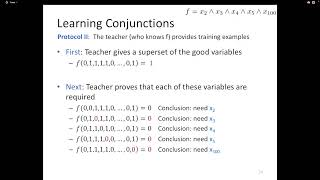
How Good is a Learning Algorithm? Quantifying the Learning Process - Lecture 7B
Explore the quantitative aspects of machine learning by examining how many examples are needed to effectively discover and validate hypotheses.
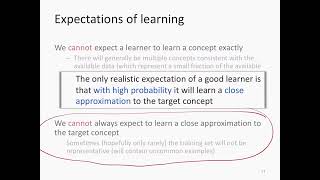
PAC Learning in Machine Learning Theory - Lecture 13
Explore the fundamental concepts of PAC (Probably Approximately Correct) learning theory and its applications in theoretical machine learning frameworks.
Beyond Worst-Case Analysis - Panel Discussion
Experts discuss advanced algorithmic analysis, exploring beyond worst-case scenarios to improve efficiency and understanding in computer science and machine learning applications.
Optimal Transport for Machine Learning - Gabriel Peyre, Ecole Normale Superieure
Explore optimal transport in machine learning, covering Kantorovitch's formulation, entropic regularization, and applications in generative models and GANs. Gain insights into cutting-edge advances in data science.
Reinforcement Learning in Feature Space: Complexity and Regret
Explore reinforcement learning in feature space, focusing on complexity, regret analysis, and innovative approaches like MatrixRL. Learn about state feature mapping and its applications in real-world scenarios.
Exploration with Limited Memory - Streaming Algorithms for Coin Tossing, Noisy Comparisons, and Multi-Armed Bandits
Explore streaming algorithms for coin tossing, noisy comparisons, and multi-armed bandits, focusing on limited memory scenarios and efficient problem-solving techniques.