Robot Learning in the Era of Large Pretrained Models - Stanford Seminar
Exploring interactive robot learning with large pretrained models, focusing on visual representations, data collection strategies, and leveraging language models for robotics applications.

On Building General, Zero-Shot Robot Policies - EI Seminar
Explore the development of zero-shot robot policies for real-world tasks. Gain insights into Robot Utility Models (RUMs) and their ability to generalize to new environments without finetuning, achieving 90% success in novel settings.
Imitation Versus Innovation - What Children Can Do That Large Language Models Can't
Explore the unique cognitive abilities of children in comparison to AI language models, focusing on imitation and innovation in learning and problem-solving processes.
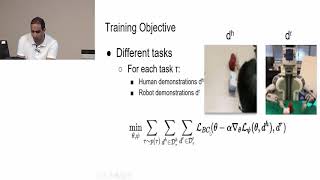
One-Shot Imitation from Observing Humans via Domain-Adaptive Meta-Learning
Learn domain-adaptive meta-learning for one-shot imitation, enabling robots to quickly learn new tasks by observing human demonstrations and adapting across domains.
Generalization in Robotic Behavior Cloning: Pitfalls and Promises
Explore challenges and solutions in robotic behavior cloning, focusing on generalization in continuous state/action spaces. Gain insights into frameworks enabling agents to imitate complex behaviors with provable guarantees.
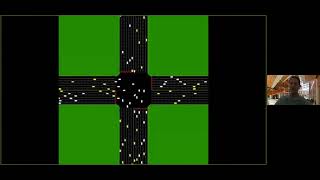
Efficient Robot Skill Learning via Grounded Simulation Learning, Imitation Learning - Peter Stone
Explore efficient robot skill learning through grounded simulation, imitation learning, and off-policy reinforcement learning. Discover innovative approaches for transferring skills from simulation to real-world robots.
What Does It Take to Be a Good Fisherman?
Explore statistical challenges in learning from biased data, focusing on self-selection issues in various fields and discussing recent progress in econometric modeling and auction theory.
Updates from NVIDIA's Seattle Robotics Lab - Task and Motion Planning, Visuomotor Transformers, and Fine-grained Robot Manipulation
Explore cutting-edge robotics research from NVIDIA's Seattle lab, covering task and motion planning, visuomotor transformers, and fine-grained manipulation techniques for advanced robotic applications.
Scaling Probabilistically Safe Learning to Robotics
Explores advancements in safe robot learning, focusing on imitation learning theory, scalable reward inference, and efficient policy evaluation to enable real-world deployment with safety guarantees.
Interactive Imitation Learning - Planning Alongside Humans
Explore interactive imitation learning for robots to adapt to human preferences, focusing on challenges beyond dataset collection and enabling seamless human-robot collaboration in real-world scenarios.

HumanPlus and MobileAloha - Humanoid Shadowing and Bimanual Mobile Manipulation - Tech Talk 6
Exploración de HumanPlus y MobileAloha: avances en robótica humanoide e imitación de movimientos humanos para manipulación bimano móvil y teleoperación de bajo costo.
ALOHA and ACT: Advancing Robot Learning - Research Presentation 1
Explore ALOHA and ACT methodologies for robotic learning, presented by Alexander Soare. Gain insights into cutting-edge research and advancements in robot manipulation techniques.
Robots Learning Through Interaction
Explore robot learning through interaction, covering supervised, imitation, reinforcement, and interactive learning methods. Gain insights into motor skill acquisition and human-robot collaboration.
Generalizable Robotic Agents Through Large-Scale Simulation
Explore how large-scale simulation training produces proficient robotic agents capable of real-world navigation and manipulation using only RGB sensors, guided by language instructions.
Learning Abstractions from Humans for Generalizable Robot Learning
Explore methods for integrating human knowledge into robot learning abstractions, focusing on feedback as a prior, personalized interface, and framework for user-aligned reward functions.

Data-Driven Fine Manipulation: Pushing Boundaries in Robotic Precision
Explore data-driven solutions for fine robotic manipulation, enabling low-cost hardware to perform intricate tasks with superhuman precision using imitation and reinforcement learning techniques.
Strategic Deviations in Multi-Agent Imitation Learning: From Value Optimization to Regret Analysis
Delve into the complex dynamics of multi-agent AI systems, exploring strategic deviations, regret gaps, and equilibrium concepts in imitation learning through practical applications and mathematical frameworks.
Behavior Cloning and Residual Reinforcement Learning for Visual Assembly
Explore advanced imitation learning techniques combining behavior cloning with reinforcement learning for autonomous robotic systems, focusing on precise visual assembly and sim-to-real transfer applications.
Adapting Image-based Reinforcement Learning Policies via Predicted Reward Fine-Tuning
Explore groundbreaking research on Predicted Reward Fine-Tuning (PRFT), a novel approach solving domain shift challenges in image-based reinforcement learning and sim-to-real AI transfer.
This AI Learns from YouTube
Explore OpenAI's innovative approach to training AI agents using YouTube videos, focusing on Minecraft gameplay and combining imitation learning with reinforcement learning techniques.
AMP- Adversarial Motion Priors for Stylized Physics-Based Character Control
Explores adversarial imitation learning for physics-based character control, combining goal-achieving reinforcement learning with style imitation from motion datasets to produce realistic, task-oriented behaviors.