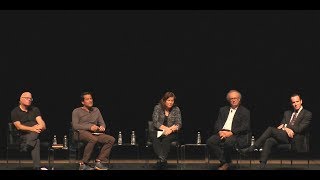
The Complexity of Economics - Exploring Markets as Complex Adaptive Systems
Explore the intersection of complexity science and economics with experts discussing agent-based modeling, behavioral economics, and machine learning to gain insights into real-world economic systems.
Probabilistic Topic Models and User Behavior
Explore latent thematic structures in document collections and user behavior data. Learn how topic modeling algorithms can enhance predictions and understanding of collection organization.
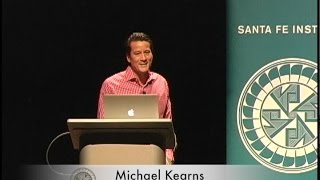
Machine Learning and Social Norms - Balancing Fairness and Accuracy
Machine learning's impact on social decisions: Exploring fairness, privacy, and accountability in algorithmic decision-making across various domains. Discusses recent research and challenges in embedding social norms into predictive algorithms.

All Watched Over by Machines of Loving Grace - The Future of Biological Intelligence
Explore the future of biological intelligence in a world of distributed machine intelligence and potential cultural mechanisms surpassing human analytical capabilities.
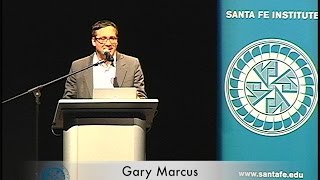
Smart Machines and What They Can Still Learn from People
Cognitive scientist Gary Marcus explores AI's progress, challenges, and potential lessons from human cognition, offering insights into the future of machine intelligence.
Using Buckingham's Π Theorem for Dimensionless Similarity Parameters in Macroecology
Explore dimensionless similarity parameters in macroecology using Buckingham's Π theorem, presented by Sandra Chapman from the University of Warwick.
Automated Recognition of Visual Situations in Images
AI architecture for recognizing visual situations in images, using learned models of object features and spatial relationships to actively search and score images for specific situations.
Blessings of Dimensionality for Gaussian Latent Factor Models
Explore how high-dimensional data analysis can benefit from restricted latent factor overlaps, with applications in brain fMRI and financial markets.

Parables from Complex Systems and Their Possible Meanings for Our Lives - Lecture 2
Explore complex systems through parables, examining prediction models, chaos theory, and market dynamics to gain insights applicable to everyday life and decision-making.
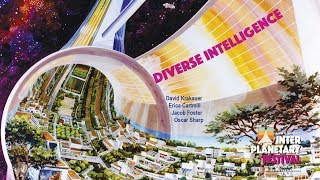
Diverse Intelligence - From Human Minds to Complex Systems
Exploring diverse forms of intelligence: from human evolution to complex systems and future discoveries. Experts discuss biological, artificial, and collective intelligence across species and technologies.
The Statue in the Stone: How Dynamical Systems Discover Environmental Patterns
Explores how complex systems adapt to environmental patterns, favoring stable configurations that match external forces. Illustrates with toy models and swarm-robotics experiment.
Unifying the Study of Biodiversity Across Timescales - What a MESS!
Explore a mechanistic model of community assembly that integrates macro-ecology, phylogeography, and macro-evolution to predict biodiversity patterns and infer complex histories of island assembly.
The Future of Artificial Intelligence
Demystifying AI: its current capabilities, true intelligence, and future prospects. Expert insights on expectations and concerns for near-term and long-term AI developments.

Large Language Models and the Changing Face of Computational Linguistics
Explore the impact of Large Language Models on computational linguistics, discussing their transformative effects and future implications for language processing and understanding.
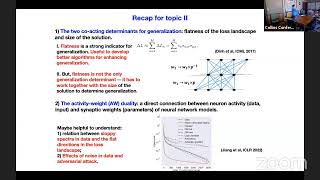
Stochastic Learning Dynamics and Generalization in Neural Networks
Explore stochastic learning dynamics and generalization in neural networks, uncovering key insights into their behavior and performance in various applications.
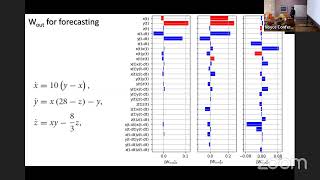
Next-Generation Reservoir Computing
Explore cutting-edge advancements in reservoir computing, a powerful machine learning technique for processing sequential data and solving complex temporal problems.
Prediction, Explanation, and Control - From AI to Human Mind
Explore the connections between AI and human cognition, focusing on prediction, explanation, and control mechanisms in both artificial and biological intelligence systems.
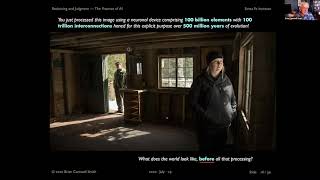
Reckoning and Judgment: The Promise of AI
Explore the distinction between AI's calculative "reckoning" and human "judgment," examining the potential and limitations of machine intelligence in ethical decision-making.
Geoffrey West on Scaling, Open-Ended Growth, and Accelerating Crisis/Innovation Cycles
Geoffrey West explores scaling laws in cities, discussing how urban environments amplify human creativity and challenges, and examines the accelerating cycle of crisis and innovation driving our global economy towards potential peril.
Scaling Laws and Social Networks in the Time of COVID-19 - Part 1
Exploring scaling laws in biology, cities, and economies, and their implications for societal challenges like pandemics and sustainability. Insights from complex systems science for understanding human civilization.
Fairness in Machine Learning: Tasks, Experiences, and Performance Measures
Explore fairness in machine learning, focusing on risk assessment tasks, data representation challenges, and performance measures. Learn about new findings and alternative approaches to promote equitable AI systems.