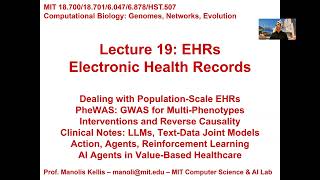
Machine Learning for Computational Biology: Electronic Health Records - Lecture 19
Dive into machine learning applications for Electronic Health Records (EHRs), exploring computational biology approaches and data analysis techniques for healthcare systems.

Is AI Progress Stuck? - Evaluating Current Artificial Intelligence Advancement Claims
Explore a critical analysis of AI's current state as computer scientist Jennifer Golbeck examines major claims about artificial intelligence, separating genuine breakthroughs from exaggerated promises.

Understanding AI Agents as Neuro-Symbolic Systems
Explore the concept of AI agents as neuro-symbolic systems through an analysis of MRKL paper, examining their definition, evolution, and relationship with connectionism and modern AI architectures.
Build Your Own CoPilot Using Azure OpenAI and Semantic Kernel
Discover how to create custom AI CoPilots using Azure OpenAI and Semantic Kernel, from understanding model training fundamentals to implementing personalized solutions for internal applications.
Why Diverse Data is Essential for Inclusive Generative AI
Explore how diverse datasets in generative AI development can create more equitable and inclusive systems, addressing bias mitigation and accessibility across different cultures and languages.

Why Larger Language Models Struggle with Subjective Reasoning
Explore how larger language models handle subjective tasks, examining their limitations in emotion and morality recognition despite advanced prompting techniques and increased model sizes.
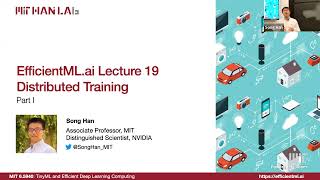
Distributed Training Methods and Parallelization Techniques - Lecture 19
Explore advanced distributed training concepts, from data parallelism and communication primitives to pipeline, tensor, and sequence parallelism methods for efficient machine learning systems.
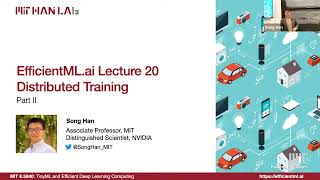
Distributed Training: Hybrid Parallelism and Gradient Optimization - Lecture 20
Delve into advanced distributed training concepts, covering hybrid parallelism, gradient compression techniques, and strategies for optimizing bandwidth and latency in ML systems.

EfficientML.AI - Introduction to Efficient Machine Learning
Master efficient machine learning techniques and optimization strategies for deploying ML models in resource-constrained environments, focusing on practical implementation methods and performance enhancement.
Distributed Training: Hybrid Parallelism and Gradient Optimization - Lecture 20
Delve into advanced distributed training concepts, exploring hybrid parallelism, gradient compression techniques, and strategies to overcome bandwidth and latency bottlenecks in ML systems.

Automatically Deriving Adjectival Scales from Neural Network Language Models - 2013
Discover how computational linguistics can derive meaning from adjective scales, using web data and neural networks to understand gradable modifiers in everyday language and medical contexts.

Encoder-Only Transformers: Understanding BERT and RAG Architecture
Discover how encoder-only transformers power RAG, sentiment analysis, and classification through clear explanations of word embedding, positional encoding, and attention mechanisms.
GPU Sharing and Container Device Interface in Kubernetes Device Plugins
Dive into GPU resource management in Kubernetes, exploring Container Device Interface (CDI), device plugin architecture, and various GPU sharing mechanisms for optimized AL/ML workload performance.
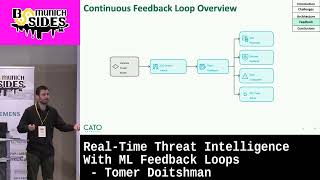
Real-Time Threat Intelligence with Machine Learning Feedback Loops
Discover how machine learning feedback loops enhance real-time threat intelligence systems, improving cybersecurity detection and response capabilities through automated learning mechanisms.

Enhancing Custom IDEs with AI: Strategies, Use Cases, and Pitfalls - OCX 2024
Discover strategies for integrating AI into custom IDEs, from selecting use cases and models to implementing natural language workflows and context-aware features for enhanced development productivity.
Sustaining Git Performance Under Heavy Workloads - An AI-Driven Approach
Discover how AI-driven maintenance strategies optimize Git repository performance under heavy workloads, focusing on efficient solutions beyond traditional GC and geometric repacking methods.
Vector Databases: A New Search Paradigm - OCX 2024
Explore how vector databases revolutionize information search through multidimensional data representation, with hands-on examples using Milvus, Weaviate, and Neo4J for enhanced data analysis.
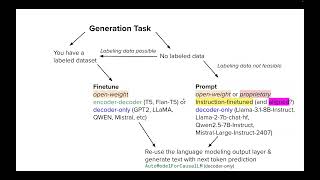
Abstractive Summarization and Text Generation Evaluation
Explore advanced techniques in abstractive summarization and learn effective methods for evaluating text generation outputs in natural language processing.
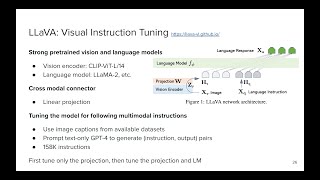
Vision and Language Large Language Models
Explore the intersection of vision and language in Large Language Models, understanding their capabilities, architectures, and real-world applications in AI systems.
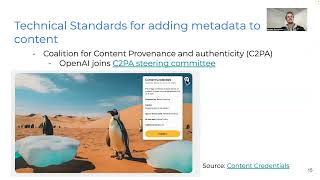
Detecting AI-Generated Content - Advances in Generative AI
Explore cutting-edge techniques for detecting AI-generated content, focusing on latest methodologies, challenges, and practical applications in content authentication and verification.
Evaluating World Models in Generative AI - A Critique of AI Intelligence Assessment
Explore groundbreaking research from top universities challenging AI evaluation methods, revealing limitations in language models' structural understanding and proposing new assessment frameworks.