
The Emergence of Essential Sparsity in Large Pre-trained Models
Explore essential sparsity in large pre-trained models, examining efficient handling of complex transformers and the impact of weight removal on performance.

Distill Whisper Explained - Robust Knowledge Distillation for Speech Recognition
Explore Distill-Whisper: a compact, efficient speech recognition model. Learn about its robust knowledge distillation, large-scale pseudo labelling, and performance compared to the larger Whisper model.

OpenMoE: An Early Effort on Open Mixture-of-Experts Language Models
Explore OpenMoE, an open-source Mixture-of-Experts language model series. Discover its cost-effectiveness, routing mechanisms, and key insights in comparison to dense LLMs.

DSPy Explained - Compiling Declarative Language Model Calls into Self-Improving Pipelines
Explore DSPy, a programming model for LM pipelines that enables self-improving AI systems through declarative modules and computational graphs. Learn its potential to enhance AI performance.
LayerSkip: Enabling Early Exit Inference and Self-Speculative Decoding
Explore LayerSkip, an LLM acceleration method that speeds up inference by strategically restricting model layers, achieving 2x speed-ups on various tasks through innovative techniques.

ReFT: Representation Finetuning for Language Models Explained
Explore ReFT, a novel approach to fine-tuning language models by modifying internal representations, achieving efficiency with fewer parameters than traditional methods.

Towards Monosemanticity: Decomposing Language Models with Dictionary Learning
Explore monosemanticity in neural networks through sparse autoencoders. Learn how extracting interpretable features enhances understanding of language model behavior and improves reasoning capabilities.

Complex Agentic RAG Systems - Overcoming Limitations of Traditional RAG
Explore advanced agentic RAG systems with expert Atita Arora, overcoming traditional limitations and revolutionizing information retrieval for AI and machine learning applications.
Hierarchical Prompting Taxonomy - A Universal Evaluation Framework for Large Language Models
Explore a universal evaluation framework for large language models using Hierarchical Prompting Taxonomy. Gain insights into assessing dataset complexity and model capabilities.

Knowledge Circuits in Pretrained Transformers Explained
Explore knowledge circuits in pretrained transformers, uncovering computational mechanisms behind language models' articulation of specific knowledge. Gain insights into AI's inner workings.
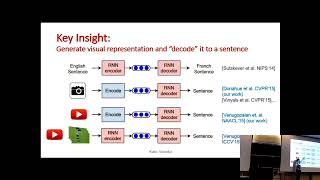
Connecting Vision and Language End-to-End - 2018
Explore neural models for vision-language understanding, focusing on End-to-End Module Networks and dense video captioning. Learn about interpretable, compositional approaches to visual question answering.

Reducing Confusions and Ambiguities in Speech Translation - 2005
Explore techniques to enhance speech translation by addressing accent-related confusions, named entity recognition, and semantics-based disambiguation for improved accuracy and understanding.
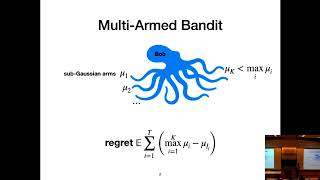
Adversarial Machine Learning: Beyond Manipulating Pixels and Words
Explore vulnerabilities in sequential machine learning and challenge assumptions about imperceptible attacks on image classification through human behavioral studies.

Tutorial on Hidden Markov Models - Part 2
Explore advanced concepts of Hidden Markov Models, including applications and algorithms, in this in-depth continuation of Jason Eisner's tutorial series.
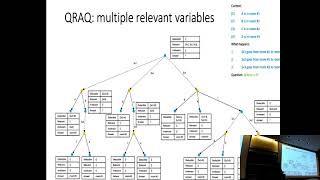
Deep Reinforcement Learning for Sequential Decision Making Tasks with Natural Language Interaction
Explore deep reinforcement learning applications in natural language tasks, focusing on querying ambiguous texts and navigating 3D mazes with unseen instructions using hierarchical architectures.
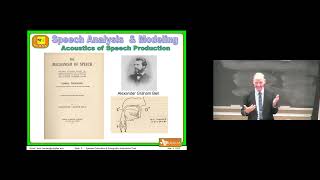
Challenges and Advancements in Speaker Diarization and Recognition for Naturalistic Data
Explore advancements in speech technology for analyzing human interactions, focusing on child learning spaces and NASA APOLLO missions. Gain insights into ML-based audio processing and diarization techniques.
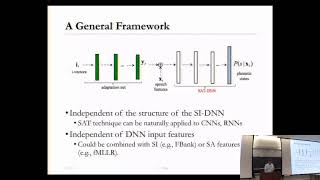
Visual Features for Context-Aware Speech Recognition - 2016
Explore visual features for context-aware speech recognition, improving transcription of consumer-generated multimedia content by adapting acoustic and language models to detected objects and scenes.
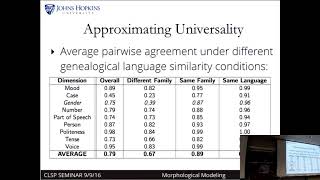
Rich Morphological Modeling for Multi-lingual HLT Applications - 2016
Explore advanced morphological modeling techniques for diverse languages, enhancing HLT applications through innovative approaches like neural networks and cross-lingual projection.
Improving Conversational Interactions through Visually Situated Context
Explore how visual context enhances conversational AI accuracy. Learn about augmentation strategies, grounding techniques, and recent advancements in language models for more effective human-machine interactions.
Practical Linguistically Motivated Parsing
Explore linguistically motivated parsing techniques with Stephen Clark, focusing on practical applications and advanced methodologies in natural language processing.
Personalized Speech Enhancement: Data- and Resource-Efficient Machine Learning
Explore data-efficient machine learning techniques for personalized speech enhancement, focusing on modularized models and self-supervised learning to achieve user-specific improvements with minimal data.