Artificial Intelligence and Machine Learning - An Introduction to Core Concepts and Applications
Discover the fundamentals of AI and ML, exploring core components, real-world applications, future trends, and key challenges in technology transformation across multiple industries.

Tensors of Minimal Border Rank and Their Role in Matrix Multiplication Complexity
Delve into advanced algebraic geometry concepts exploring minimal border rank tensors and their crucial role in matrix multiplication complexity theory and computational mathematics.
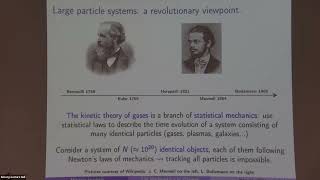
Challenges and Breakthroughs in the Mathematics of Plasmas
Explore fundamental mathematical concepts in plasma physics, focusing on Vlasov equations, kinetic theory, and new Wasserstein-type distances for analyzing charged particle behavior.
Automating Data Integration with Machine Learning
Discover how machine learning techniques can streamline and automate data integration processes, enhancing efficiency and reducing manual effort in data management workflows.
NVIDIA HYMBA: A Hybrid-Head Architecture for Small Language Models with MetaTokens
Explore NVIDIA's Hymba hybrid architecture combining transformer attention and state-space models, featuring innovative meta tokens and memory optimizations for enhanced language model performance and efficiency.
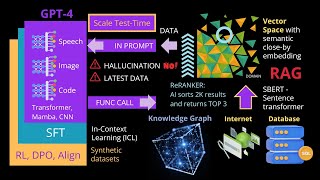
A Brief History of AI and AI Agents - From Language Models to Multi-Agent Systems
Explore the evolution of AI from GPT-3 to modern multi-agent systems, covering key developments in language models, function calling, AI agents, and future implications for global artificial intelligence.

TokenFormer - Rethinking Transformer Scaling with Tokenized Model Parameters
Delve into an innovative approach to transformer architecture scaling that treats model parameters as tokens, enabling flexible parameter adjustments without complete retraining from scratch.
Choosing the Right LLM - A Framework for Model Evaluation and Selection
Discover a systematic approach to evaluating and selecting Large Language Models for specific tasks, focusing on practical frameworks and custom testing methods for optimal results.
Learning in a Dynamic World: From PAC to Prospective Learning Theory
Explore dynamic learning theory and its evolution beyond PAC learning, examining how AI systems can adapt to changing data distributions and goals while maintaining performance over time.
Deep Learning, Correlations, and the Statistics of Natural Images
Explore how Deep Neural Networks leverage statistical patterns in natural images and diverse datasets, examining their remarkable ability to identify and utilize robust correlational structures.
Fine-tuning T5-Large Model for Text Summarization with MLFlow
Master fine-tuning T5-Large models for text summarization using MLflow, covering model tracking, logging, and specialized training techniques for enhanced summarization capabilities.
Converting T5 Large Models to ONNX Format and 8-bit Quantization with MLflow and Optimum
Master model optimization techniques by converting T5 Large to ONNX format and implementing 8INT quantization using Hugging Face Transformers Optimum, with MLflow integration for text summarization tasks.
MLOps with MLFlow: Evaluating and Quantizing Fine-Tuned LLM Models
Discover how to evaluate fine-tuned LLMs using MLflow, convert models to ONNX format, and implement INT8 quantization for optimized performance and deployment.
Introducing Firebase Genkit - Adding AI-Powered Features to Node.js and Go Backends
Master Firebase Genkit's framework for building AI-powered backends in Node.js and Go, including LLM integration, RAG implementation, testing tools, and production deployment strategies.
Build AI Apps in 5 Minutes - Live Demo with Vercel AI SDK, v0.dev, and RAG
Dive into rapid AI app development using Vercel AI SDK, v0.dev, and RAG through a practical demonstration showcasing how to build and deploy powerful AI applications in minutes.
Weakly Supervised Learning for Adaptive Language Learning Model Agents
Explore cutting-edge techniques for training adaptable LLM agents through weakly supervised learning, focusing on frameworks like Agent Lumos and innovative approaches to enhance generalization capabilities.
Probabilistic Inference in Language Models via Twisted Sequential Monte Carlo
Explore advanced probabilistic inference techniques for Large Language Models using Sequential Monte Carlo methods, focusing on safety, capability enhancement, and evaluation frameworks.
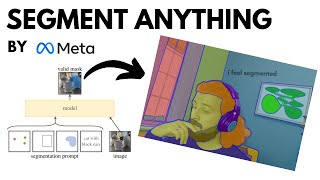
Segment Anything Model (SAM) - Deep Dive into Meta's Image Segmentation Foundation Model
Dive into Meta's Segment Anything Model (SAM), exploring its architecture, implementation, and zero-shot capabilities for advanced image segmentation tasks through detailed code analysis and practical demonstrations.
Dynamical Systems and Reservoir Computing - Lecture 1
Explore dynamical systems and reservoir computing applications in climate network analysis, focusing on methods for understanding and predicting climate patterns and phenomena.
Dynamical Systems and Reservoir Computing - Lecture 2
Delve into dynamical systems and reservoir computing applications in climate networks, focusing on analysis methods, bifurcation behavior, and network characterizers for climate data organization.
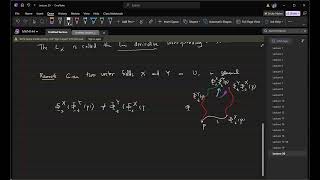
Lie Groups and Quantization - Lecture 20
Delve into advanced mathematical concepts exploring Lie groups and quantization theory, focusing on their interconnections and applications in theoretical physics and geometry.