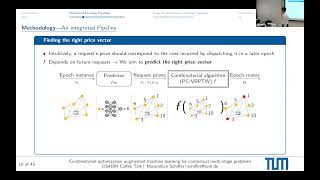
Combinatorial Optimization Augmented Machine Learning for Contextual Multi-Stage Problems
Explore combinatorial optimization augmented machine learning for contextual multi-stage problems, focusing on industrial applications and dynamic stochastic optimization challenges.
Generalizations of Matrix Multiplication for Solving the Light Bulb Problem
Explore a novel approach to solving the Light Bulb Problem using tensor-based algorithms, potentially outperforming traditional matrix multiplication methods for faster data analysis and pattern recognition.

Finite Time Singularities in Fluids
Explorez les singularités en temps fini dans les fluides, en examinant les résultats récents et classiques, les preuves assistées par ordinateur et les applications de l'apprentissage automatique.
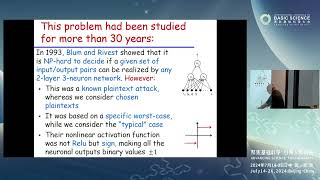
Polynomial Time Cryptanalytic Extraction of Neural Network Models
Explore polynomial-time techniques for extracting neural network parameters, improving upon previous methods and demonstrating practical efficiency on a CIFAR10 classifier.
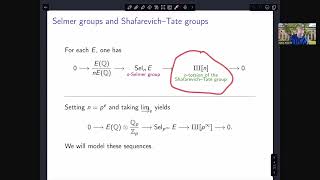
Heuristics for the Arithmetic of Elliptic Curves and Abelian Varieties
Explore probabilistic models for elliptic curve arithmetic, examining theoretical evidence and predictions for higher-dimensional abelian varieties.
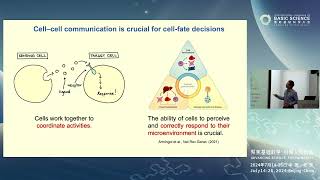
Modeling and Analyzing Cell-Cell Communication from Single-Cell Data
Explore CellChat, an integrated method for inferring and analyzing cell-cell communication from single-cell sequencing data using systems biology and machine learning approaches.
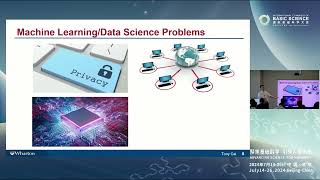
Federated Learning for Nonparametric Function Estimation - Framework and Optimality
Explore federated learning for nonparametric regression, focusing on statistical optimality, privacy preservation, and the balance between accuracy and data protection in distributed settings.
Geometric Deep Graph Learning: Exploring Opportunities in Different Geometric Spaces
Explore geometric deep graph learning in non-Euclidean spaces. Discover properties of hyperbolic and hyperspherical spaces for enhanced graph representation and analysis across various applications.
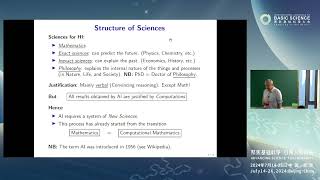
Optimization: The Philosophical Background of Artificial Intelligence
Explore optimization's role in AI, computational models, and its impact on modern science. Gain insights into efficient optimization schemes related to human activity.
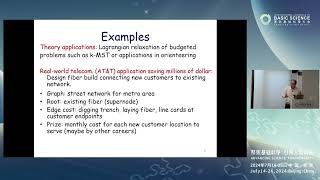
Classic Problems with Modern Techniques - Prize-collecting Framework
Explore state-of-the-art approximation algorithms for classic network design problems using modern techniques, from clustering to recursive methodologies.
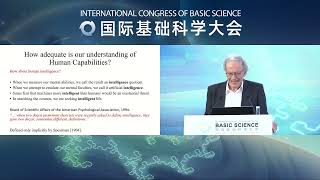
Educability: Defining and Simulating Human Capabilities - ICBS 2024
Explore "educability" as a defining human capability, synthesizing learning from experience and others to explain humanity's achievements and guide future technology development.
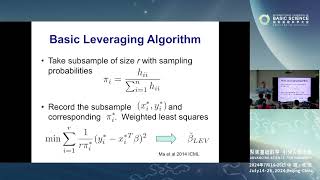
Small but Mighty: Subset Selection and Knowledge Distillation
Explore cost-efficient AI training methods, focusing on subset selection and knowledge distillation techniques to address challenges in large language model development.
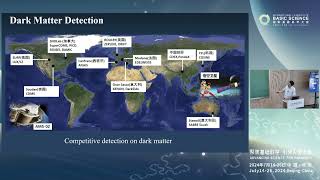
Comparative Lattice Analysis of SU(2) Dark Glueball
Explore SU(2) glueballs as dark matter using lattice simulations. Compare traditional and machine learning methods for mass calculation and scattering cross-section analysis.
Computational Quantum Mechanics in Phase Space - An Attempt to Break the Curse of Dimensionality
Explore computational quantum mechanics in phase space, focusing on breaking the curse of dimensionality through grid-based and particle-based methods for high-dimensional Wigner quantum dynamics simulations.
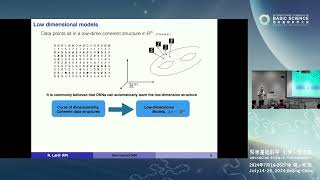
Learning Manifold-Structured Data Using Deep Neural Networks - Theory and Applications
Explore deep neural networks' ability to learn geometric data structures using multi-chart latent spaces and Chart Auto-Encoders, with theoretical foundations and practical applications.
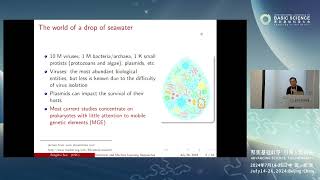
Statistical and Machine Learning Approaches for Investigating Viruses and Virus-Host Interactions
Explore statistical and machine learning methods for identifying novel viruses and virus-host interactions in metagenomic studies, enhancing understanding of microbial communities.
AI on the Edge - Advancing Edge Computing and Next-Generation Networks
Explore AI's role in advancing edge computing and next-gen networks. Discover opportunities for AI on the edge in DOD Microelectronics Commons Program.

Self-Play Fine-Tuning Converts Weak Language Models to Strong Language Models
Explore a novel fine-tuning method for Large Language Models that improves performance without additional human-annotated data, using self-play mechanisms and theoretical guarantees.
Multimodal Machine Intelligence and Health
Explore multimodal machine intelligence applications in medical sciences and health research, addressing challenges in creating trustworthy, inclusive AI for clinical and quality of life domains.
An Open Source Approach to Build Guardrails for Deploying ML Models in Healthcare
Explore an open-source framework for responsible ML deployment in healthcare, focusing on evaluation and monitoring across patient sub-populations.
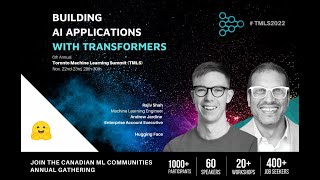
Building AI Applications with Transformers
Learn to leverage transformers for AI applications like auto-completion, semantic search, and document AI using open-source tools and models. Explore embeddings, Generative AI, and emerging trends in multimodal and large language models.