The Elusive Generalization: Classical Bounds to Double Descent to Grokking
Explore the evolution of generalization in machine learning, from classical bounds to double descent and grokking, challenging traditional assumptions and practices in the field.
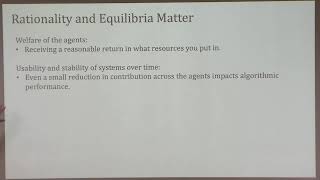
A Theory of Multi-objective Machine Learning
Explore multi-objective learning as a unifying paradigm for robustness, collaboration, and fairness in machine learning, with technical tools and empirical evidence.
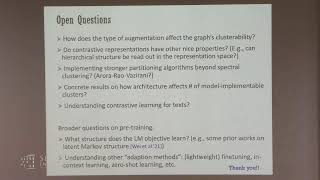
Understanding Generalization from Pre-training Loss to Downstream Tasks
Explore the mystery of pre-trained models' effectiveness, examining contrastive loss, embedding spaces, and the roles of inductive bias and optimizers in generalization to downstream tasks.
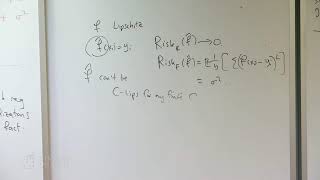
Prediction, Generalization, and Complexity in Statistical Decision Theory - Part 2
Explore statistical decision theory's insights on prediction error, generalization gap, and model complexity. Examine fixed-X vs. random-X perspectives and their implications for machine learning.
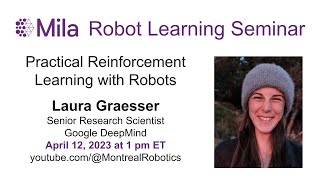
Practical Reinforcement Learning with Robots
Explore practical reinforcement learning for robotics, covering environment design in simulation and real-world applications, with insights on implementing RL in robotic systems.
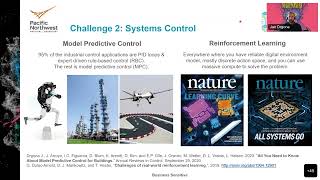
Differentiable Programming for Modeling and Control of Dynamical Systems
Explore differentiable programming for optimal control of dynamical systems, focusing on differentiable predictive control and its applications in building control and power systems optimization.
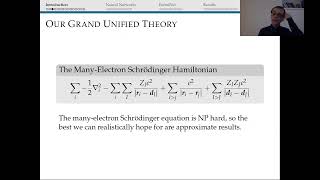
Solving the Many-Electron Schrödinger Equation with Deep Neural Networks
Explore deep neural networks for solving complex quantum mechanical equations in many-electron systems, advancing computational physics and materials science.
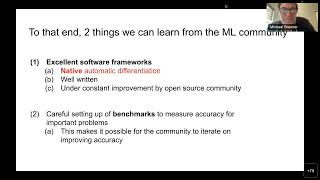
Scientific Uses of Automatic Differentiation - DDPS
Explore automatic differentiation's scientific applications beyond machine learning. Discover innovative approaches in PDEs, self-assembly, fluid dynamics, and protein modeling using large-scale optimization.
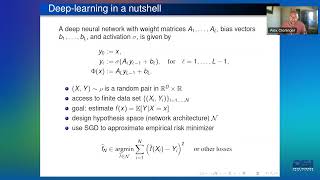
Networks that Adapt to Intrinsic Dimensionality Beyond the Domain
Explore neural networks' ability to adapt to intrinsic dimensionality, focusing on ReLU networks approximating functions with dimensionality-reducing feature maps. Gain insights into manifold learning and data analysis.
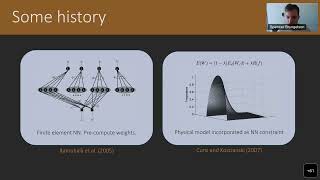
Competitive Physics Informed Networks - Overcoming Limitations in PDE Solutions
Explore competitive physics-informed neural networks for solving PDEs with unprecedented accuracy. Learn about adversarial approaches and zero-sum games to achieve single-precision accuracy in numerical simulations.
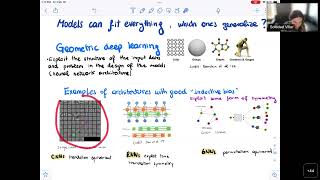
The Passive Symmetries of Machine Learning
Explore passive symmetries in machine learning, their implications, and implementation as group equivariances. Gain insights on generalization and links to causal modeling.
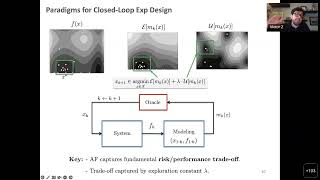
Bayesian Optimization: Exploiting Machine Learning Models, Physics, and Throughput Experiments
Explore new Bayesian Optimization paradigms leveraging machine learning, physics, and high-throughput experiments. Learn to accelerate searches, enable parallel exploration, and utilize large-scale models for various applications.
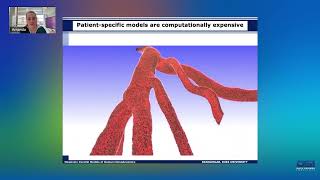
Using Data Science to Advance the Impact of Vascular Digital Twins in Medicine
Explore high-resolution digital twins of vascular anatomy to inform disease treatment. Learn how data science and physics-based modeling combine to address personalized medicine challenges.
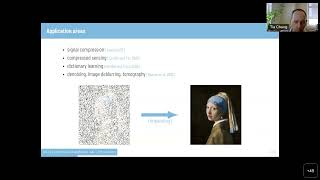
Big Data Inverse Problems - Promoting Sparsity and Learning to Regularize
Explore novel methods for solving big data inverse problems, focusing on sparse representation and L1 regularization. Learn about variable projection and deep neural networks for parameter optimization.
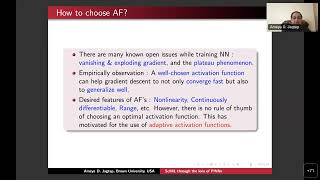
Scientific Machine Learning through the Lens of Physics-Informed Neural Networks
Explore physics-informed neural networks (PINNs) as an alternative to traditional scientific computation, addressing limitations and showcasing applications in solving complex physical problems.
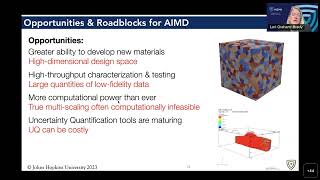
ML-driven Models for Material Microstructure and Mechanical Behavior - DDPS
Explore ML-driven approaches for generating microstructures and accelerating material behavior analysis. Learn transfer learning techniques and rapid assessment methods for materials design optimization.
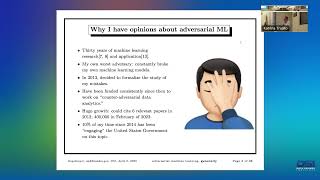
Adversarial Machine Learning: Categories, Concepts, and Current Landscape
Explore adversarial machine learning vulnerabilities, including data subversion, evasion, and model revelation. Learn to identify potential threats and build robust defense strategies.
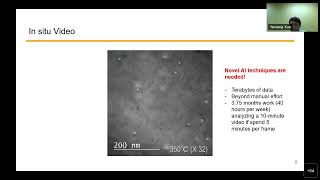
Scaling Up AI: Embedding Physics Modeling into End-to-end Learning and Harnessing Random Projection
Explore AI-driven scientific discovery through embedding physics models in end-to-end learning and utilizing random projection for efficient simulation and gradient propagation in PDE-based systems.
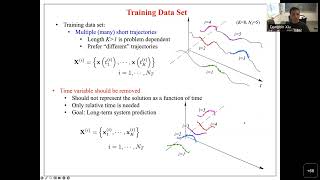
Data-Driven Modeling of Unknown Systems with Deep Neural Networks
Explore data-driven modeling of unknown systems using deep neural networks. Learn to discover and approximate evolution operators for predictive analysis across various problem domains.
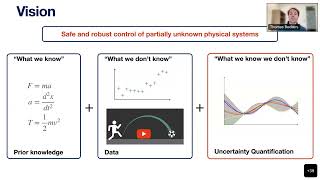
Physics-Enhanced Gaussian Processes for Learning of Electromechanical Systems
Explore physics-enhanced Gaussian processes for modeling electromechanical systems. Learn about GP-PHS and physics-enhanced variational autoencoders to improve data efficiency and ensure physical correctness.
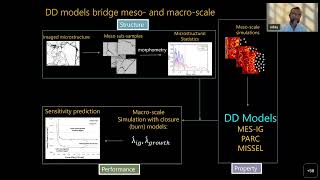
Data-Driven Multi-Scale Simulations for Materials-by-Design of Energetic Materials
Explore multi-scale modeling of energetic materials using machine learning for scale bridging. Learn about structure-property-performance relationships and optimization strategies for materials design.