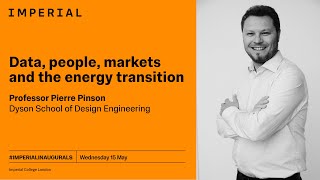
Data, People, Markets and the Energy Transition
Explore data-driven approaches for societal value creation in energy applications, focusing on the intersection of data, people, and markets in the energy transition.
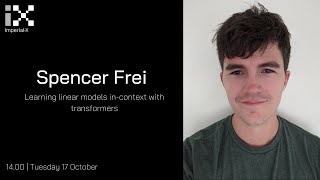
Learning Linear Models In-Context with Transformers
Explore in-context learning of linear models using transformers with UC Davis professor Spencer Frei in this insightful seminar.
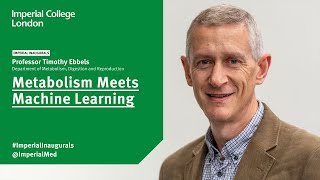
Metabolism Meets Machine Learning: Computational Metabolomics
Explore computational metabolomics, combining metabolism and machine learning. Discover metabolite measurement, data analysis, and future directions in biomedical science.

Data Learning: Machine Learning in Climate Action
Explore machine learning applications in climate action, focusing on data-driven solutions for environmental challenges and sustainable development.

Exploring AI's Role in Fine Art: An Introduction to Explainable Fine Art
Explore AI's impact on fine art through an introduction to explainable fine art, delving into innovative technologies and interdisciplinary perspectives.

Equivariant Machine Learning from Classical Physics
Explore equivariant machine learning techniques inspired by classical physics, presented by Soledad Villar from John Hopkins University.

AlphaGeometry: Solving IMO Geometry Problems without Human Demonstrations
Explore AlphaGeometry, a groundbreaking theorem prover for Euclidean plane geometry that outperforms previous methods and approaches IMO gold medallist level, solving complex problems without human demonstrations.

Deep Learning with Noisy Labels
Explore techniques for training deep learning models with noisy labels, addressing challenges in data collection and annotation across various domains, including medical imaging.

Robust Multivariate Time-Series Forecasting: Adversarial Attacks and Defense Mechanisms
Explore adversarial attacks on multivariate forecasting models and learn effective defense strategies, including randomized smoothing and adversarial training, to enhance robustness in time-series predictions.

Recent Progress on Grokking and Probabilistic Federated Learning
Explore recent advancements in grokking phenomenon and probabilistic federated learning. Gain insights into neural networks, Gaussian processes, and Bayesian inference for machine learning applications.

Optimal Transport for Distributionally Robust Optimization and Applications in Machine Learning
Explore optimal transport in distributionally robust optimization, focusing on its applications in machine learning, distribution shifts, and responsible AI. Gain insights into solving challenging optimization problems.
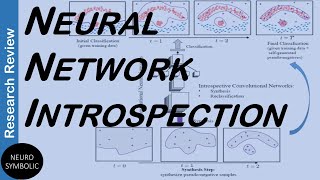
Neural Network Introspection - Approaches from Machine Learning and Knowledge Representation
Explore AI introspection approaches from ML and KR perspectives, covering ICNs, generative vs. discriminative models, and concept induction for enhanced machine learning understanding.
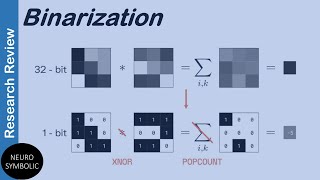
Introduction to Binarized Neural Networks
Explore binarized neural networks: motivation, quantization benefits, core concepts, training methods, and recent developments in this cutting-edge AI field.
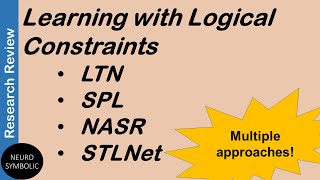
Learning with Logical Constraints: Methods and Applications
Explore multiple methods for learning with logical constraints, including LTN, SPL, NASR, and STLNet. Gain insights into cutting-edge AI techniques combining symbolic methods and deep learning.
Empowering Security Teams with Generative AI: Fundamentals and Applications of GPT Models
Explore how GPT models can enhance security research through few-shot learning, code generation, and retrieval augmentation. Gain insights and practical examples to leverage AI in empowering security teams.
Machine Learning for Gravitational Wave Astronomy
Explore machine learning applications in gravitational wave astronomy, focusing on advanced detection and analysis techniques for cosmic phenomena.
Full Fine-tuning LLMs with Lower VRAM: Optimizers, GaLore, and Advanced Techniques
Explore advanced techniques for full fine-tuning LLMs with limited GPU resources, including optimizer tricks, Galore, and Adafactor. Enhance model performance and efficiency.
How to Pick a GPU and Inference Engine for Large Language Models
Explore GPU selection and inference engine optimization for large language models. Compare quantization effects, software options, and cost-efficiency across various GPUs and model sizes.
LLM Tool Use - GPT4o-mini, Groq, and Llama.cpp
Explore advanced LLM tool use techniques with GPT4o-mini, Groq, and Llama.cpp. Learn function calling, zero-shot prompting, and local inference for efficient AI development.
Text-to-Speech Fine-tuning Tutorial - StyleTTS2 Voice Cloning and Model Adaptation
Master text-to-speech fine-tuning techniques, from dataset preparation to model training. Explore voice cloning, StyleTTS2, and performance optimization for advanced speech synthesis projects.
Mastering Retrieval for LLMs - BM25, Fine-tuned Embeddings, and Re-Rankers
Enhance LLM retrieval with advanced techniques: BM25, fine-tuned embeddings, and re-rankers. Learn document chunking, semantic search, and performance optimization for improved AI-powered information retrieval.