From Uncertainty to Certainty: Strategies for Deterministic LLMOps
Explore strategies for implementing deterministic approaches in LLM operations, focusing on assessment, evaluation, and refinement to enhance reliability and stakeholder trust in AI applications.
Introduction to Vector Search on Databricks
Explore vector search integration in Databricks for enhanced data retrieval. Learn fundamentals, implementation, optimization, and real-world applications to transform your data processes.
Eight Weeks, Two Developers, One Production AI Conference Assistant
Discover the journey of creating Brickbot, an AI assistant for DAIS '24. Learn about design decisions, technical challenges, and insights gained from real-world user interactions in this behind-the-scenes discussion.
Mastering Data Science: The Impact of Large Language Models
Explore the evolving synergy between data science fundamentals and LLMs, learning essential skills for adapting to technological advancements and shaping the future of the field.
Hybrid Chatbots - Merging LLMs and Classification Models for Enhanced Conversational Experiences
Explore hybrid chatbots combining LLMs and classification models for natural, engaging interactions. Learn to accelerate development, optimize resources, and enhance accuracy in customer service and healthcare applications.
Temporal Difference Learning for Model Predictive Control - Research Presentation 3
Presentation on Temporal Difference Learning for Model Predictive Control, exploring innovative approaches in robotics and AI. Insights into recent papers and project developments by researcher Nicklas Hansen.

Boltzmann Machines - The Grandfather of Generative Models
Explore Boltzmann Machines, early generative models learning data probability distributions using stochastic rules and latent representations. Understand their goals, distribution, update rules, and evolution to Restricted Boltzmann Machines.
Confused Learning: Supply Chain Attacks Through Machine Learning Models
Explore novel ML model vulnerabilities, including malware distribution and data exfiltration. Learn to create, distribute, and analyze ML malware, with insights on threat hunting and mitigation strategies.

Painful Learnings of Applying AI in Security - Don't Make This Mistake
Explore AI's limitations in AppSec, examining real-world examples and a live demo. Learn about the RAG Framework for more reliable AI integration in security applications.
Secure AI: 20 Years of Machine Learning Security - Keynote
Exploración histórica de la seguridad en IA, desde sus inicios hace 20 años hasta los desafíos actuales. Análisis crítico de las prácticas modernas y orientación para profesionales en el campo.
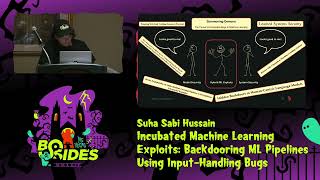
Incubated Machine Learning Exploits: Backdooring ML Pipelines Using Input-Handling Bugs
Explore vulnerabilities in ML pipelines through input-handling bugs, introducing incubated ML exploits and backdoors. Learn about security implications and guidelines for ML practitioners.
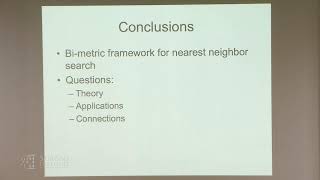
A Bi-metric Framework for Fast Similarity Search
Explore a novel bi-metric framework for efficient nearest neighbor search, combining accurate but costly ground-truth metrics with faster proxy metrics to optimize data structures and query procedures.
Consciousness and Large Language Models - Understanding Higher-Level Intelligence
Explore the intersection of consciousness and AI through philosophical and scientific lenses, examining implications for higher-level intelligence and cognitive science.

AI as a Tool for Discovery in Animal Communication
Explore innovative AI applications for decoding animal communication, uncovering insights into nonhuman species' language and behavior.

Automated Functional Synthesis: An Ideal Meeting Ground for Symbolic Reasoning and Machine Learning
Explores Manthan, a data-driven approach combining machine learning and symbolic reasoning to improve scalability in functional synthesis, viewing it as a classification problem.
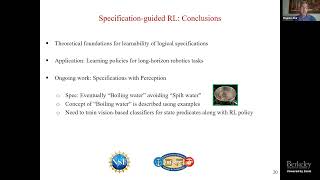
Specification-guided Reinforcement Learning
Explore specification-guided reinforcement learning techniques for synthesizing models and systems, presented by Rajeev Alur from the University of Pennsylvania.
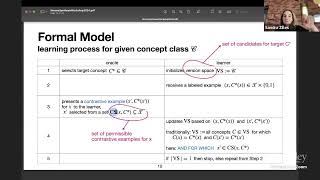
Learning From Contrastive Examples in Machine Learning
Explores how contrastive training examples impact active learning algorithms, focusing on sample complexity for geometric concepts and Boolean functions, with connections to self-directed learning.
Understanding the Expressive Power of Transformers Through Formal Language Theory
Explore the intersection of formal language theory and machine learning, focusing on transformer expressiveness and recent developments in understanding their learning capabilities.
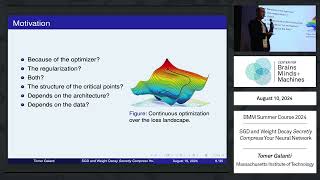
SGD and Weight Decay Secretly Compress Your Neural Network
Explore how SGD and weight decay techniques compress neural networks, enhancing efficiency and performance in deep learning models.

AI-Powered Decision Tree for Talking Computer - Python, OpenAI API, Google Speech
Learn to create an AI-powered decision tree for natural language interaction with computers using Python, OpenAI API, and Google Speech. Enhance user communication flexibility and eliminate hard-coded triggers.
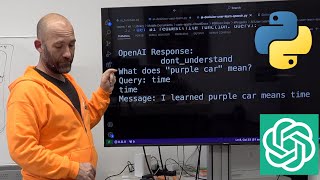
Manual Training of Voice-Powered AI Computer - OpenAI, Python, SQLite, Google Voice
Learn to manually train an AI-powered voice assistant using OpenAI, Python, SQLite, and Google Voice. Covers system design, text and voice-based implementations, and code review.