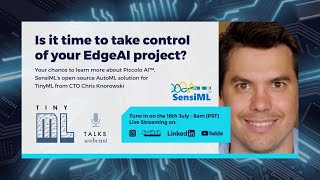
Taking Control of Edge AI Projects - Tools and Automation
Explore the need for improved tools and automation in edge AI projects, featuring insights on SensiML's Piccolo AI™ open-source suite for TinyML development.
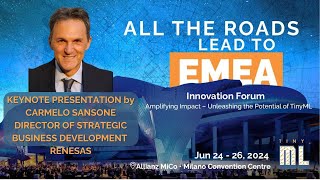
TinyML: From Concept to Reality - Transforming Everyday Devices
Explore TinyML's impact on smart devices, from smartphones to autonomous vehicles. Learn about AI applications in home automation, industrial settings, and the challenges of real-time analytics implementation.
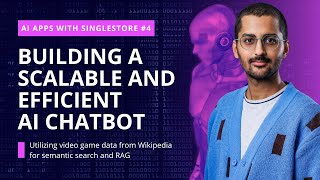
Building a Scalable AI Chatbot with Wikipedia Data - Semantic Search and RAG
Learn to create an AI chatbot using Wikipedia video game data, implementing semantic search and RAG with SingleStore, optimizing with vector indexes, and integrating GPT models for an interactive experience.
Big Math Libraries in Interactive Theorem Provers
Explore five key aspects of Big Math in Interactive Theorem Provers: inference, computation, concretization, narration, and organization. Learn about library sizes, searching, integration, and maintenance.
Text Mining the arXiv with Large Language Models
Explore text mining techniques using Large Language Models to analyze and extract insights from the vast arXiv repository of scientific papers.
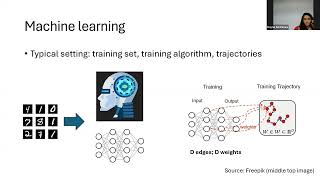
Metric Space Magnitude and Generalization in Neural Networks
Exploring metric space magnitude in neural networks: new topological complexity measures for assessing generalization capabilities, with applications to transformers and deep graph networks.
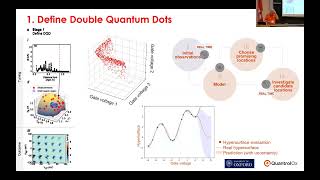
Accelerating Quantum Progress Through Machine Learning
Explore how machine learning can accelerate advancements in quantum technology, enhancing quantum information and control capabilities.
Debugging Kubernetes Applications with GenAI and Machine Learning
Explore automated root cause analysis for Kubernetes using AI and machine learning. Learn about ScienceLogic's Skylar AI solution through live demos, use cases, and Q&A sessions.

Can AI Read Your Mind? - Decoding Thoughts with AI and Neural Imaging
Explore cutting-edge AI technologies decoding human thoughts through neural patterns, with experts discussing FMRI, EEG signals, and future implications for mind-reading advancements.
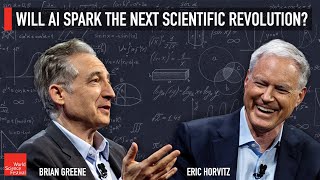
Will AI Spark the Next Scientific Revolution?
Explore AI's potential to revolutionize scientific research across materials science, bioscience, and physics, with insights from Microsoft's Chief Scientific Officer and renowned physicist Brian Greene.

Visual Arts in the Age of AI - Exploring AI's Impact on Creativity
Explore AI's impact on visual arts with Matthew Ritchie and Brian Greene. Delve into AI creativity, its potential to enhance artistic expression, and the future of human-AI collaboration in the creative realm.

LLaMA 3 Deep Dive - Synthetic Data, Privacy, and Model Architecture
Explore LLaMA 3's innovations with Meta's Thomas Scialom, covering synthetic data, privacy concerns, scaling techniques, and architectural choices in this in-depth discussion on advanced language models.
End-to-End Multi AI Agents RAG with LangGraph, AstraDB, and Llama 3.1
Explore multi-agent AI systems using LangGraph, AstraDB, and Llama 3.1. Learn to build advanced RAG applications with vector databases and open-source models.

MLOps Tutorial - Automating CI/CD Workflow for Dockerized Flask App Using GitHub Actions
Automate CI/CD for Dockerized Flask apps using GitHub Actions. Learn to build Docker images, push to Docker Hub, and streamline deployment workflows for Python applications.

Build a Semantic Search App Using Next.js and SingleStoreDB
Learn to create a semantic search app with Next.js and SingleStoreDB, focusing on vector embeddings and efficient data retrieval for enhanced search functionality.

Why AI Is Here to Stay and How New Developers Can Find the Right Balance
Explore AI engineering opportunities, learn to leverage AI tools, and stay future-proof in tech with insights from Sam Julien, Director of Developer Relations at Writer.

Python Apple MLX Tutorial: Introduction to Machine Learning on Apple Silicon
Learn MLX framework for Apple Silicon: GPU operations, transformers, language models, and generative AI concepts. Applicable to PyTorch and NumPy users.

Informer Architecture Explained - Complete Guide
Comprehensive exploration of Informer encoder architecture, detailing its components and implementation for advanced time series forecasting and sequence modeling tasks.

Informer: Training and Inference
Explore time series prediction using Informer, a transformer-based model. Learn to train and make predictions through hands-on coding, enhancing your skills in advanced forecasting techniques.
Make Your RAGs Work at Scale - Insights on Retrieval Augmented Generation
Insightful podcast on scaling RAG systems, covering AI evolution, search optimization, and practical implementation strategies for production-ready solutions.

Local RAG with Llama 3.1 for PDFs - Private Chat with Documents using LangChain and Streamlit
Build a local RAG system for PDFs using LLMs, LangChain & Streamlit. Extract text, create vector stores, implement advanced retrieval, and integrate local/remote LLMs for efficient document processing.