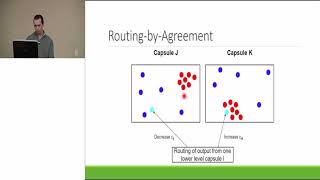
Dynamic Routing Between Capsules
Explore capsule networks, routing-by-agreement, and their applications in computer vision, with a focus on MNIST and multiMNIST datasets.
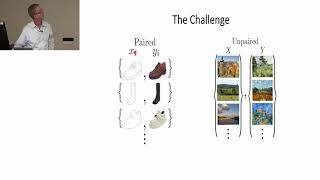
Unpaired Image-to-Image Translation Using Cycle-Consistent Adversarial Networks
Learn about unpaired image-to-image translation using cycle-consistent adversarial networks, exploring challenges, intuition, loss functions, and results in this comprehensive overview.
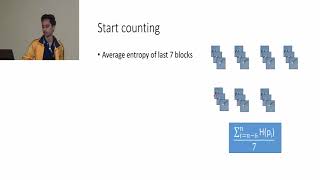
Live Repetition Counting - CNN Architecture and System for Online Motion Detection
Learn techniques for real-time repetition counting in video, including CNN architecture, counter integration, and online mode counting for multiple detectors and regions of interest.

Understanding Deep Learning Requires Rethinking Generalization
Explore deep learning generalization, examining regularization techniques, randomization tests, and neural network expressivity to challenge conventional understanding and improve model performance.
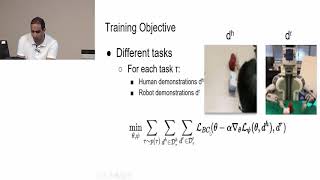
One-Shot Imitation from Observing Humans via Domain-Adaptive Meta-Learning
Learn domain-adaptive meta-learning for one-shot imitation, enabling robots to quickly learn new tasks by observing human demonstrations and adapting across domains.
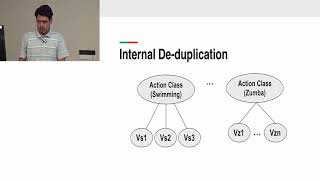
A Sparsely Labeled Dataset for Action Classification and Localization - SLAC
Explore a novel dataset for action classification and localization, covering data collection, training, validation, and evaluation methods for human action detection.
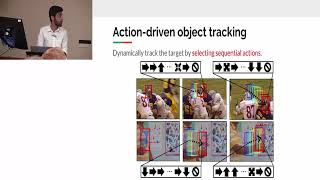
Deep Reinforcement Learning for Object Tracking
Explore action-driven object tracking using deep reinforcement learning, covering policy, value functions, and training approaches for improved visual tracking performance.
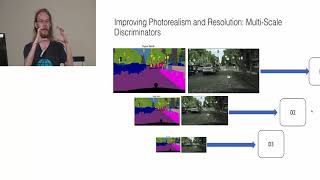
High-Resolution Image Synthesis and Semantic Manipulation with Conditional GANs
Explore high-resolution image synthesis and semantic manipulation using conditional GANs, covering advanced techniques like coarse-to-fine generation and multi-scale discriminators for improved photorealism.
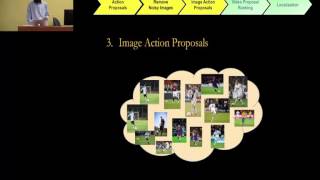
What If We Do Not Have Multiple Videos of the Same Action - Video Action Localization
Explore video action localization techniques for scenarios with limited action samples, covering key challenges, innovative approaches, and experimental results.
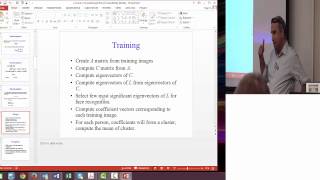
Facial Recognition: Eigenvectors and Covariance Matrices - Lecture 14
Explore facial recognition technology, from simple approaches to advanced techniques using eigenvectors and covariance matrices. Learn about challenges and solutions in this field.
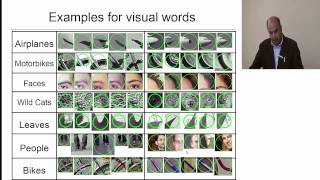
Bag of Words Model for Image Classification - Lecture 16
Explore bag-of-features for image classification, including feature extraction, quantization, and spatial pyramid matching. Learn about datasets and applications in scene and action recognition.
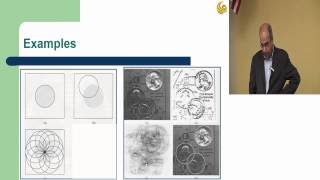
Hough Transform for Image Feature Extraction - Lecture 17
Explore image feature extraction, line fitting techniques, and the Hough Transform for shape detection in computer vision, including practical applications and challenges.
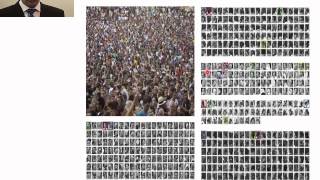
Visual Analysis of Extremely Dense Crowded Scenes
Analyzing dense crowd scenes using computer vision techniques for counting, detecting, and tracking individuals. Explores multiple data sources, context, and neighborhood motion to address challenges in extremely crowded environments.
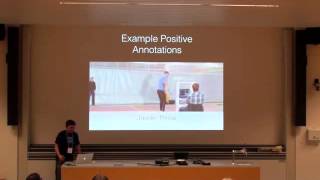
Action Recognition in Temporarily Untrimmed Videos
Action recognition in untrimmed videos: challenges, datasets, and annotation techniques for improving accuracy in real-world scenarios with ambiguous content and varying video qualities.
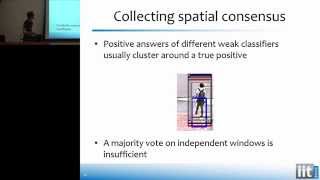
Statistical and Spatial Consensus Collection for Detector Adaption
Explore detector adaptation techniques for improved pedestrian detection across domains, focusing on statistical and spatial consensus methods to enhance accuracy and generalization.

CAP6412 - Final Project Presentations - Lecture 27
Final project presentations showcasing innovative approaches in video action recognition, offline reinforcement learning, and decision transformer encoders, with discussions on methodologies, results, and implications.
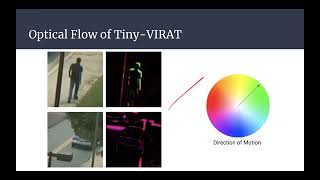
CAP6412 - Advanced Computer Vision - Lecture 24: Project Presentations
Students present their projects, showcasing innovative approaches in computer vision and AI. Topics include object detection, video analysis, and visual question answering, highlighting challenges and novel solutions.
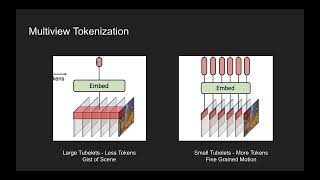
Computer Vision: Tokens and Cross-View Fusion - Lecture 22
Explore tokens, cross-view fusion, and attention in computer vision, examining experimental results and innovations in multi-view learning techniques.
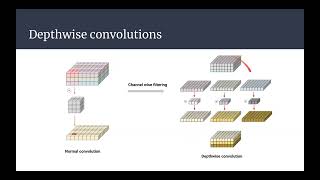
Computer Vision Architecture Evolution: ConvNets to Transformers - Lecture 21
Explore the evolution of vision architectures, comparing SWIN and CNNs, and learn about modernizing ConvNets with macro and micro design changes for improved performance.
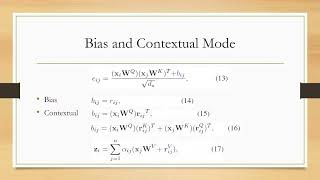
Rethinking and Improving Relative Position Encoding for Vision Transformer - Lecture 23
Explore vision transformer improvements through relative position encoding, examining bias modes, piecewise indexing, and 2D calculations for enhanced performance in image processing tasks.
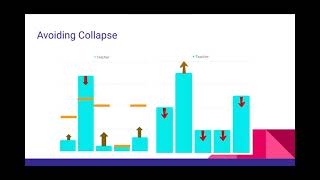
Emerging Properties in Self-Supervised Vision Transformers - Lecture 25
Explore emerging properties in self-supervised vision transformers, covering related topics, model overview, and implementation details for advanced computer vision applications.