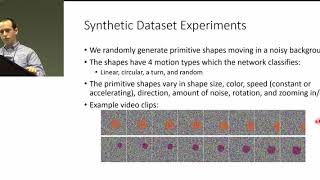
Generalization to Video Capsules - From Convolutional to Video Capsule Networks
Explore video capsule networks for action detection and object segmentation, including multi-modal approaches and semi-supervised techniques for improved performance in computer vision tasks.
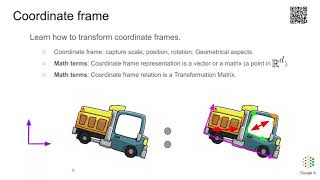
Introduction to Capsule Networks for Computer Vision
Explore Capsule Networks for computer vision, covering sparse pattern recognition, viewpoint equivariance, object detection, and dynamic routing techniques.
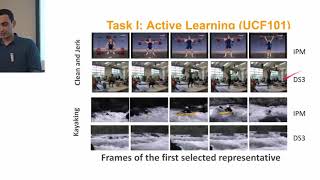
Iterative Projection and Matching: Finding Structure-Preserving Representatives and Applications
Explore iterative projection and matching for finding structure-preserving representatives, with applications in active learning, GANs, image processing, and video summarization.
Describing Images Using Semantic Modeling with Attributes and Tags
Explore semantic modeling for image description using attributes and tags, covering frameworks, methodologies, and experiments in visual content analysis and popularity prediction.
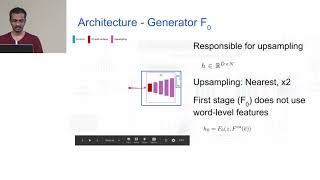
AttnGAN: Fine-Grained Text to Image Generation with Attentional Generative Adversarial Networks
Explore fine-grained text-to-image generation using attentional GANs, covering architecture, experiments, and novel scenarios in this technical deep dive.
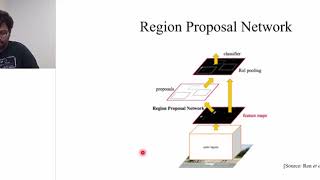
Video Action Transformer Network: Implementation and Experiments
Learn about Video Action Transformer Networks, exploring their architecture, implementation, and experimental results for advanced video understanding and action recognition.
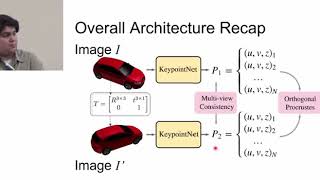
Discovery of Latent 3D Keypoints via End-to-End Geometric Reasoning
Explore end-to-end geometric reasoning for latent 3D keypoint discovery, combining keypoint and geometry learning networks to outperform supervised methods in semi-supervised keypoint finding.
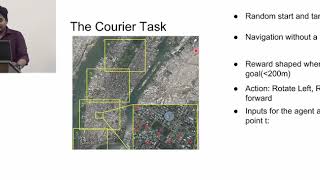
Learning to Navigate in Cities Without a Map
Explore reinforcement learning techniques for urban navigation without maps, focusing on value functions, courier tasks, and multi-site experiments.
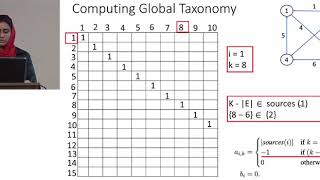
Taskonomy - Disentangling Task Transfer Learning
Explore task transfer learning, higher-order transfers, and task-specific networks. Discover global taxonomies, evaluate computed structures, and assess generalization to novel tasks.
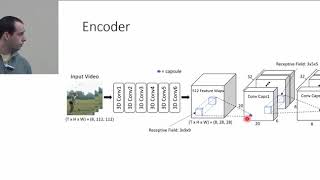
VideoCapsuleNet - A Simplified Network for Action Detection
Explore VideoCapsuleNet, a simplified network for action detection in videos. Learn about capsule networks, convolutional layers, and innovative techniques for improved video analysis.
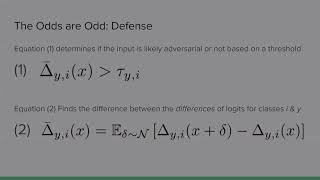
Adaptive Attacks to Adversarial Example Defenses - CAP6412 Spring 2021
Explore adaptive attacks on adversarial example defenses, covering expectation over transformation, K winners take all, chaos partitioning, and local gradient estimation.
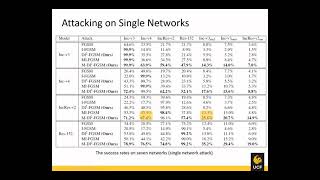
Improving Transferability of Adversarial Examples with Input Diversity - CAP6412 Spring 2021
Explore techniques to enhance adversarial example transferability using input diversity, including FGSM family methods and ensemble network attacks.
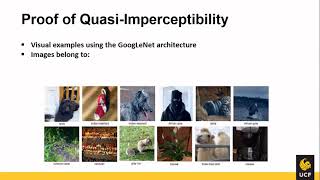
Universal Adversarial Perturbations in Machine Learning - Spring 2021
Explore universal adversarial perturbations in machine learning, covering definitions, contributions, experiments, and cross-model universality.
Explaining and Harnessing Adversarial Examples in Machine Learning - Spring 2021
Explore adversarial examples in machine learning, their impact on linear and non-linear models, and techniques like adversarial training to improve model robustness and generalization.
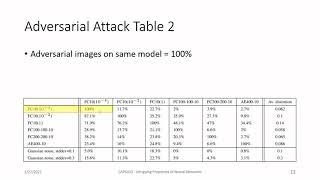
Intriguing Properties of Neural Networks - Spring 2021
Explore intriguing properties of neural networks, including adversarial attacks, transfer, training overlap, and semantic information in units. Analyze weaknesses and spectral instability.
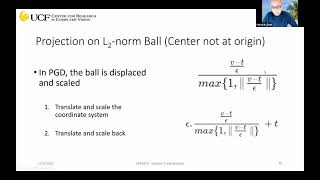
Introduction to Adversarial Attacks in Machine Learning - Lecture 1
Introduction to adversarial attacks on AI systems, covering real-world examples, attack methods, and defense strategies for various applications like face recognition and object detection.
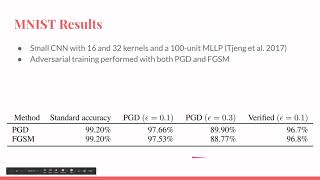
Fast Is Better Than Free: Revisiting Adversarial Training - CAP6412 Spring 2021
Explore adversarial training techniques, comparing PGD with newer methods. Learn about technical contributions, experimental results, and implications for machine learning security.
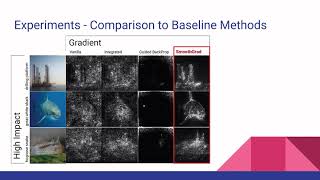
CAP6412 - SmoothGrad: Removing Noise by Adding Noise - Lecture
Explore SmoothGrad, a technique for enhancing neural network visualization by adding noise to input images and averaging resulting sensitivity maps.
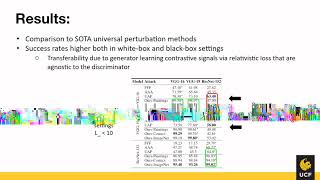
Cross-Domain Transferability of Adversarial Perturbations - CAP6412 Spring 2021
Explore cross-domain transferability of adversarial perturbations, focusing on generative models, discriminator loss, and experimental results in this advanced computer vision lecture.
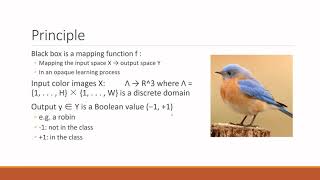
Interpretable Explanations of Black Boxes by Meaningful Perturbation - CAP6412 Spring 2021
Explore principles and methods for explaining black box functions in machine learning, focusing on image saliency, perturbation techniques, and meta-predictors for interpretable AI.
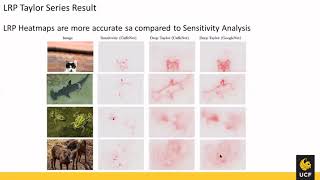
Unmasking Clever Hans Predictors and Assessing Machine Learning - Spring 2021
Unmasking clever predictors: Explore Layer-wise Relevance Propagation and SPRAY techniques to assess machine learning models' decision-making processes and identify potential biases or faults.