Deep Generative Models - Energy Based Models - Lecture 11
Explore energy-based models in deep learning, their applications, and theoretical foundations. Gain insights from Stanford's expert on advanced generative modeling techniques.
Stanford CS236: Deep Generative Models - Lecture 7 - Normalizing Flows
Explore normalizing flows in deep generative models with Stanford's Stefano Ermon. Learn advanced techniques for creating flexible and expressive probability distributions in machine learning.

Stanford CS236 - Deep Generative Models - Lecture 1: Introduction
Explore deep generative models with Stanford's Prof. Ermon. Learn key concepts, applications, and cutting-edge techniques in this comprehensive introduction to a rapidly evolving field of AI.
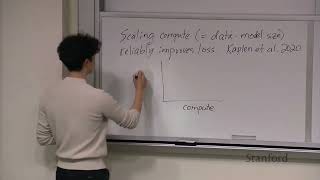
Intuitions on Language Models and Shaping AI's Future - Stanford CS25 Lecture
Explore intuitions on language models and the evolution of Transformer architectures with OpenAI researchers. Gain insights into next-word prediction, scaling laws, and the future of AI development.
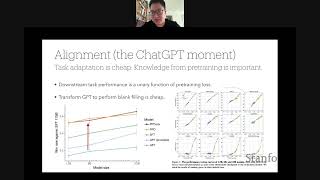
From Large Language Models to Large Multimodal Models - Stanford CS25 - Lecture 4
Explore the evolution from large language models to multimodal AI, focusing on CogVLM and CogAgent. Learn about integrating visual perception with language capabilities and future research directions.
Leveraging Social Theories to Enhance Human-AI Interaction
Explores challenges in human-AI partnerships, focusing on interpretability tools' limitations and cognitive heuristics. Proposes incorporating social theories to improve decision-support systems and human-AI interaction.
Stanford CS109 - Future of Probability - Lecture 28
Explore the future of probability in computer science with Stanford's expert insights, covering advanced concepts and their applications in emerging technologies.
Overview of Transformers - Stanford CS25: Lecture 1
Comprehensive introduction to NLP, Transformers, and AI agents, covering history, functionality, recent breakthroughs, applications, and challenges in the field of artificial intelligence.
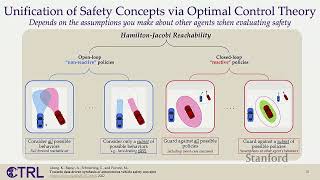
Towards Trusted Human-Centric Robot Autonomy - Stanford Seminar
Exploring human-centric robot autonomy: balancing safety and fluency in interactions. Insights on data-driven safety concepts and legible robot behavior for prosocial human-robot engagement.
Towards Safe and Efficient Learning in the Physical World - Stanford Seminar
Exploring safe Bayesian optimization and model-based deep reinforcement learning for efficient, safe online learning in real-world applications like robotics and laser tuning.
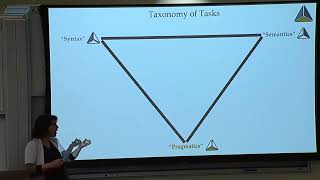
Robot Learning in the Era of Large Pretrained Models - Stanford Seminar
Exploring interactive robot learning with large pretrained models, focusing on visual representations, data collection strategies, and leveraging language models for robotics applications.
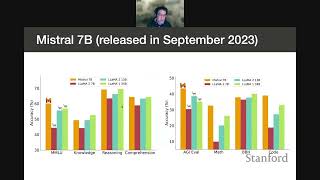
Demystifying Mixtral of Experts - Stanford CS25 Lecture
Explore Mixtral 8x7B, a Sparse Mixture of Experts model, with Albert Jiang. Learn about its architecture, expert routing, and how it processes 47B parameters while using only 13B during inference.
Robot Skill Acquisition: Policy Representation and Data Generation
Explore solutions for scalable, reusable, and robot-complete data in robotics, addressing challenges and hidden costs to advance robot learning beyond current limitations.
Divide and Conquer - Concept-based Models for Efficient Transfer Learning
Exploring concept-based interpretable AI models for efficient transfer learning in healthcare, focusing on generalizability and minimal data requirements for domain adaptation in medical imaging.

AI's Role in Improving Health Care Services in Our Communities
Stanford experts discuss AI initiatives in healthcare, focusing on early disease detection, preventive care, and reducing provider burnout, while addressing privacy and equity concerns.
AI Transforms Health Care - The Future of Medicine and Health Care
Explore AI's transformative role in healthcare, focusing on ethical implementation, data structure, and real-world applications. Learn about Stanford's innovative AI projects and their impact on patient care.

SleepFM - Multi-modal Representation Learning for Sleep Across Brain Activity, ECG and Respiratory Signals
Explore SleepFM, a groundbreaking multi-modal foundation model for sleep analysis, leveraging brain, cardiac, and respiratory data to improve sleep stage classification and disorder detection.
Towards Robust Radiogenomic Models for Brain Tumor Characterization - MedAI #123
Exploring stability of radiomics features in brain tumor segmentation and impact on predictive models. Investigates how stable, discriminatory features lead to generalizable radiogenomics for tumor characterization.
Integrating Pathology Images and Genomics Data for Cancer Grading
Innovative AI methods for integrating pathology images and genomics data to enhance cancer grading accuracy, addressing modality challenges and improving performance when genomics data is missing.
Holistic OR Domain Modeling with Large Vision Language Models - MedAI #120
Innovative approach to automated OR modeling using Large Vision Language Models, leveraging semantic scene graphs for comprehensive surgical environment understanding and enhanced decision-making.
AI-Driven Advancements in Mammogram Analysis - MedAI #119
Exploring AI applications in mammogram analysis for cancer screening and cardiovascular risk assessment, addressing challenges in healthcare AI adaptation and extracting actionable clinical insights.