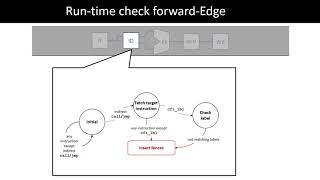
Mitigating Spectre Attacks Using CFI Informed Speculation
Mitigating Spectre attacks using Control-Flow Integrity to constrain speculative execution, combining forward and backward edge protection for comprehensive defense against non-vendor-specific vulnerabilities.
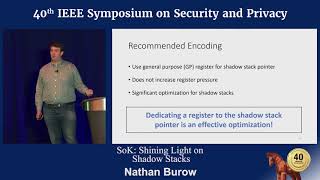
Shining Light on Shadow Stacks
Comprehensive analysis of shadow stack mechanisms for protecting against control-flow hijacking attacks, evaluating performance, compatibility, and security. Proposes a novel design using a dedicated register.
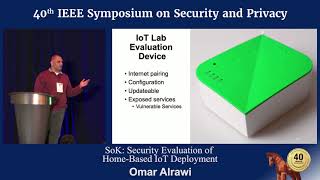
SoK- Security Evaluation of Home Based IoT Deployment
Comprehensive security evaluation methodology for home IoT devices, analyzing attack techniques, mitigations, and stakeholders. Includes assessment of 45 devices to identify research gaps.
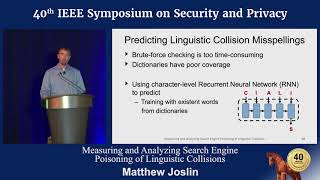
Measuring and Analyzing Search Engine Poisoning of Linguistic Collisions
Analyzing linguistic-collision search poisoning attacks, revealing prevalence and impact on Google and Baidu. Explores misspellings, auto-correction evasion, and targeted categories, offering insights for threat mitigation.
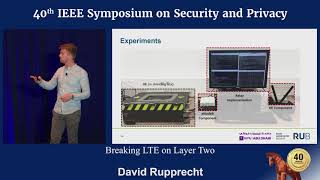
Breaking LTE on Layer Two
Exploring LTE layer two vulnerabilities: identity mapping, website fingerprinting via resource allocation, and payload modification through the A LTE R attack, demonstrating critical security risks in mobile communications.
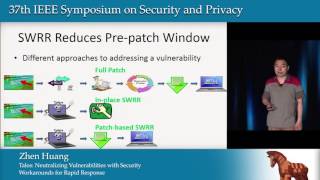
Talos - Neutralizing Vulnerabilities with Security Workarounds for Rapid Response
Neutralizing vulnerabilities using error-handling code for rapid response, minimizing patch delays while maintaining functionality. Explores automated security workarounds to mitigate risks in popular Linux server applications.
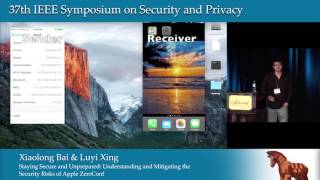
Staying Secure and Unprepared - Understanding and Mitigating the Security Risks of Apple ZeroConf
Explore security risks in Apple's ZeroConf systems, uncovering vulnerabilities in popular apps and services. Learn about innovative protection techniques, including voice-based certificate verification.
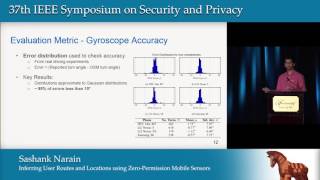
Inferring User Routes and Locations Using Zero-Permission Mobile Sensors
Explore zero-permission mobile sensor vulnerabilities for inferring user routes and locations, highlighting privacy risks and proposing detection methods through maximum likelihood route identification.
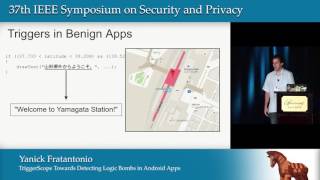
TriggerScope - Towards Detecting Logic Bombs in Android Applications
Explore techniques for detecting logic bombs in Android apps using symbolic execution and path predicate analysis. Learn about TriggerScope, a tool for identifying time-, location-, and SMS-related triggers in mobile applications.
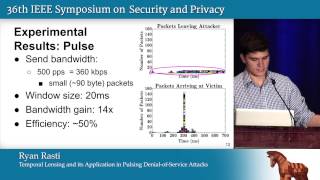
Temporal Lensing and Its Application in Pulsing Denial-of-Service Attacks
Explore temporal lensing, a technique concentrating low-bandwidth floods into high-bandwidth pulses, and its potential for amplifying denial-of-service attacks using DNS infrastructure.
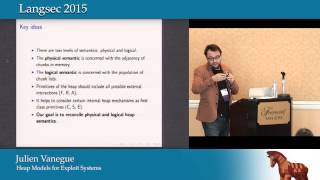
Heap Models for Exploit Systems
Formal modeling of heap exploits as abstract machines, exploring physical and logical heap properties to express attacks as reachability problems in specific heap configurations.
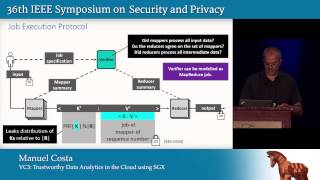
Trustworthy Data Analytics in the Cloud Using SGX
Explore trustworthy cloud-based data analytics using SGX technology. Learn about VC3, a system enabling secure MapReduce computations while preserving confidentiality and integrity of code and data.
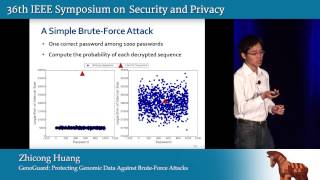
GenoGuard - Protecting Genomic Data Against Brute-Force Attacks
Innovative encryption tool for genomic data offering long-term protection against brute-force attacks. Utilizes honey encryption to generate plausible decoy genomes, ensuring information-theoretic security for sensitive genetic information.
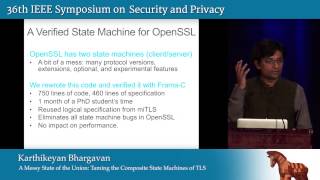
A Messy State of the Union - Taming the Composite State Machines of TLS
Explore critical security vulnerabilities in TLS implementations, including the FREAK flaw, and learn about a verified composite state machine for OpenSSL that addresses these issues.
Secure Track Verification
Innovative approach for secure verification of mobile node location claims, exploiting inherent mobility to detect spoofing attacks with minimal system requirements and high accuracy.
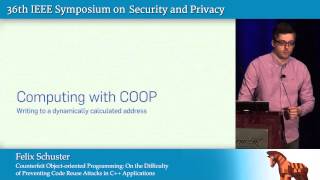
Counterfeit Object-Oriented Programming
Explores counterfeit object-oriented programming, a novel code reuse attack technique in C++ applications, demonstrating its effectiveness against existing defenses and discussing potential prevention strategies.
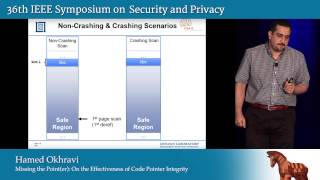
Missing the Point(er) - On the Effectiveness of Code Pointer Integrity
Explores effectiveness of Code Pointer Integrity (CPI) in preventing memory corruption attacks. Demonstrates vulnerabilities in CPI implementations relying on information hiding, highlighting importance of robust secret protection in security mechanisms.
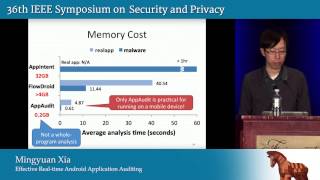
Effective Real-Time Android Application Auditing
Innovative approach combining static and dynamic analysis for efficient, real-time Android app auditing to detect data leaks, offering improved speed and accuracy over existing methods.
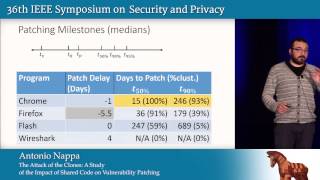
The Attack of the Clones - A Study of the Impact of Shared Code on Vulnerability Patching
Explores impact of shared code on vulnerability patching, revealing delays between patch releases and novel exploitation techniques. Analyzes patch deployment data from millions of hosts to improve cybersecurity strategies.
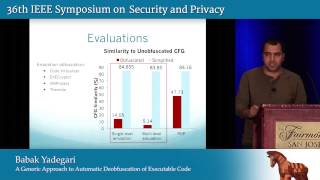
A Generic Approach to Automatic Deobfuscation of Executable Code
Explore a generic approach to automatically deobfuscate executable code, applicable to various obfuscation techniques. Learn about semantics-preserving transformations and their effectiveness in extracting internal logic from obfuscated malware.
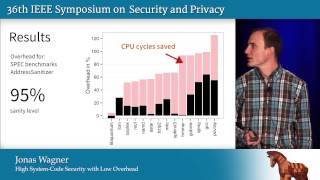
High System-Code Security with Low Overhead
Maximize system code security within specified overhead budgets. Automatically instrument programs to balance security and performance, focusing on critical, low-cost checks for effective protection.