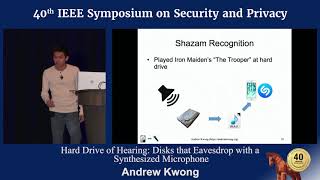
Hard Drive of Hearing - Disks that Eavesdrop with a Synthesized Microphone
Discover how hard drives can be exploited as microphones, potentially compromising privacy. Learn about this unique security threat and explore defense mechanisms against acoustic eavesdropping.
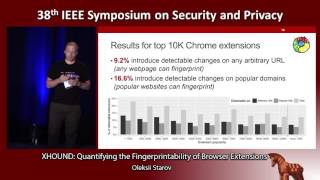
XHOUND - Quantifying the Fingerprintability of Browser Extensions
Quantifying browser extension fingerprintability and its impact on user privacy. Explores detection methods, analyzes popular extensions, and discusses implications for online tracking and user identification.
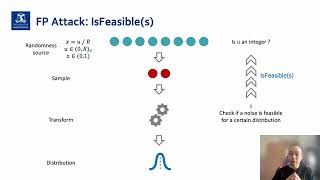
Are We There Yet? Timing and Floating-Point Attacks on Differential Privacy Systems
Explore timing and floating-point vulnerabilities in differential privacy systems, uncovering potential privacy leaks and discussing mitigation strategies for enhanced data protection.

How Geopolitical Change Affects Computer Security and Privacy for Vulnerable Populations
Explores how geopolitical changes impact computer security and privacy for vulnerable populations, examining case studies and recommending design strategies to reduce vulnerability during times of crisis and change.
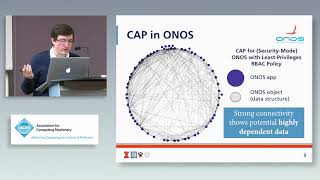
Cross-App Poisoning in Software-Defined Networking
Explore SDN control plane integrity attacks and cross-app poisoning, uncovering vulnerabilities in RBAC and evaluating their impact on network security.
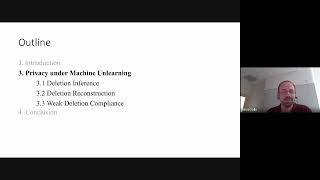
Machine Unlearning and Privacy Implications - Differential Privacy for ML
Explore privacy implications of machine unlearning, including threat models, deletion inference, and experimental results in this Google TechTalk on differential privacy for ML.
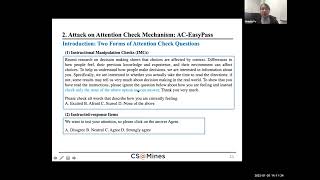
Security Protection and Quality Control in Crowdsourcing
Explore security threats in crowdsourcing, analyze research findings, and learn strategies for protecting data integrity and quality control in online surveys and annotations.

Addressing Evolving Threat Models in Cloud Security with Open-Source Software
Explore evolving cloud security threats and learn to address them using open-source solutions, focusing on practical strategies and real-world use cases for robust cloud-native security.
Homomorphic Encryption - Nick Gonella
Explore homomorphic encryption's potential and limitations in cryptography, including RSA's workings, critical pitfalls, and its relation to the CIA Triad.
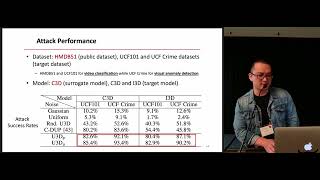
Universal 3-Dimensional Perturbations for Black-Box Attacks on Video Recognition Systems
Explore innovative techniques for creating universal 3D perturbations to challenge and test the robustness of video recognition systems in black-box attack scenarios.
CryptGPU: Fast Privacy-Preserving Machine Learning on the GPU
Explore GPU-accelerated privacy-preserving machine learning techniques for enhanced performance and scalability in image classification and private training.

Lessons Learned from Evaluating the Robustness of Defenses to Adversarial Examples
Explore robustness of AI defenses against adversarial examples, evaluating threat models and defense strategies to improve security in deep learning systems.
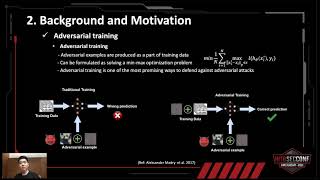
Model Robustness Will Hurt Data Privacy?
Exploring the trade-off between AI model robustness and data privacy, revealing how adversarial training may increase vulnerability to privacy attacks and data reconstruction from gradient information.

Horcrux Encrypted Messaging
Explore secure messaging using Horcrux, leveraging adversarial nation-states to protect against surveillance. Learn about the design, visualization, and potential applications of this innovative encryption method.

Measuring Cybersecurity Effectiveness in a Threat-Based World
Experts discuss leveraging threat data for improved cybersecurity, focusing on DHS, NSA, and NIST initiatives to enhance information protection, detection, and response in government agencies.

Your Security Tools Are Just a Stop-Gap to Secure DevOps
Secure DevOps: Beyond tools, focus on risk assessment, threat modeling, and custom security controls. Learn to integrate security effectively in CI/CD pipelines for robust application protection.

The Sounds of the Phones - Dangers of Zero-Effort Second Factor Login Based on Ambient Audio
Explores security vulnerabilities in ambient audio-based two-factor authentication, demonstrating potential attacks and discussing mitigation strategies for improved cybersecurity.
The Misuse of Android Unix Domain Sockets and Security Implications
Explore Android Unix domain socket vulnerabilities, their security implications, and mitigation strategies in this comprehensive analysis of potential misuse and authentication weaknesses.

Redesigning PKI to Solve Revocation, Expiration, and Rotation Problems
Explore PKI redesign for IoT security, addressing key revocation, expiration, and rotation challenges. Learn from real-world experiences and discover innovative solutions for robust device management.

Keeping Secrets - Emerging Practice in Database Encryption
Explore emerging database encryption practices for high-sensitivity workloads, covering threat models, production ops, data in-use protection, and blind administrator approaches.

Privid - Practical, Privacy-Preserving Video Analytics Queries
Explore privacy-preserving video analytics with Privid, a system enforcing duration-based privacy for public surveillance footage while maintaining utility for various applications.