
MLOps Platform Architecture for End-to-End ML Pipelines
Explore Avast's MLOps journey, tooling, and cultural shift for enhanced ML productivity. Learn strategies for model tracking, storage, orchestration, and E2E deployments in large-scale ML pipelines.

Fine-Tuning BERT for Text Classification - Python Code Tutorial
Dive into fine-tuning BERT for text classification, focusing on phishing URL detection. Learn key concepts and implement Python code to enhance your natural language processing skills.
Redes Neuronales de Grafos para la Prevención de Fraude
Explora el uso de grafos y redes neuronales para detectar phishing en banca empresarial, analizando patrones de conexión entre usuarios e IPs para identificar comportamientos sospechosos.

Towards an Assessment of Audio, Visual, and Haptic Alerts and Warnings
Explore human-centric cybersecurity, focusing on behavioral economics, email compromise detection, and cyber situational awareness to enhance alert systems and reduce human error.
Improved Phishing Detection Using Perceptual Hashing - AppSecUSA 2014
Explore advanced phishing detection using perceptual hashing algorithms, with insights on identifying malicious sites masquerading as popular platforms and a demonstration of new defensive tools.

OWASP AppSecUSA 2014 - Defenders Track Sessions
Explore cutting-edge cybersecurity topics including secure software design, memory scraping malware, cloud security, phishing detection, and attacks on in-memory platforms in this OWASP AppSecUSA conference.
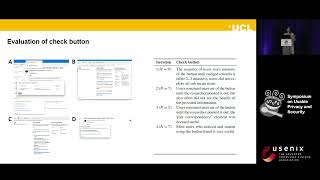
Evaluating Email User Security Tools: Checking, Nudging, and Scoring - SOUPS 2023
Evaluates three e-mail security tools to improve phishing detection, finding "suspicion score" nudge and "check" button most effective for professional users without hindering productivity.
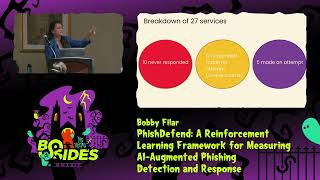
PhishDefend - A Reinforcement Learning Framework for AI-Augmented Phishing Detection and Response
Explore a reinforcement learning framework for measuring AI-augmented phishing detection and response, enhancing cybersecurity strategies against evolving threats.

MATS Stack for Cross-System Orchestration of Machine Learning Pipelines
Explore the MATS stack for orchestrating ML pipelines across systems, featuring MLFlow, Airflow, Tensorflow, and Spark. Learn how Avast leverages this approach for efficient phishing detection and streamlined ML workflows.
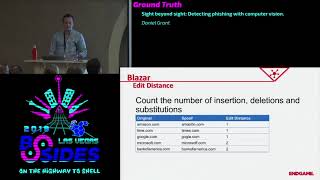
Sight Beyond Sight - Detecting Phishing with Computer Vision
Explore innovative computer vision techniques for detecting phishing attacks, enhancing cybersecurity through advanced visual analysis and machine learning.
Detección automatizada de phishing
Técnicas avanzadas de detección automatizada de phishing presentadas por experto en ciberseguridad. Enfoque en protección financiera y estrategias de prevención contra ataques de ingeniería social.
Detecting Phishing on Mobile Devices - Mobile Hacking
Explore latest phishing trends, mobile-specific attacks, and detection methods. Learn about zero-day phishing detection in mobile environments and how attackers evade automated systems.
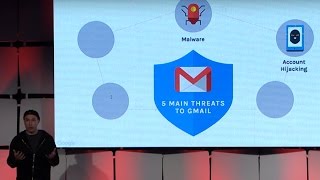
Lessons Learned While Protecting Gmail
Insights into Gmail's defense strategies against various cyber threats, covering spam detection, phishing prevention, malware scanning, network security, and web frontend protection.
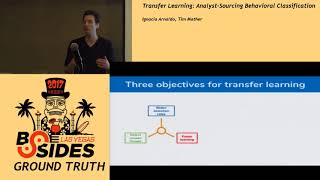
Transfer Learning - Analyst-Sourcing Behavioral Classification
Explore advanced threat detection using AI and transfer learning techniques. Learn about active learning, data sharing, and improving phishing domain detection across organizations.
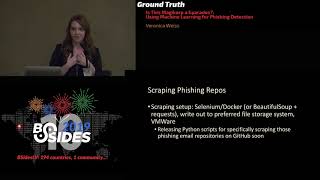
Is This Magikarp a Gyarados? - Machine Learning for Phishing Detection
Explore machine learning techniques for detecting phishing attacks, focusing on email and website classification, data collection, and modeling strategies to enhance cybersecurity.
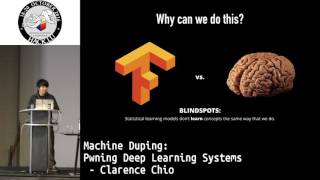
Machine Duping - Pwning Deep Learning Systems
Explore vulnerabilities in deep learning systems and learn techniques to manipulate image recognition, speech recognition, and phishing detection through practical demonstrations and attack methodologies.

All Security Is Good(s)- Design Guidance for Economics - L Jean Camp - USENIX Enigma Conference - 2020
Explore economic aspects of security adoption failures, incentive-aligned design, and the balance between information sharing and privacy, with real-world examples and research insights.
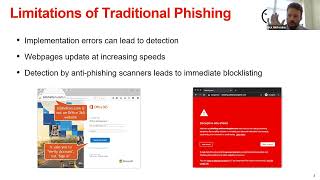
Catching Transparent Phish - Understanding and Detecting MITM Phishing Kits
Explore MITM phishing toolkits, their threat models, and detection methods. Learn about network-level analysis, classifiers, and countermeasures to enhance cybersecurity defenses.
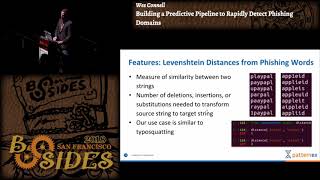
Building a Predictive Pipeline to Rapidly Detect Phishing Domains
Learn to build a predictive pipeline using Python and machine learning to detect phishing domains in real-time, leveraging Certificate Transparency logs and supervised learning techniques.

Qualitative Look at Autonomous Peer Communication's Impact on Organizational Phishing Detection
Explore how autonomous peer communication enhances organizational phishing detection through user education and marketing tools in information security awareness programs.
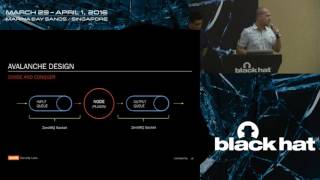
The Security Wolf of Wall Street - Fighting Crime With High-Frequency Classification
Explore real-time threat detection using machine learning on massive DNS data. Learn about Avalanche stream processing and NLP-Rank for automated phishing detection at scale.