Malware Analysis
Learn comprehensive malware analysis techniques, from environment setup to static analysis, PE header examination, and creating YARA rules. Gain practical skills through real-world examples like Stuxnet.
Activation Analysis of a Byte-Based Deep Neural Network for Malware Classification
Explores deep learning models for malware classification, analyzing learned features from byte-level to end-to-end, connecting activations to binary semantics, and examining impacts of training data and regularization.
A Lustrum of Malware Network Communication: Evolution and Insights
Explore the evolution of malware network communication over five years, examining trends, insights, and implications for cybersecurity through analysis of 26.8 million samples.

Malware Detection: Propagation, Types, and Analysis Techniques
Learn techniques for identifying and analyzing malware, including propagation methods, backdoor types, static analysis, and hands-on demonstrations using MSS Venom and Calc.
Malware Analysis: Types, Classification, and Analysis Techniques
Comprehensive overview of malware analysis techniques, covering types, virtualization, classification, dynamic analysis, file monitoring, and practical examples for various file formats.

Classifying Malware with YARA
Learn to classify malware using YARA rules, from setup to integration. Explore writing techniques, resources, and practical applications for effective malware analysis and detection.
When the Magic Wears Off - Flaws in Machine Learning for Security Evaluations
Explores biases in machine learning for malware classification, proposing constraints and metrics for realistic evaluation. Introduces TESSERACT framework to improve classifier performance and ensure fair comparisons.
Security and Information Assurance with Deep Learning
Explore deep learning applications in security, focusing on intrusion detection systems and common pitfalls. Learn about complex security data and real-world examples of machine learning challenges.
An Open Source Malware Classifier and Dataset
Explore open-source malware classification using machine learning, featuring a diverse Windows PE file dataset, pre-trained models, and reproducible code for enhanced static malware detection research.
DGA Detection & Optimization
Explore advanced machine learning for network-level DGA detection and the latest crimeware evasion techniques. Learn about botnet elements, forensics, and new detection technologies.
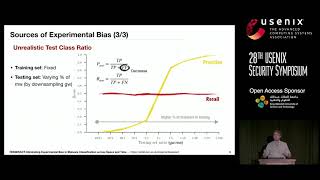
TESSERACT - Eliminating Experimental Bias in Malware Classification Across Space and Time
Unveils TESSERACT framework to eliminate spatial and temporal biases in Android malware classification, improving real-world robustness and revealing counterintuitive performance insights.
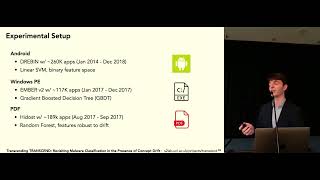
Transcending TRANSCEND - Revisiting Malware Classification in the Presence of Concept Drift
Explore innovative approaches to malware classification, addressing concept drift challenges and advancing beyond traditional methods for improved cybersecurity defenses.
Comparing Malicious Files
Explore techniques for comparing malicious files, including sample identification, shared engines, and various metadata analysis methods to enhance threat detection and incident response.
Hybrid Image-Based Approaches for Modern Malware Classification
Explore innovative hybrid image-based techniques for classifying modern malware, enhancing cybersecurity through advanced visual analysis and machine learning approaches.
Malware Classification With Machine Learning Enhanced by Windows Kernel Emulation
Explore hybrid machine learning for malware classification using static and dynamic analysis, Windows kernel emulation, and neural networks. Learn about adversarial ML and future developments.
Machine Learning for Enhanced Malware Detection and Classification
Leverage AI and machine learning to enhance malware detection and classification, analyzing large datasets and creating a new ensemble classification facility for improved cybersecurity.

Generative AI for Defenders with Sec-PaLM 2 and Duet AI
Explore how defenders can leverage generative AI to combat cyberattacks, focusing on Google Cloud Security AI Workbench powered by Sec-PaLM 2 and Duet AI capabilities for enhanced threat detection and response.

Black Hat USA 2025
Black Hat USA 2025

Black Hat Asia 2025
Black Hat Asia 2025

Black Hat Europe 2024
Black Hat Europe 2024