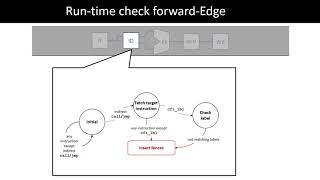
Mitigating Spectre Attacks Using CFI Informed Speculation
Mitigating Spectre attacks using Control-Flow Integrity to constrain speculative execution, combining forward and backward edge protection for comprehensive defense against non-vendor-specific vulnerabilities.
Ghost in the Machine: Challenges in Embedded Binary Security - Enigma 2017
Explores challenges in embedded binary security, highlighting the lag behind general-purpose systems and difficulties in adopting modern exploit mitigations due to constraints in embedded environments.
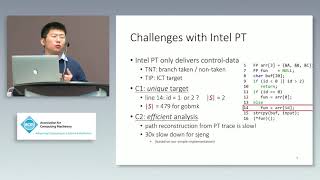
Enforcing Unique Code Target Property for Control-Flow Integrity
Explore control-flow integrity enhancement through unique code target property, addressing challenges in Intel PT implementation, security enforcement, and efficiency optimization.
Hardware-Assisted Fine-Grained Control-Flow Integrity - Adding Lasers to Intel's CET/IBT
Explore advanced control-flow integrity techniques, enhancing Intel's CET/IBT with fine-grained protections for improved software security and memory corruption prevention.
Synthesized CFI for Hand-Written Assembly in GNU Assembler
Extending GNU assembler to synthesize CFI for hand-written assembly, with focus on x86_64. Discusses potential applications for Linux kernel and future extensions for inline assembly.
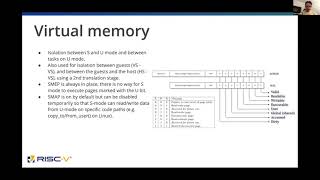
Current Status of RISC-V Security Mechanisms - Nick Kossifidis, FORTH
Explore RISC-V security mechanisms, including privilege modes, page tables, and control flow integrity, with insights on current status and future proposals.
Lessons Learned Applying Compile-time Hardening Options for Security-Critical Programs in Linux
Explore compile-time hardening techniques for Linux security, including SafeStack and CFI. Learn practical lessons from rebuilding critical system components with enhanced protection.
Control Flow Integrity on RISC-V
Explore hardware-assisted control flow integrity mechanisms for RISC-V, focusing on shadow stacks and landing pad instructions to enhance program safety and prevent memory-based attacks.
Advancing Kernel Control Flow Integrity with eBPF
Explore eBPF's potential in enhancing kernel security through control flow integrity. Learn about challenges, implementation techniques, and performance optimization for improved kernel protection.

Security Features Status Update for Linux Kernel Toolchains
Comprehensive update on Linux kernel security features across GCC and Clang, discussing toolchain parity, open problems, and new features like CFI, LTO, and overflow protection.
Kernel Self-Protection Project: Eliminating Bug Classes and Blocking Exploitation Techniques
Overview of Kernel Self-Protection Project's progress, highlighting security defenses implemented in Linux kernels 4.19-5.3, ongoing developments, and areas needing assistance in enhancing kernel security.
BPF-NX and CFI - Enhancing Linux Kernel Security
Explore BPF-NX+CFI: Enhancing Linux kernel security through innovative techniques and control flow integrity mechanisms.

Making C Less Dangerous
Exploring strategies to enhance C language safety in Linux kernel development, focusing on undefined behaviors, memory management, and control flow integrity.

Year in Review - Android Kernel Security
Comprehensive overview of Android kernel security, analyzing vulnerabilities, discussing mitigations, and exploring future improvements for enhanced platform protection.

On Code Execution Tracking via Power Side-Channel
Explore power side-channel analysis for code execution tracking in embedded systems, covering key extraction attacks, control flow integrity, and Hidden Markov Models for security applications.
Securing the Hypervisor with Control-Flow Integrity
Explore advanced techniques for securing hypervisors using Control-Flow Integrity, including Shadow Stack and Safe Stack implementations in QEMU, with insights on protecting function pointers.
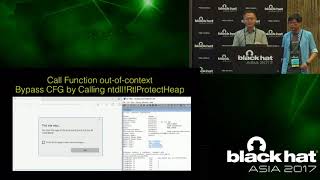
The Power of Data-Oriented Attacks - Bypassing Memory Mitigation Using Data-Only Exploitation Techniques
Explore data-oriented attacks that bypass memory mitigation techniques, focusing on exploiting vulnerabilities without altering control flow. Learn about innovative exploitation methods and their implications for cybersecurity.
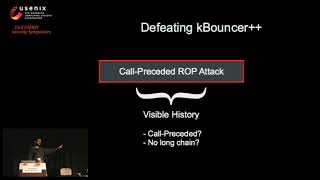
ROP is Still Dangerous - Breaking Modern Defenses
Explores advanced Return Oriented Programming attacks, demonstrating vulnerabilities in modern defense mechanisms and proposing strategies to overcome security measures like kBouncer and ROPecker.
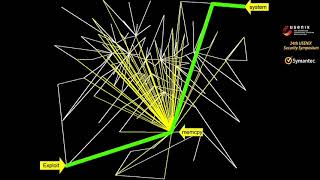
Control-Flow Bending - On the Effectiveness of Control-Flow Integrity
Explores Control-Flow Bending attacks on Control-Flow Integrity defenses, revealing vulnerabilities in fine-grained CFI implementations and demonstrating the necessity of shadow stacks for enhanced security against memory corruption.
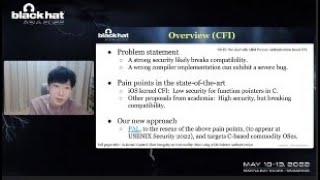
Taking Kernel Hardening to the Next Level
Explore advanced kernel hardening techniques, focusing on CFI and UAF defense. Learn about new approaches to enhance OS security against evolving exploitation methods.

Two-Faces of WASM Security
Explore WebAssembly's dual nature: its potential for malicious use in sophisticated attacks and the vulnerabilities it introduces, presenting challenges for both users and web developers.