
Dragonblood - Analyzing the Dragonfly Handshake of WPA3 and EAP-pwd
Analyze vulnerabilities in WPA3 and EAP-pwd protocols, exploring attacks on clients and access points, information leakage, and potential solutions for Wi-Fi security.
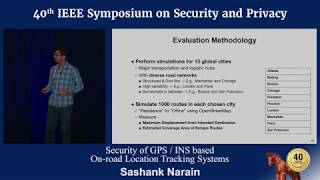
Security of GPS - INS Based On-Road Location Tracking Systems
Explores vulnerabilities in GPS/INS location tracking for road transport, demonstrating how adversaries can spoof routes to reach alternate destinations undetected. Proposes countermeasures to enhance system security.

SensorID - Sensor Calibration Fingerprinting for Smartphones
Exploring smartphone sensor calibration fingerprinting as a novel device identification method, demonstrating high effectiveness and potential privacy implications for iOS and Android users.
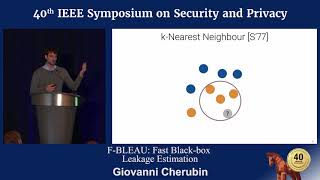
F-BLEAU - Fast Black-Box Leakage Estimation
Innovative method for estimating information leakage in black-box systems using machine learning techniques, improving efficiency and applicability to continuous output spaces.
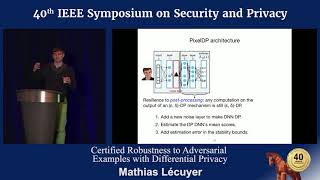
Certified Robustness to Adversarial Examples with Differential Privacy
Explore certified defense against adversarial examples using differential privacy. Scalable solution for large networks and datasets, providing robustness guarantees for various model types.
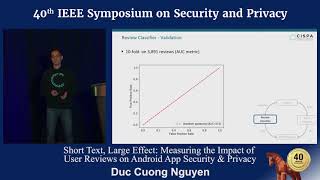
Short Text, Large Effect - Measuring the Impact of User Reviews on Android App Security & Privacy
Exploring the impact of user reviews on Android app security and privacy, analyzing 4.5M reviews to identify concerns and measure developers' responses through code changes.

The 9 Lives of Bleichenbacher's CAT - New Cache Attacks on TLS Implementations
Explores novel cache-based attacks on TLS implementations, demonstrating vulnerabilities in popular systems and introducing a parallelization technique for padding oracle attacks against RSA.
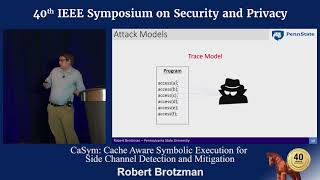
CaSym: Cache Aware Symbolic Execution for Side Channel Detection and Mitigation
Explores cache-aware symbolic execution for detecting and mitigating side-channel vulnerabilities, offering novel abstract cache models and guidance for effective countermeasures.
Iodine - Fast Dynamic Taint Tracking Using Rollback Free Optimistic Hybrid Analysis
Explores fast dynamic taint tracking using optimistic hybrid analysis, reducing overhead while maintaining soundness. Introduces Iodine tool for efficient security policy enforcement without rollbacks.
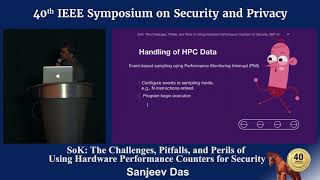
SoK: The Challenges, Pitfalls, and Perils of Using Hardware Performance Counters for Security
Explores challenges and pitfalls of using Hardware Performance Counters for security applications, highlighting measurement imprecisions and incorrect assumptions that can undermine protection efforts.

Tracking Browser Fingerprint Evolutions - Antoine Vastel
Explore browser fingerprint tracking techniques, including FP-STALKER's rule-based and hybrid approaches, to understand long-term user identification without cookies.
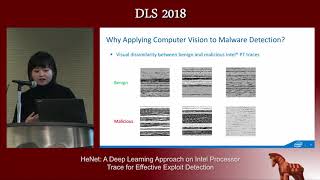
HeNet- A Deep Learning Approach on Intel Processor Trace for Effective Exploit Detection
Explore a deep learning approach using Intel Processor Trace for effective exploit detection. Learn about HeNet's hierarchical ensemble neural network for classifying hardware-generated control flow traces in malware detection.
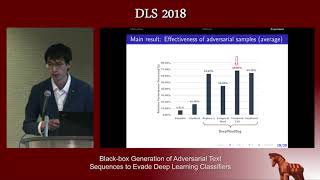
Black-Box Generation of Adversarial Text Sequences to Evade Deep Learning Classifiers
Explores techniques for generating adversarial text sequences to deceive deep learning classifiers, focusing on black-box attacks and their effectiveness in real-world scenarios.
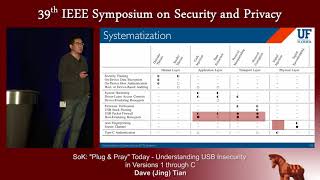
Plug & Pray Today - Understanding USB Insecurity in Versions 1 through C
Comprehensive overview of USB security vulnerabilities and defenses across multiple layers, analyzing attacks, countermeasures, and the USB Type-C Authentication protocol's limitations.
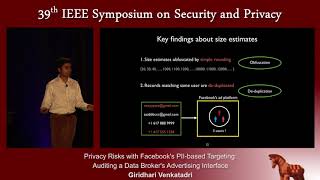
Privacy Risks with Facebook's PII-Based Targeting
Explore privacy risks in Facebook's PII-based targeting, uncovering vulnerabilities in custom audience features that allow user data inference and de-anonymization. Learn about potential fixes and implications for advertising platforms.
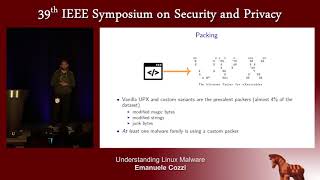
Understanding Linux Malware
Explore Linux malware analysis challenges, infrastructure design, and insights from a large-scale study of 10,548 samples, addressing the growing threat in embedded devices and IoT.

SoK: Keylogging Side Channels
Comprehensive analysis of keylogging side channel attacks, exploring spatial and temporal vulnerabilities, historical context, and current state-of-the-art techniques in cybersecurity research.
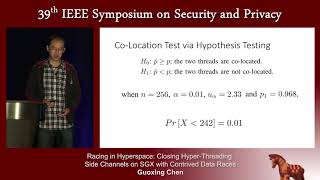
Racing in Hyperspace - Closing Hyper-Threading Side Channels on SGX
Explore techniques to mitigate Hyper-Threading side-channel vulnerabilities in Intel SGX enclaves using HYPERRACE, an LLVM-based tool that creates shadow threads and verifies physical-core co-location.
NTFUZZ: Enabling Type-Aware Kernel Fuzzing on Windows with Static Binary Analysis
Explore type-aware kernel fuzzing on Windows using static binary analysis, enhancing security testing with NTFUZZ's innovative approach and real-world applications.
Revealer- Detecting and Exploiting Regular Expression Denial-of-Service Vulnerabilities
Explore techniques for detecting and exploiting ReDoS vulnerabilities, including static analysis, pattern identification, and automated exploit generation.
CacheOut - Leaking Data on Intel CPUs via Cache Evictions
Explore Intel CPU vulnerabilities, focusing on CacheOut attack, its mechanisms, potential targets, and countermeasures for enhanced system security.