
Memory Forensics with Volatility - HackerSploit Blue Team Series
Explore memory forensics with Volatility in this hands-on tutorial. Learn to analyze system crashes, identify hidden processes, extract crucial information, and enhance your incident response skills.

Pediatric Moonshot - Global, Real-Time, Privacy-Preserving Applications for Children's Medicine
Exploring innovative AI applications in pediatric medicine using privacy-preserving, decentralized edge cloud technology to improve global healthcare equity and enable real-time diagnosis and treatment.
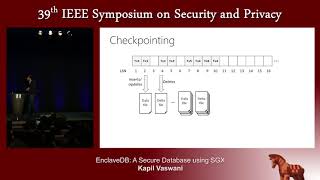
EnclaveDB: A Secure Database Using SGX
Explore EnclaveDB, a secure database engine using Intel SGX to protect sensitive data from malicious administrators and compromised systems, offering confidentiality, integrity, and freshness guarantees.
Slow But Steady - Achieving Real Security Within Two Decades
Explore strategies for achieving real security in software systems over two decades, focusing on incremental improvements, formal verification, and well-engineered infrastructure.
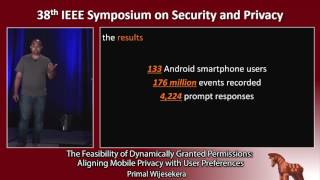
The Feasibility of Dynamically Granted Permissions: Aligning Mobile Privacy with User Preferences
Explores dynamic mobile app permissions based on user context, presenting a classifier that predicts privacy preferences with 96.4% accuracy, reducing prompts and improving user experience.
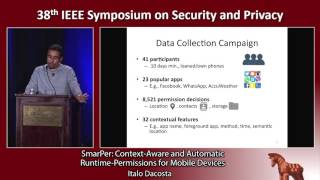
SmarPer- Context-Aware and Automatic Runtime-Permissions for Mobile Devices
Explores context-aware, automatic runtime permissions for mobile devices, using machine learning to predict user decisions and offering data obfuscation options to balance privacy and utility.
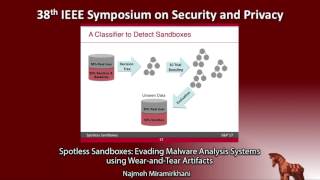
Spotless Sandboxes: Evading Malware Analysis Systems Using Wear-and-Tear Artifacts
Explore techniques for evading malware analysis systems by exploiting wear-and-tear artifacts on real devices, with insights on detection accuracy and potential defensive strategies.
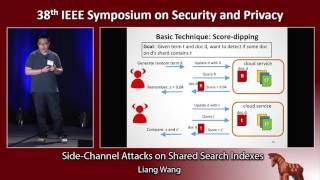
Side-Channel Attacks on Shared Search Indexes
Explore side-channel attacks on shared search indexes, uncovering vulnerabilities in multi-tenant systems. Learn about STRESS attack techniques and their implications for popular services.
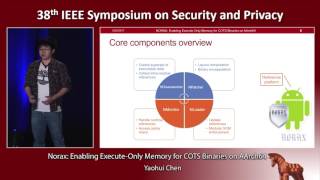
Norax - Enabling Execute-Only Memory for COTS Binaries on AArch64
Explore execute-only memory implementation for AArch64 binaries, enhancing security against code reuse attacks without source code or debugging symbols. Learn about NORAX's design, components, and real-world performance.
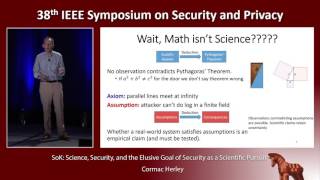
SoK - Science, Security, and the Elusive Goal of Security as a Scientific Pursuit
Explore the challenges of applying scientific principles to computer security research, examining methodological issues and the need for consensus in the field.
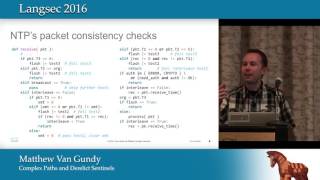
Complex Paths and Derelict Sentinels - Software Engineering Underpinnings of NTP Vulnerabilities
Explore software engineering choices behind recent NTP vulnerabilities, focusing on packet consistency checks, ephemeral associations, and spoofing in this IEEE conference talk.
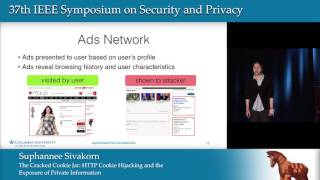
The Cracked Cookie Jar - HTTP Cookie Hijacking and the Exposure of Private Information
Explores HTTP cookie hijacking vulnerabilities in major websites, revealing how partial HTTPS deployment can expose sensitive user information and functionality to attackers.
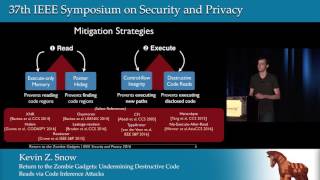
Return to the Zombie Gadgets - Undermining Destructive Code Reads via Code-Inference Attacks
Explores techniques to bypass destructive code reads, a defensive strategy against code reuse attacks, through constructive reloads and code association via implicit reads, demonstrating vulnerabilities in this security approach.
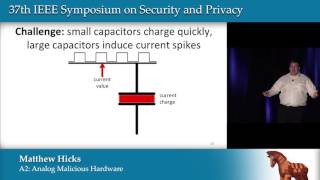
Analog Malicious Hardware
Explore stealthy hardware attacks using analog circuits to bypass security measures. Learn techniques for creating small, undetectable malicious modifications during chip fabrication.
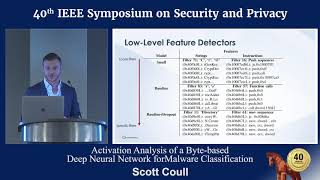
Activation Analysis of a Byte-Based Deep Neural Network for Malware Classification
Explores deep learning models for malware classification, analyzing learned features from byte-level to end-to-end, connecting activations to binary semantics, and examining impacts of training data and regularization.
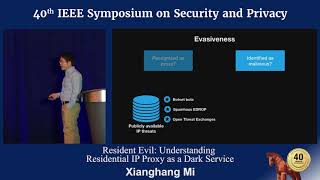
Resident Evil - Understanding Residential IP Proxy as a Dark Service
Explore residential IP proxies as a dark service, uncovering their operations, security risks, and involvement in cybercrimes through infiltration and analysis of millions of proxy IPs across 230+ countries.
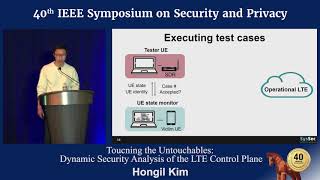
Touching the Untouchables - Dynamic Security Analysis of the LTE Control Plane
Dynamic security analysis of LTE control plane procedures, uncovering 36 vulnerabilities in operational networks. Demonstrates attacks affecting service availability, SMS spoofing, and data manipulation.
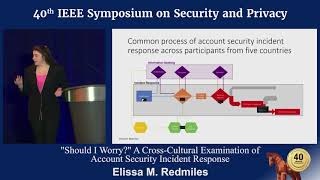
Should I Worry? A Cross Cultural Examination of Account Security Incident Response
Exploring users' real-time responses to suspicious login incidents across cultures, revealing common patterns and unique challenges in digital security incident handling.
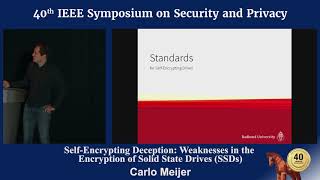
Self-Encrypting Deception: Weaknesses in the Encryption of Solid State Drives
Uncovers critical vulnerabilities in solid state drive hardware encryption, revealing potential data recovery risks and the need for additional security measures.
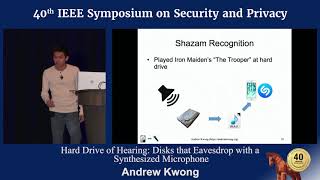
Hard Drive of Hearing - Disks that Eavesdrop with a Synthesized Microphone
Discover how hard drives can be exploited as microphones, potentially compromising privacy. Learn about this unique security threat and explore defense mechanisms against acoustic eavesdropping.
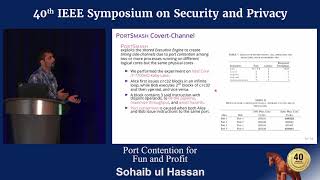
Port Contention for Fun and Profit
Explore SMT execution engine sharing as a side-channel leakage source, targeting ports to create a high-resolution timing side-channel for attacks on various architectures and applications.