
The Accidental Universe: The World You Thought You Knew
Explore the intersection of science, philosophy, and spirituality as Alan Lightman delves into profound questions about our universe, existence, and the nature of reality.
Eating Our Words: What the Language of Food Reveals About History and Culture
Explore how language in food reveals insights on history, economics, and culture. From ketchup's origins to menu linguistics, uncover surprising connections between words and cuisine.
Physics-Inspired Algorithms and Phase Transitions in Community Detection - 2014 Symposium
Explore physics-inspired algorithms for community detection, including phase transitions, statistical inference, and belief propagation. Learn about innovative approaches to clustering and network analysis.
The Conceptual Framework of Urban Scaling - 2014
Explore the theoretical foundations of urban scaling, examining how cities grow and evolve over time through complex systems analysis and mathematical modeling.
Large-Scale Structure in Networks - 2014
Explore large-scale network structures and their implications in complex systems, focusing on theoretical approaches and practical applications in various fields.
Tokens and Complex Systems - Part 2
Explore the intersection of complex systems and blockchain technology, including AI DAOs, token design, and agent-based simulations for innovative ecosystem development.
The Geometry of the Cosmic Web and Primordial Information Flow
Explores networks with Voronoi-based geometries, including cosmic web and spiderwebs. Discusses primordial information flow in cosmic web formation and its implications for structure determinism at different scales.
Complex Adaptive Systems and the Depopulation of Mesa Verde
Explore how complex adaptive systems reveal factors behind Mesa Verde's depopulation, including resource overuse, high population density, and environmental vulnerabilities in the face of prolonged droughts.
On the Foundations of Info-Metrics
Explore the science of info-metrics for modeling and inferring from limited data, with insights on reasoning under uncertainty and insufficient information.
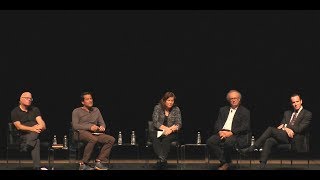
The Complexity of Economics - Exploring Markets as Complex Adaptive Systems
Explore the intersection of complexity science and economics with experts discussing agent-based modeling, behavioral economics, and machine learning to gain insights into real-world economic systems.
Probabilistic Topic Models and User Behavior
Explore latent thematic structures in document collections and user behavior data. Learn how topic modeling algorithms can enhance predictions and understanding of collection organization.
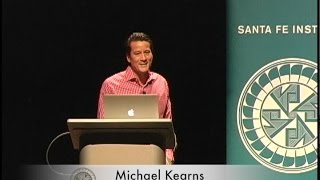
Machine Learning and Social Norms - Balancing Fairness and Accuracy
Machine learning's impact on social decisions: Exploring fairness, privacy, and accountability in algorithmic decision-making across various domains. Discusses recent research and challenges in embedding social norms into predictive algorithms.
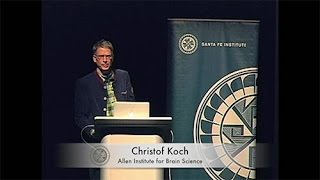
Consciousness in Biological and Artificial Brains
Exploration of consciousness in biological and artificial brains, discussing Integrated Information Theory and why digital systems may never truly experience consciousness like humans do.
The Information Edge: Creation in Life, the Economy, and the Universe - Lecture 1
Explore the Information Edge principle and its role in creation across the universe, from cosmic structures to economic systems, with MIT professor Seth Lloyd.
The Information Edge: Collapse and Rebirth in Complex Systems - Lecture 2
Seth Lloyd explores the Information Edge's role in cosmic destruction and rebirth, from black holes to mass extinctions, and how complex systems regain balance after collapse.

All Watched Over by Machines of Loving Grace - The Future of Biological Intelligence
Explore the future of biological intelligence in a world of distributed machine intelligence and potential cultural mechanisms surpassing human analytical capabilities.
Smart Machines and What They Can Still Learn from People
Cognitive scientist Gary Marcus explores AI's progress, challenges, and potential lessons from human cognition, offering insights into the future of machine intelligence.
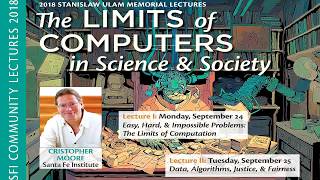
Data, Algorithms, Justice and Fairness - Lecture 2
Exploring algorithmic fairness in justice systems: accuracy, data sources, and potential biases. Discusses AI decision-making, explainability, and societal implications of algorithms in criminal justice.
Using Buckingham's Π Theorem for Dimensionless Similarity Parameters in Macroecology
Explore dimensionless similarity parameters in macroecology using Buckingham's Π theorem, presented by Sandra Chapman from the University of Warwick.
Research Problems in Blockchain and Ethereum
Explore cutting-edge research challenges in blockchain technology and Ethereum with insights from expert Virgil Griffith, delving into potential solutions and future developments.
Automated Recognition of Visual Situations in Images
AI architecture for recognizing visual situations in images, using learned models of object features and spatial relationships to actively search and score images for specific situations.