
Julia: Great Language or the Greatest Language - Keynote by Jan Vitek
Keynote explores Julia's design, implementation, and performance, covering subtyping algorithms, type stability, and JIT compilation. Insights into language evolution and scientific programming revolution.
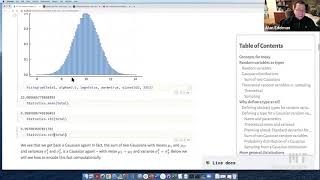
Random Variables as Types - Lecture 11
Explore random variables as types in Julia programming, covering Gaussian distributions, sampling, abstract types, and generic programming for probability distributions.
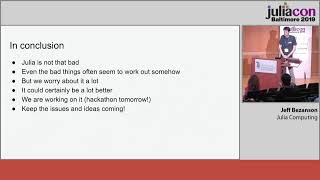
What's Bad About Julia - Addressing Fundamental Issues
Julia co-creator Jeff Bezanson discusses fundamental issues in the language, focusing on modularity, types, and method specificity rules, offering insights into potential solutions for a better programming experience.

Scala - Your First Programming Language
Learn programming from scratch with Scala! Explore key concepts like recursion, functions, object-orientation, and error handling. Ideal for beginners seeking a comprehensive introduction to coding.

A Taste of ELPI - Introduction to Extensible Logic Programming Interpreter
Explore ELPI, a programming language for implementing type-checkers and elaborators. Learn its features, applications, and potential in theorem proving and meta-programming.
Secure by Design: Insights and Pitfalls
Explore secure software design principles, their benefits, and potential pitfalls. Learn from real-world examples and gain insights on crafting more secure code through thoughtful design choices.
Eradicating Vulnerability Classes: Embracing Secure Defaults and Invariants
Explore innovative approaches to application security, focusing on secure defaults and invariants instead of traditional SAST methods to effectively eliminate vulnerability classes.
War Time Proofs and Futuristic Programs
Exploring Gödel's Dialectica interpretation and its connection to linear logic type theory, revealing how past mathematical ideas influence modern programming languages and type systems.

No More Loopy Code: Data Science Goes Functional
Explore functional programming principles in data science to enhance reliability, maintainability, and reproducibility of workflows. Learn to improve code clarity and debugging through practical examples.
A Look at Trust, Time, and Teams in Software Engineering
Explore trust in engineering, its psychology, and relationship to time. Learn to create better trust rituals by reframing goals for improved team dynamics.

The Work Done by Something Else - Exploring Declarative Programming
Explore declarative programming through everyday and exotic examples. Gain insights into abstraction, automation, and the philosophy of programming for practical knowledge.
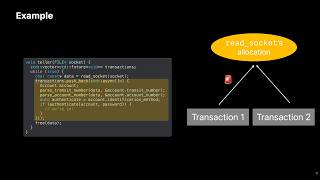
Security in C++ - Hardening Techniques From the Trenches
Discover practical memory safety mitigation techniques for C++ applications, including Standard Library hardening and typed memory allocation, with insights on implementing these security measures in production environments.
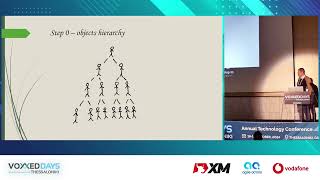
Enums on Steroids - A Deep Dive into Sealed Classes from Java 17 to 21
Dive into advanced enum implementations using sealed classes in Java, exploring evolution from Java 17 to 21 and discovering powerful hierarchy control mechanisms.
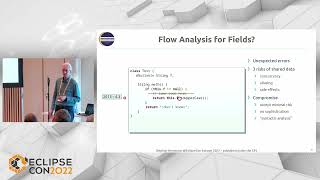
The Long Goodbye to NullPointerException - Eclipse Tools and Solutions
Explore practical strategies for reducing NullPointerExceptions in Java, covering improved tooling, safety levels, and external annotations for gradual risk reduction in legacy code.
How Rust Primitive Types and Functions Really Work Under the Hood in Rust Programming with Assembly
Explore Rust's low-level mechanics: function handling, memory allocation, and compiler optimizations through assembly code analysis. Gain deep insights into Rust's performance and efficiency.
How JavaScript and TypeScript Is Heavily Influenced by Pascal
Explore the surprising Pascal influences on JavaScript and TypeScript, from syntax to programming paradigms, with hands-on examples in Netscape Navigator 3 and modern code comparisons.

Type Systems Will Make You a Better JavaScript Developer - React Conf 2017
Explore how type systems enhance JavaScript development, focusing on error prevention, code clarity, and improved tooling for more robust applications.

Rethinking Best Practices: Building Applications in Elm
Exploring Elm's innovative approach to web development, emphasizing its advantages over JavaScript in building large, maintainable applications with fewer runtime errors and improved developer experience.
Combining Type Systems with PHP: Hack's Approach
Explore Hack, Facebook's PHP dialect with a strong static type system. Learn how it enhances PHP's productivity while maintaining its core strengths.
Error Handling in Rust - A Pragmatic Approach
Pragmatic approach to error handling in Rust: modeling, types, reporting, and best practices for different scenarios, based on Luca Palmieri's expertise.
Rust: Removing the Sharp Edges from Systems Programming
Explore Rust's safety features for systems programming, including memory management, type system, and error handling. Learn to integrate Rust into Yocto systems using meta-rust.