Introduction to Database Systems
This course introduces the students to the various theoretical and practical principles involved in the design and use of databases systems with the help of database management systems (DBMS) and the SQL Standard.
Intro to Database Systems - Fall 2017
Comprehensive introduction to database systems covering relational models, SQL, storage, query processing, optimization, concurrency control, recovery, and distributed systems.

DBMS - Database Management System
Comprehensive exploration of database management systems, covering key concepts, design principles, and practical applications for students and professionals.
Algebraic Structures in Logic and Query Evaluation - Part 2
Explore advanced algebraic structures in logic and their applications to database query evaluation, building on fundamental concepts.
Algebraic Structures in Logic and Query Evaluation - Part 1
Explore algebraic structures' role in logic and query evaluation, focusing on their applications in database theory and AI algorithms.
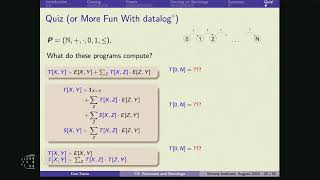
Algebraic Structures in Logic and Query Evaluation - Lecture 3
Explore algebraic structures in logic and query evaluation, focusing on advanced concepts and their applications in database theory and AI.
Algebraic Structures in Logic and Query Evaluation - Part 4
Explore algebraic structures' role in logic and query evaluation, focusing on advanced concepts and their applications in database theory and AI.

Database Management Systems - Lecture 3
Explore advanced database concepts, query optimization techniques, and data management strategies in this comprehensive lecture on modern database systems.

Functional Collection Programming with Semi-Ring Dictionaries
Explore semi-ring dictionaries, a versatile collection type for functional programming. Learn about SDQL language and its optimizations for efficient database and linear algebra processing.

Additional Relational Algebra Operations
Explore advanced relational algebra operations including aggregate functions, recursive closure, outer joins, and outer unions. Enhance your database management skills with practical examples.
Incremental View Maintenance - Part 1
Explore efficient techniques for updating database views as underlying data changes, focusing on algorithmic approaches and their applications in modern data management systems.
Factorized Databases
Explore compressed yet lossless representations of relational data, their efficient processing, and applications in algorithms, probabilistic databases, and in-database machine learning.
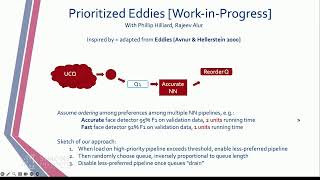
Deep Learning and the Relational Algebra
Exploring the integration of machine learning inference in query processing, including tensor operations and autograd in relational algebra, with insights from early research experiences.
Towards Iterative Relational Algebra on the GPU
Explores GPU-based iterative relational algebra for high-performance data analytics, presenting a novel hash-join implementation with optimizations for memory access and deduplication, outperforming existing solutions.
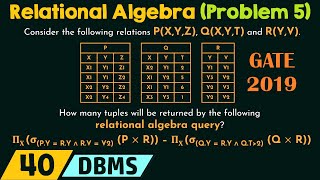
Relational Algebra - GATE 2019 Solved Problem 5
Master relational algebra problem-solving techniques through a detailed walkthrough of a GATE 2019 examination question with step-by-step solutions.
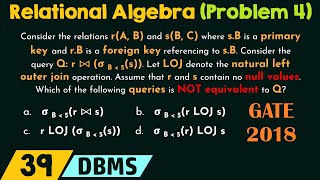
Relational Algebra - GATE 2018 Solved Problem - Part 4
Master relational algebra problem-solving techniques through a detailed walkthrough of a GATE 2018 examination question with step-by-step solutions.
Indexed Streams - A Formal Intermediate Representation for Fused Contraction Programs
Explore a formal operational model for fused execution of contraction languages, covering sparse tensor and relational algebra. Learn about indexed streams and their compiler implementation.
Uses of Renaming, Join and Division in Relation Algebra
Explore advanced relational algebra operations: renaming, join, and division. Master their applications for efficient database manipulation and querying.
Convert ER-Model to a Relational Model
Learn to transform ER-Models into Relational Models, enhancing your database design skills and understanding of data structure conversion techniques.
Introduction to Relational Algebra
Explore relational algebra fundamentals, including select and project operators, through examples and practical applications in database management.
Relational Model and Algebra - Lecture 1
Explore relational models and algebra in database systems. Learn fundamental concepts and operations for efficient data management and querying.