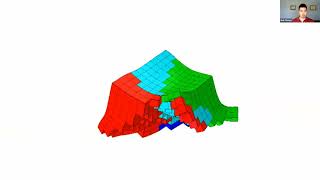
Embodiment Without Situatedness - An Embodied Perspective on Neural Architecture Search
Explore embodied perspectives on neural architecture search with Nick Cheney, examining the intersection of neurorobotics and complex systems in AI development and intelligence research.
Language Comprehension Requires Affordances
Explore how language comprehension is grounded in physical interactions with the world, challenging traditional views of cognition and offering insights into embodied intelligence.
Why Intelligent Reasoning Must Be Embodied
Explore the philosophical perspective on embodied intelligence and its implications for AI, presented by Lisa Miracchi from the University of Pennsylvania's GRASP Lab and MindCORE.
Are Foundation Models Castles in the Air?
Explore the trustworthiness and effectiveness of foundation models in AI with Stanford professor Percy Liang, examining their potential and limitations for human-computer interaction and continuous learning.
Learning About Possibilities Through Scientific Models
Exploring how scientists use models to study possibilities, examining epistemic and alethic possibilities, and discussing implications for model construction, assessment, and interpretation in scientific research.
The Laws of Life, Time and Chance
Explore the intersection of physics and biology, uncovering mathematical frameworks for understanding life, time, and probability. Discover how chance governs cellular behavior and impacts complex biological phenomena.
Information and Model Misspecification - Classical Statistics vs. Info-Metrics
Explore info-metrics framework for handling model misspecification, contrasting classical methods with innovative approaches using entropy and empirical likelihood in power law distributions.
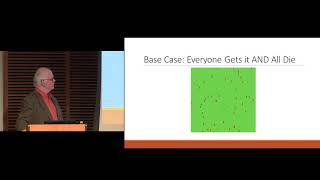
Frontiers of Computational Social Science - Agent-Based Modeling and Artificial Societies
Explore agent-based modeling in computational social science, from playground simulations to global epidemic models, with insights on future developments in neuro-cognitive agents and their applications.
Energy, Scaling, and The Future of Life on Earth
Explore the roles of energy and information in 21st century biology with Geoffrey West's lecture on scaling laws, energy dynamics, and their implications for life on Earth and our future.
The Transformative Power of Information
Explore the transformative power of information in biology, featuring insights on communication, data, and technological advancements from a leading complexity scientist.

The Principles of Collective Behavior
Explore the fascinating world of collective animal behavior, from insect swarms to human crowds. Discover how individual actions create complex group dynamics and problem-solving abilities in nature.

The Origin of Life - From Chemistry to Information Theory
Explore the enigma of life's origin through information theory and complexity, examining the transition from chemistry to biology and its implications for life in the universe.
Provably-Secure Proof-of-Stake Blockchains - From Bitcoin to Ouroboros
Explore proof-of-stake blockchains as an energy-efficient alternative to Bitcoin's proof-of-work, focusing on the Ouroboros protocol's security and implementation in Cardano cryptocurrency.

Harnessing Chaos and Predicting the Unpredictable with Artificial Intelligence
Explore how Reservoir Computing and AI can predict chaotic systems like weather and brain dynamics, pushing beyond traditional forecasting limits and combining knowledge-free and knowledge-based approaches.

Forecasting Natural Disasters in Complex Earth Systems - SFI Lecture
Explore forecasting natural disasters using satellite data, nonlinear dynamics, and numerical simulations. Learn about ensemble forecasting and pattern methods for predicting extreme events.
Practice Makes Perfect - Learning from Massive Data
Explore how computers learn from massive data to perform tasks like spelling correction and translation, rivaling human capabilities through example-based learning.

A Cooperative Species - Altruism, Parochialism, and War
Explore how war and hostility may have shaped human morality through computer simulations of alternative historical trajectories, challenging our understanding of altruism and cooperation.
Big Data, Global Development, and Complex Systems
Explore how big data from everyday technologies can reveal human behavior patterns and societal trends, with applications in global development, health, and socioeconomic analysis.

The Inevitability of Life: Geochemistry and the Emergence of Living Systems
Explore the inevitability of life's emergence and persistence on Earth through geochemistry, challenging the notion of improbable events in life's origin.
The Most Human Human - What Artificial Intelligence Teaches Us About Being Alive
Explore the intriguing intersection of AI and human nature, examining what our interactions with machines reveal about our own humanity and consciousness.

Sending Secrets: Security and Cryptography in a Quantum World
Explore cryptography's evolution, from Caesar's cipher to quantum computing challenges. Learn about modern encryption, prime numbers, and the potential impact of quantum computers on cybersecurity.