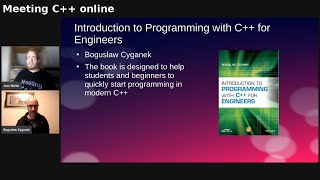
Introduction to Programming with C++ for Engineers
Discover key concepts of C++ programming tailored for engineers, exploring practical applications and fundamental principles in this concise introduction.
Discrete and Continuous Mathematics - MIT Computational Thinking Spring 2021 - Lecture 14
Explore discrete and continuous mathematics, bridging concepts through indexing, function evaluation, area calculation, and random walks in computational thinking.
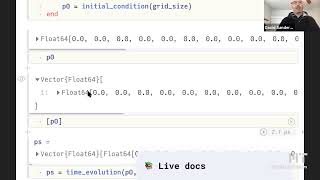
Random Walks II - Lecture 13
Explore random walks, Pascal's triangle, and probability distributions using Julia programming. Learn to implement time evolution of probabilities and understand cumulative sums in computational thinking.
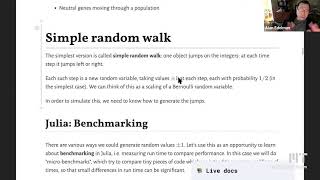
Random Walks in Computational Thinking - Lecture 12
Explore random walks in computational thinking, covering visualization, Julia concepts, benchmarking, and advanced topics like mutable structs and type parameters.
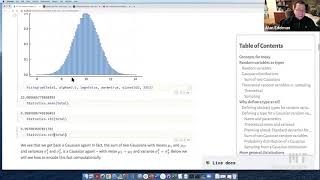
Random Variables as Types - Lecture 11
Explore random variables as types in Julia programming, covering Gaussian distributions, sampling, abstract types, and generic programming for probability distributions.
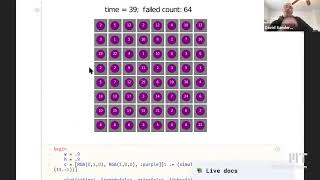
Modeling with Stochastic Simulation - Lecture 10
Explore stochastic simulation modeling using Julia, covering individual-based models, failure visualization, string interpolation, Bernoulli variables, and running simulations with practical examples.
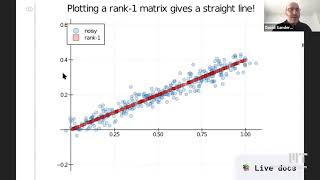
Principal Component Analysis - Lecture 8
Explore Principal Component Analysis: from matrix rank to SVD. Learn to measure data cloud size, understand correlated data, and navigate high-dimensional spaces using statistical techniques.
Transformations - Composability and Linearity in Computational Thinking - Lecture 4
Explore composability and linearity in transformations, focusing on image processing applications and advanced Julia programming techniques for vector-valued functions and linear/nonlinear transformations.
Transformations and Automatic Differentiation in Computational Thinking - Lecture 3
Explore transformations and automatic differentiation in Julia, covering linear and non-linear transformations, function types, and applications in machine learning, with practical examples and visualizations.
Transforming Images and Image Processing Techniques - Lecture 2
Explore image transformation techniques using Julia, including downsampling, linear combinations, convolutions, and filters. Learn about complexity, GPUs, and data structures in computational thinking.
Introduction to Arrays and Images in Computational Thinking - Lecture 1
Explore computational thinking through image manipulation and array operations in Julia, with hands-on examples and an introduction to abstraction concepts.
Structure and Matrices in Julia Programming - Lecture 3
Explore matrices, sparse structures, and SVD for image compression and computational thinking in Julia, with practical applications in machine learning and linear algebra.
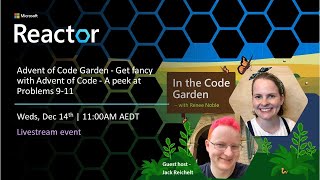
Advent of Code: Solving Problems 9-11 - Tips and Tricks
Explore Python solutions for Advent of Code problems 9-11. Learn methodologies, tips, and tricks for tackling complex algorithmic challenges and improving your programming skills.
When and How to Start Coding with Kids
Explore scientific insights on teaching coding to children, including brain development, learning methods, and age-appropriate approaches. Discover benefits and practical starting points for introducing kids to programming.
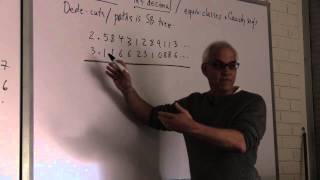
A Socratic Look at Logical Weaknesses in Modern Pure Mathematics
Exploring logical weaknesses in pure mathematics, focusing on continuum, analysis, and set theory. Challenges conventional understanding of limits and introduces computational thinking perspectives.
The Power of Abstraction Through History - Episode 7
Explore the role of abstraction in human progress and its unique human capability with Jon and Conrad in this thought-provoking discussion.

Numerical Integration, Root Finding, and Computational Thinking - ME3255
Explore numerical integration, root finding techniques, and computational thinking principles for solving complex engineering problems.
Training People to Teach with Computation
Strategies for integrating computation into physics courses, including expanding the circle of instructors, creating space for computational content, and exploring CS pathways for effective teaching.
The Role of Computer Science in Computer Science Education
Exploring computer science's role in CS education, addressing challenges and opportunities in curriculum design, language development, and accessibility for diverse learners.
Empowering Minds - Using Code to Foster Innovative Learning
Discover how coding transcends science, empowering innovative learning and fostering creativity in education.
Coding as a Developmental Playground
Explore computational thinking and robotics in early childhood education, focusing on coding as a new literacy and developmental tool for young children's creativity and self-expression.