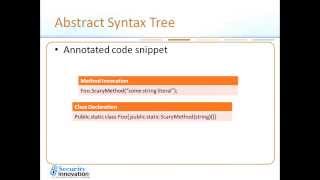
Adventures in Reviewing Mountains of Code
Explore strategies for efficiently reviewing large codebases, including experiments, tools, and unexpected challenges encountered during a 2.6 million line code assessment.
C# Expression Trees Explained - Reading and Creating Examples
Explore C# expression trees: structure, reading, creation, and practical applications. Gain insights into this powerful feature for dynamic code generation and analysis.
React Applications Structure Analysis Using AST - React.js Conf 2015
Explore how to leverage the Abstract Syntax Tree (AST) to unlock new possibilities in React applications, enabling powerful code analysis and transformations.
Rust Analyzer Syntax Trees Implementation - 2019 Overview
Explore rust-analyzer's syntax tree implementation, covering API design, incremental parsing, and memory efficiency techniques for Rust development.
Demystifying Rust Parsing - Applications and Examples
Explore Rust parsing applications beyond the compiler, including automatic binding generation. Learn to leverage abstract syntax trees for practical projects and gain insights into Rust's internal workings.
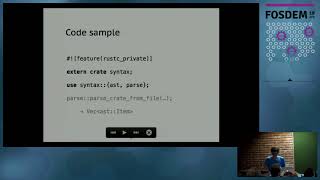
Demystifying Rust Parsing - Language Parsing and Automatic Binding Generation
Explore language parsing and automatic binding generation in Rust with Nikita Baksalyar, covering lexical analysis, syntax libraries, and code generation techniques.
Popping Into CRuby - Understanding Ruby's Instruction Sequences
Explore CRuby's inner workings, focusing on "popped" instruction sequences and how Ruby optimizes code execution. Gain insights into parsing, compiling, and abstract syntax trees for a deeper understanding of Ruby's performance.
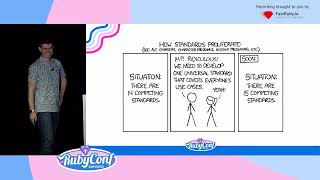
The Future of Understanding Ruby Code - Ruby 3.3 Parsing API
Explore the evolution of Ruby code parsing and the new unified API in Ruby 3.3, revolutionizing how developers understand and work with Ruby code.

Build Your Own Babel Plugin - Learn With Jason
Discover how to create custom Babel plugins with expert guidance. Learn to manipulate and transform JavaScript code, enhancing your development skills and workflow efficiency.

Creating a Netlify Build Plugin - Learn With Jason
Explore Netlify Build Plugins: powerful utilities for enhancing build processes. Learn to create custom plugins, understand their structure, and leverage them for cross-framework development superpowers.
Automatically Instrument Your Go Source Code with Orchestrion
Explore Orchestrion, an extensible tool for automatic Go code instrumentation. Learn about parsing, code analysis, distributed tracing, and using annotations for cross-cutting concerns.

3D in React with Triplex - Visual Editor for React-Three-Fiber
Explore Triplex, a visual editor for react-three-fiber, enabling Figma-like 3D component editing in React. Learn implementation, lighting techniques, and supported 3D model formats.

AST Helper Classes for Operating System Development
Explore helper classes for representing Abstract Syntax Trees (AST) on the heap, enhancing your understanding of compiler design and memory management.
Targeted Static Analysis for OCaml C Stubs - Eliminating Gremlins from the Code
Explore a static analyzer for OCaml C bindings, addressing safety issues and aiding migration to OCaml 5. Learn about tools and techniques to improve code reliability.
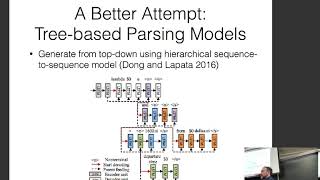
Neural Nets for NLP 2018 - Neural Semantic Parsing
Explore neural semantic parsing techniques, including tree-based models, code generation, weakly supervised learning, and various meaning representations. Learn about graph structures and neural approaches to semantic role labeling.
Transform Content With Abstract Syntax Trees
Explore abstract syntax trees (ASTs) and learn to transform files using unified, remark, and rehype. Dive into practical applications and techniques for content manipulation.
Compilers - Jared Shumway
Explore compiler internals, optimization techniques, and security enhancements to improve code efficiency and write better programs.

Automate Image Performance Using ASTs - Learn With Jason
Optimize website performance by automating image optimization, generating multiple sizes, and implementing lazyloading using AST transformations for improved user experience and faster load times.
Analysis of High Level Intermediate Representation in a Distributed Environment for Large Scale Malware Processing
Explore advanced malware analysis techniques using distributed reverse engineering and machine learning to identify code similarities and extract key characteristics from millions of samples.
Defending against PowerShell Attacks
Learn defensive strategies against PowerShell attacks, exploring security measures, logging techniques, and best practices to protect systems from malicious PowerShell usage.
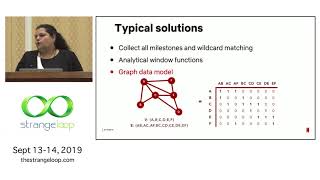
Pattern Matching at Scale Using Finite State Machine
Explore pattern matching at scale using finite state machines for big data analysis. Learn to build a framework for expressing user journey patterns and applying them across billions of events using Spark.