Theory of Computation
Explore finite automata, regular languages, context-free grammars, and Turing machines. Learn about computational models, their properties, and fundamental concepts in theoretical computer science.
Theory of Automata, Formal Languages and Computation
Explore automata theory, formal languages, and computation through grammars, finite state automata, pushdown automata, Turing machines, and advanced topics in theoretical computer science.
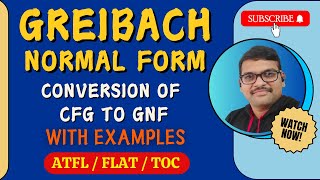
Greibach Normal Form and Conversion of Context Free Grammar to GNF in Automata Theory
Explore Greibach Normal Form and learn how to convert context-free grammars to GNF. Gain insights into this important concept in automata theory and formal language processing.
Introduction to the Theory of Computing - Stanford
Explore fundamental concepts of theoretical computer science, including automata, computability, and complexity theory, with practical applications and algorithmic fairness.
Stanford Lecture - Don Knuth - "A Conjecture That Had To Be True"
Donald Knuth explores a fascinating problem in combinatorial geometry, presenting an intriguing formula and its unexpected universal application, showcasing the beauty of mathematical discovery.
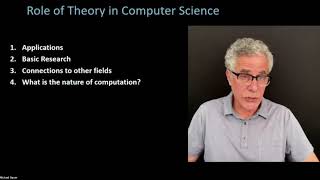
Theory of Computation, Fall 2020
Explore computability and complexity theory with MIT's in-depth course. Covers automata, Turing machines, undecidability, NP-completeness, and advanced topics in computational theory.
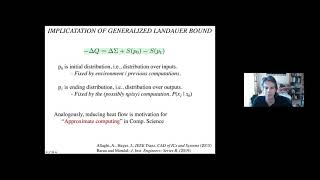
Tutorial on Stochastic Thermodynamics - David Wolpert
Explore stochastic thermodynamics with David Wolpert, covering Landauer's principle, approximate computing, performance constraints, and thermodynamic complexity in computational systems.
Effective Theories for Computational Systems - Lecture 2
Explore effective theories for computational systems, covering aggregation, finite state machines, regular languages, and emergence in complex systems modeling.
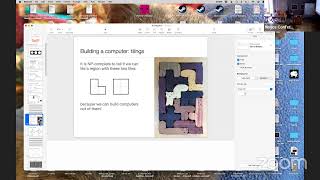
The Dynamics of Computation and the Computational Power of Dynamics
Explore the intersection of computation and dynamics, examining computational models, physical systems, and mathematical concepts to understand the nature of computation and its manifestation in various forms.
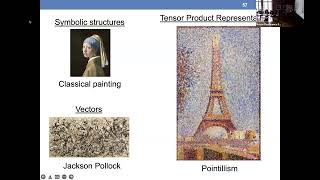
Bridging the Divide Between Vectors and Symbols in Language Processing
Explore the intersection of vectors and symbols in language processing, focusing on innovative approaches to bridge computational and cognitive models of meaning.
Approximate Polymorphisms in Boolean Functions
Explore approximate polymorphisms in theoretical computer science, focusing on stability results for functions satisfying certain properties and their implications.
Towards Understanding Modern Alchemy - Transformers as a Computational Model
Explore in-context learning of formal languages, comparing Transformers to other models and examining specialized "n-gram heads" for improved performance in language modeling.
Language Generation in the Limit - Transformers as a Computational Model
Explore language generation using basic specifications, contrasting with language learning models. Discover non-trivial guarantees for generating valid new strings from unknown languages.
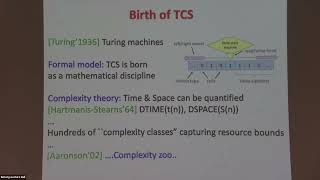
Reading Alan Turing - Exploring Turing's Influential Ideas in Theoretical Computer Science
Explore Turing's influential papers and their impact on theoretical computer science with Avi Wigderson. Gain insights into Turing's visionary ideas and their modern relevance.

Context-Free Grammars - LR(k) Grammars
Explore the LR-Technique for parser construction, covering state transitions, nonterminals, reduce conflicts, follow sets, and LR1 grammars.

Context-Free Grammars - LL(k) Grammars
Explore context-free grammars and LL(k) parsing, including hands-on implementation of an arithmetic expression parser and techniques for handling recursive rules.
Context-Free Grammars
Learn about Context-Free Grammars, their role in parser and compiler design, and applications in programming languages. Gain practical advice and understand associativity concepts.
An Introduction to Lifted Expander Graphs - Fernando Granha Jeronimo
Explore lifted expander graphs, their construction, and applications in theoretical computer science. Learn about symmetry structures, coding theory implications, and recent advancements in this field.
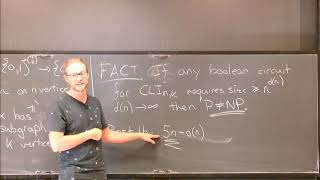
Proof and Circuit Complexity - Robert Robere
Explore proof and circuit complexity with Robert Robere, delving into Boolean circuits, monotone circuits, slice functions, and the Click function to understand computational limitations.
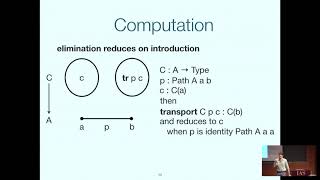
Univalence from a Computer Science Point-of-View - Dan Licata
Explore univalence in computer science with Dan Licata, covering Martin-Löf type theory, computation, and applications in homotopy theory and group structures.
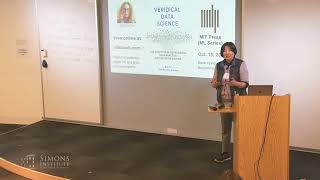
Veridical Data Science and Alignment in Medical AI - Building Trust and Interpretability in Healthcare
Explore how AI algorithms in healthcare progress from transparent to opaque, examining trust-building principles and alignment challenges through real medical case studies and data science frameworks.